Reply To:
Name - Reply Comment
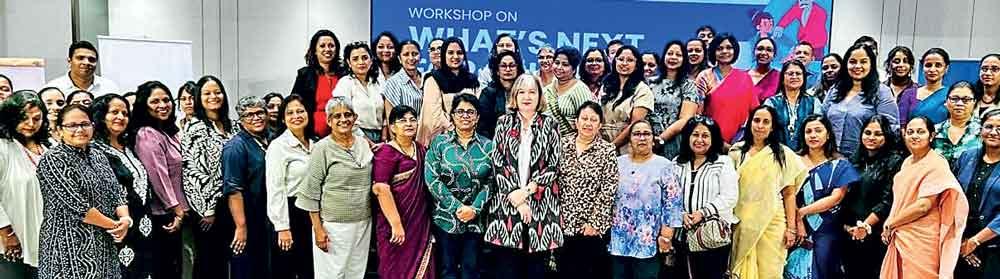
Conducted by ILO C190 specialist Shyamali Ranaraja, with presence of ILO Country Director for Sri Lanka and Maldives Joni Simpson
The Women’s Chamber of Industry and Commerce (WCIC) has been actively working to create workplace environments that are free from gender-based violence and harassment, enabling women to thrive and contribute meaningfully. Over the past few years, in collaboration with the Centre for International Private Enterprise (CIPE), the WCIC undertook extensive research to understand the realities faced by professional women and women entrepreneurs in Sri Lanka.
The advocation for the ratification of ILO C190 has been part of the mandate of the WCIC as the convention would facilitate and enable the environment needed for the creation of a safe work place. The audience consisted of private sector, public sector representatives, NGOs and CSOs, activists and organisations committed to the topic.
ILO Country Director for Sri Lanka and Maldives Joni Simpson addressing the audience stated, “It is encouraging to see the efforts of organisations such as the WCIC who are propagating the required status which will be an integral part of the change that is required for the benefit of the country. The ratification would strengthen social justice, improve enforcement mechanisms and promote proactive prevention of all forms of work-related violence and harassment, particularly for marginalised groups.
By ratifying C190, Sri Lanka will send a clear message nationally and internationally that workplace violence and harassment Is unacceptable, setting a benchmark for dignity, equality and ethical business practices across all sectors.”
Gayani de Alwis delivered the welcome address, stating, “It is heartening to see such strong participation despite the prevailing situation in the country. This clearly reflects the commitment of all participants to the important topic being discussed and the appreciation for the work we do at the WCIC.”
Policy Advocacy Pillar Leader Tusitha Kumarkulasingam outlined the work done by the WCIC over the years to promote respectful workplaces. She highlighted the extensive research conducted, which revealed not only the level of awareness and experience among employees but also the lack of action taken to report incidents—largely due to limited knowledge about available procedures and support systems. She elaborated the importance of the ratification of C190 and the importance of understanding the possibilities available.
Attorney-at-Law and C190 expert Shyamali Ranaraja then guided the audience through the key aspects of Convention C190 and the existing policy gaps. She encouraged the participants to consider concrete actions that could be taken even before formal government reforms are introduced. The discussion underscored the urgent need for specific laws to ensure adequate support mechanisms.
During the interactive workshop, the participants were divided into groups representing employees/entrepreneurs, worker representatives/trade unions, government policymakers, NGOs/CSOs and educators/lecturers. Each group deliberated on realistic actions that could be implemented immediately, avoiding the ‘wait for the law’ paralysis. Their insights reaffirmed the necessity of proactive measures while awaiting official reforms.
The myths associated with the C190 were highlighted as follows: C190 only addresses sexual harassment, violence and harassment are ‘minor’ issues, one occurrence doesn’t count (multiple incidents are required to take action), a complaint must be supported with independent evidence, it is only relevant to women, ratification immediately converts to protection, responsibility to protect is the duty of the employer only. The audience expressed appreciation for the workshop’s value and the knowledge shared. They are collectively committed to driving positive change through actionable steps within their respective spheres of influence.