Reply To:
Name - Reply Comment
Industry faces a steep climb to meet the US$ 3.5bn year-end target, requiring US$ 2bn in the second half of the year amid a downward revision of average daily spend to US$ 148
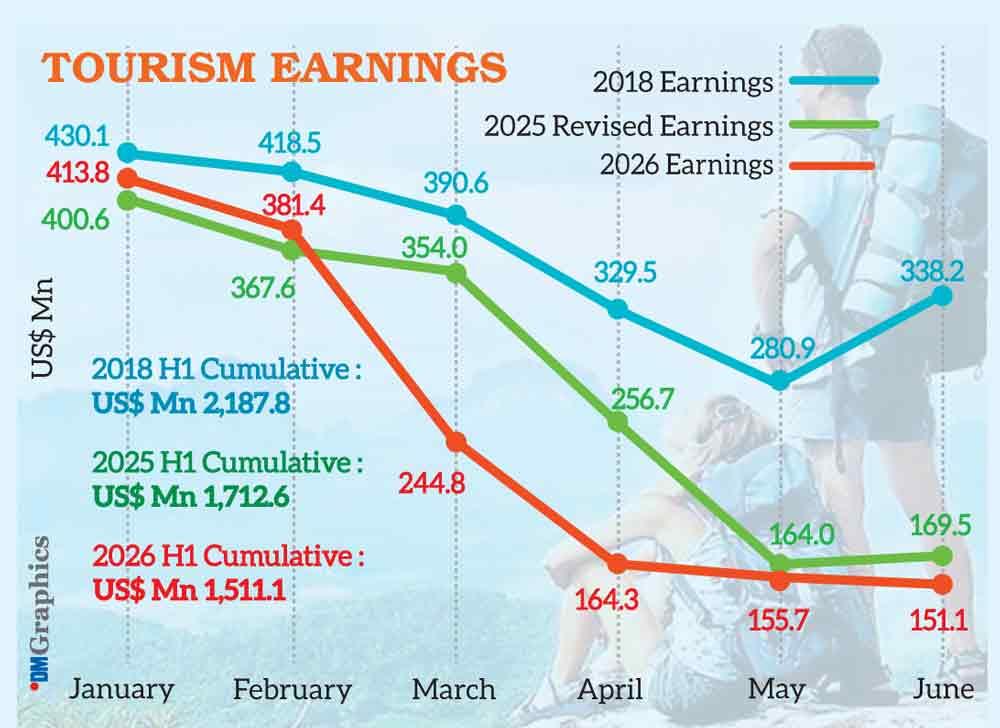
Sri Lanka’s tourism earnings dropped to US$ 151.1 million in June 2026, marking a 10.9 percent decline compared to the US$ 169.5 million generated in June 2025, while sliding marginally from the US$ 155.7 million recorded in May 2026.
Crucially, the month-on-month revenue contraction of just 2.95 percent represents a significantly softer dip than the sharp 14.5 percent plunge seen in raw visitor arrivals, which fell from 145,745 in May to 124,551 in June.
This narrower revenue decline reflects the new statistical framework introduced by the Sri Lanka Tourism Development Authority, which tracks actual visitor nights alongside arrival volumes.
While regional transit disruptions heavily curtailed the length of stay in May, June saw a notable recovery in holiday durations across high-yield European markets. The average stay for German tourists rebounded from 7.50 nights to 12.22 nights, while British and Dutch visitors extended their stays to 10.83 and 14.76 nights respectively, helping insulate industry earnings from the drop in total arrival numbers.
Cumulatively, earnings from the tourism sector for the first six months of 2026 reached US dollars 1,511.1 million, down 11.8 percent from the US dollars 1,712.6 million registered during the corresponding period of 2025. However, the industry faces an uphill task to achieve its national target of US dollars 3.5 billion for the calendar year.
Reaching this goal requires generating approximately US dollars 2.0 billion in the second half of the year. Industry stakeholders are banking on an expected capacity injection to boost winter traffic, including an interim global marketing campaign and the resumption of scheduled direct flights. Aeroflot is set to return on the Moscow route in early October, while British Airways is slated to restart direct flights to Colombo, introducing premium capacity into the UK market with introductory return fares estimated around Rs. 235,000.
However, a sharp policy divide has emerged regarding how to capture this traffic. The Sri Lanka Association of Inbound Tour Operators has urged the government to provide financial concessions for direct European charters to bypass inflated commercial ticket prices. This push has faced staunch opposition from prominent hoteliers, including Jetwing Hotels Chairman Hiran Cooray, who argued that state-subsidised charters dilute the country’s brand equity. This rift underscores distinct commercial pressures: travel agents rely on high-volume bundled tours, whereas hoteliers prioritize full-rate independent travelers who spend significantly more on in-house services.
Broader systemic challenges also continue to cloud the year-end target. The official benchmark for average daily tourist spend has been revised downward to US dollars 148, pressured by the continued expansion of informal accommodations. Furthermore, geopolitical volatility in the Middle East remains a constant threat, directly exposing the 30 percent of long-haul travelers who rely on Gulf aviation hubs to flight disruptions and increased travel costs. (NF)