Reply To:
Name - Reply Comment

 My mind travels back to a turbulent time in the early 1990s. Universities were closed amidst a youth insurgency. I had just gained admission to read for a Bachelor’s degree in Biological Sciences at the University of Colombo.
Faced with uncertainty, my father encouraged me to pursue accountancy. I vividly remember accompanying him to meet a Senior Partner of a leading audit firm in Colombo.
“My dear, accountancy is a male-dominated world; I suggest you first complete your university degree.”
That was my first encounter with an invisible barrier. I took his advice, completed my degree with First Class Honours and returned three years later to begin my journey to become a Chartered Accountant.
As a young intern, I was in awe of corporate boardrooms – the heavy wooden doors, panelled walls, leather furniture, etc. Men in suits walked in with thick folders; the doors would close and hours later they would emerge. Decisions made shaped the destinies of companies.
What struck me most, however, was not the grandeur of the room but the absence within it – there were hardly any women at the table.
Three decades later, Sri Lanka has made progress; yet, it remains inadequate. In 2025, female representation on the boards of the Colombo Stock Exchange (CSE)-listed companies reached 13.4 percent vis-à-vis 8.7 percent in 2024. While encouraging, this reflects a stark imbalance in corporate decision-making. To understand why, we must look beyond the boardrooms into out broader socio-economic.
 Economic paradox
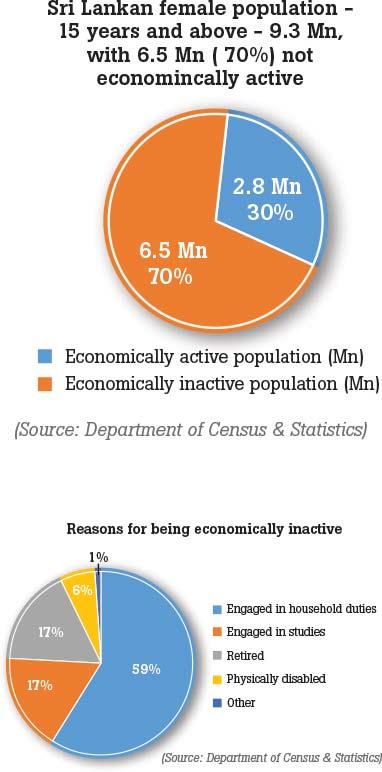
Sri Lanka’s female population is 11.26 million (51.7 percent), with a literacy rate at 91 percent. However, out of 9.3 million females over the age of 15 years, the economically active female population is only 2.8 million (29.8 percent). This is an immense economic loss.
The economically inactive female population –6.5 million, 59 percent are engaged in managing households, 17 percent engaged in studies, another 17 percent retired. They are distributed as urban – 1.1 million, rural – 5.2 million and estates – 0.2 million.
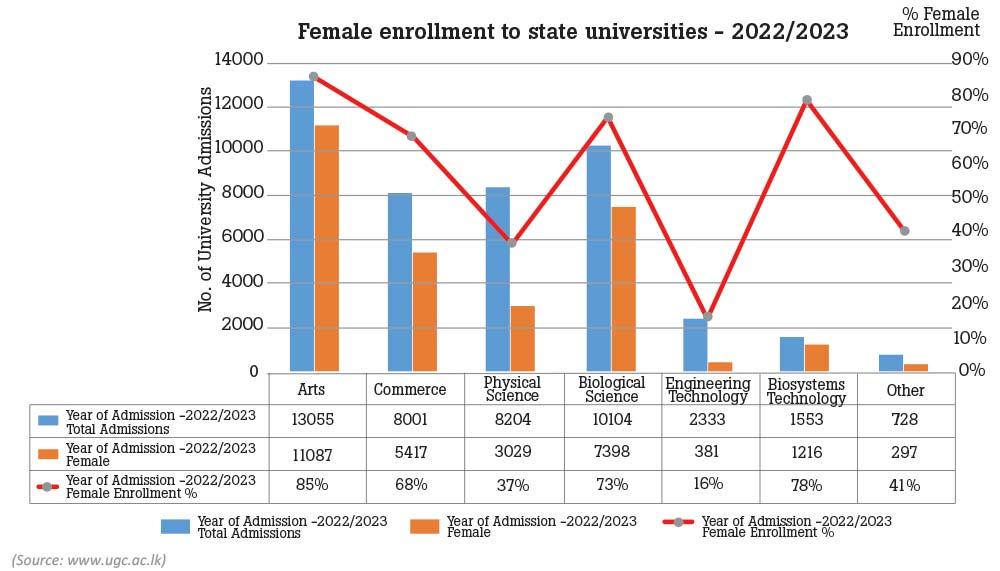
The disparity begins in education. While women make up an impressive 65.5 percent of state university enrolments, they dominate Arts (85 percent), Biological Sciences (73 percent) and Commerce (68 percent). Participation drops sharply in Physical Sciences (37 percent) and Engineering Technology (16 percent).
A shift toward STEM (Science, Technology, Engineering and Mathematics) is essential to equip females in sectors driving growth and innovation.
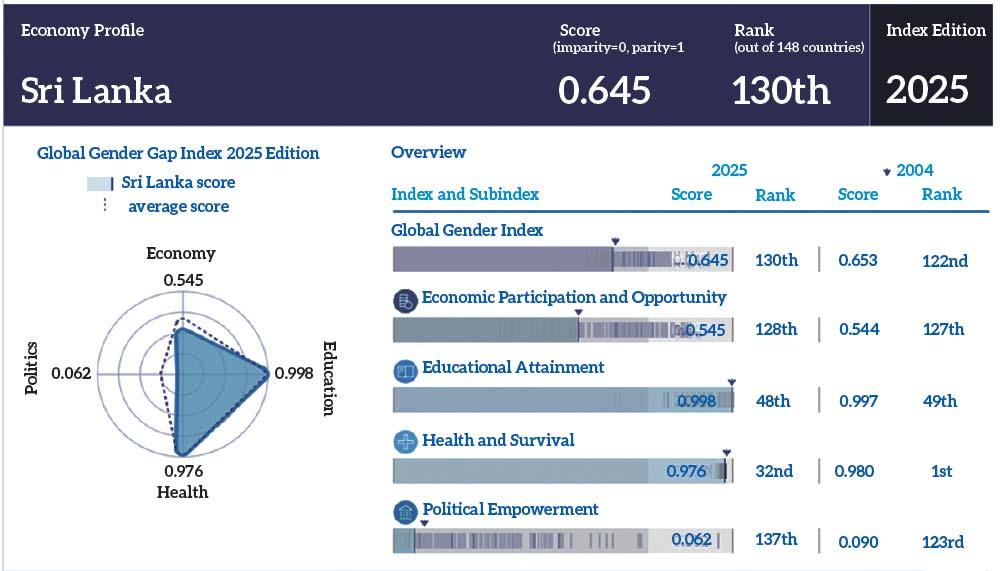
According to the World Economic Forum’s Global Gender Gap Report 2025, Sri Lanka ranks 130th, out of 148 countries. Despite high maternal healthcare and literacy rates, our low ranking is driven by poor economic and political participation.
Signs of progress
Change is beginning to surface. In the November 2025 Parliamentary election, 22 women were elected (10 percent), nearly double the 12 representatives in 2024. Dr. Harini Amarasuriya was elected as the nation’s third female Prime Minister. Many of these new faces campaigned on their own merit rather than family patronage, signalling a shift in political dynamics.
Way forward
To bridge the gap, multi-dimensional strategies need to be implemented:
A. Policy interventions – Sri Lanka needs stronger quotas for women on boards. Mckinsey research reveals that the companies with over 30 percent women on boards are likely to achieve 25 percent-27 percent higher profitability. Diverse perspectives and empathy lead to better strategic decisions and corporate governance.
The Central Bank’s mandate requiring the licensed banks to have at least one female director by 2025 and for boards > 10 members, a minimum of two female directors by end-2026 is a vital step. The CSE too signed up with 14 top companies to have a 20 percent participation of women in boards.
B. Corporate pathways – Companies need to create pathways for women to rise, providing challenging assignments, equal pay and promotional opportunities. The traditional ‘old boys’ clubs’ must give way to inclusive corporate cultures.
C. Support for working mothers – Progressive labour laws, flexible hours and female talent databases are required. Facilitating crèches at workplace and ensuring safety in public transport are necessities.
D.Changing societal norms – A cultural shift is needed where the household chores are shared. A robust support system – domestic help and grandparents are essential for women to concentrate on their careers.
E. Financial literacy – Financial independence must be non-negotiable. Managing funds, budgeting and saving habits should be included in the school curriculum to empower the young minds.
F. Entrepreneurship and capital – While the banks have dedicated credit lines for female entrepreneurs, Sri Lanka lacks venture capital for seed funding and risk taking without collateral, providing training, etc. Competitions similar to ‘Shark Tanks’, where the judges provide part equity for the best proposals, be encouraged. Evidence shows women have lower default rates and high financial discipline.
G.Networking and mentorship – Women must invest in networking, take up voluntary leadership positions and mentor aspiring female professionals and entrepreneurs.
Conclusion
Unlocking this ‘Missing Half’ – the 6.5 million women’s potential, is an economic imperative.
A financially independent woman strengthens her family and the fabric of society. Increasing the female participation is perhaps Sri Lanka’s most impactful growth lever. It is time for both the policymakers and private sector to act with urgency and intent, creating pathways for women to lead in businesses, shaping the future of our nation.
The question is no longer whether women are capable. It is whether systems are willing to make space.
The boardroom door is finally opening—it is time to ensure there is a seat at the table for everyone.
(Manohari Abeyesekera is an Independent Non-Executive Director, Council Member of the Sri Lanka Institute of Directors and a Fellow of CA Sri Lanka and CIMA (UK). She read for an MBA at the University of Colombo and a Bachelor of Sciences at the University of Colombo. An alumna of the US International Visitor Leadership Programme (IVLP) and US Fortune Mentoring Programme, she has won accolades as a Woman in Leadership)