Reply To:
Name - Reply Comment
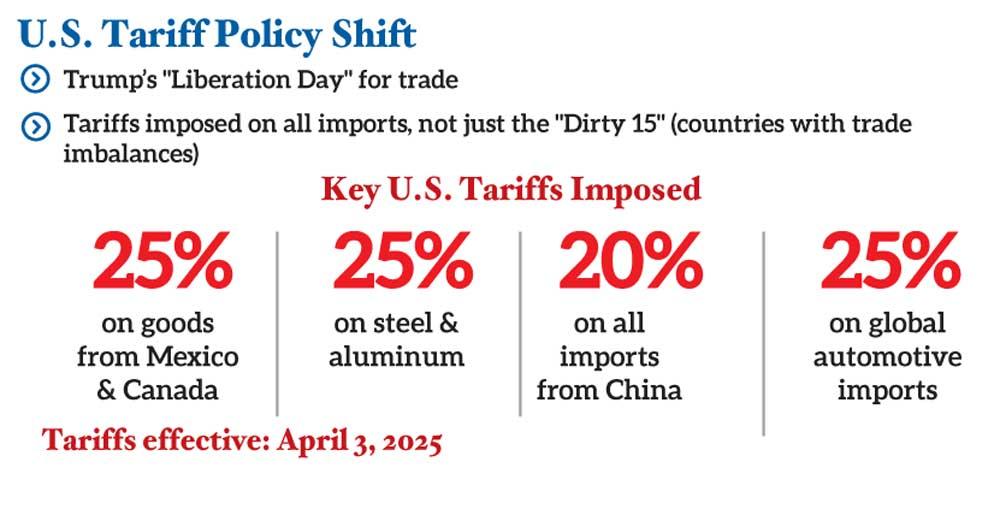
 So-called ‘Liberation Day’ tariffs, potentially on all US imports, are set to go into effect from today
Sri Lanka is yet to assess the impact of the reciprocal tariffs imposed by the Trump administration, which take effect today, April 3, following the announcement on April 2. US President Donald Trump has referred to this as the “Liberation Day” for the US trade policy.
Although there was some expectation until about a week ago that the coming tariffs of about 15 percent would be confined to the US trading partners with the persistent trade imbalances – a so-called “dirty 15”, Trump recently said it would be imposed on all imports but at much lower level than what those countries do to the US.
Sri Lankan policymakers acknowledge the uncertainty caused by these tariffs but Central Bank Governor Dr. Nandalal Weerasinghe said last week that it is too early to come up with an assessment of the tariff impact, although they are monitoring the situation.
“Sri Lanka’s market access to the US is very low compared to Mexico and Canada’s,” Dr. Weerasinghe said, as the two countries have continuously been targeted through tariffs by the US since Trump assumed duties in January.
However, the US has been Sri Lanka’s largest trading partner for its exports, especially apparel.
“It is too early for us to come up with an assessment of the tariff impact. But we are closely monitoring,” he added, in response to a question by the media last week.
The on-again, off-again tariffs by the US on its two main trading partners Mexico and Canada have caused uncertainty among the investors, businesses and consumers in the US, causing some anxiety in the minds of many.
The stock market gains, leading up to its all-time high reached on February 19 in the S&P 500, the US stock benchmark, erased its year-to-date gains and the gains in all other major US indexes to post losses for the year. The tariff uncertainty has also erased the stock index gains from the November presidential elections in the US.
However, the tariffs cannot and should not be surprising to the Americans, as Trump ran his entire election campaign on vowing to impose tariffs to rebalance US trade, bring American jobs back and restore a “golden age of America”.
The US tariffs, which so far have gone into effect, include 25 percent duties on some goods from Mexico and Canada, 25 percent duties on all steel and aluminum and 20 percent duties on all imports from China. Tariffs to come include a 25 percent tariff on global automotive imports to the US, which is set to go into effect on April 03.
Leading up to the imposition of the first set of tariffs on Mexico, Canada and China in February, many thought Trump would use tariffs only as a negotiating tool to extract concessions from its trading partners and only a few thought that he had actually meant it.
Nevertheless, according to Dr. Weerasinghe, the order books of the exporters for the first half of 2025 have been fairly strong, although what the tariffs would mean for them in the second half is yet to be known.