Reply To:
Name - Reply Comment
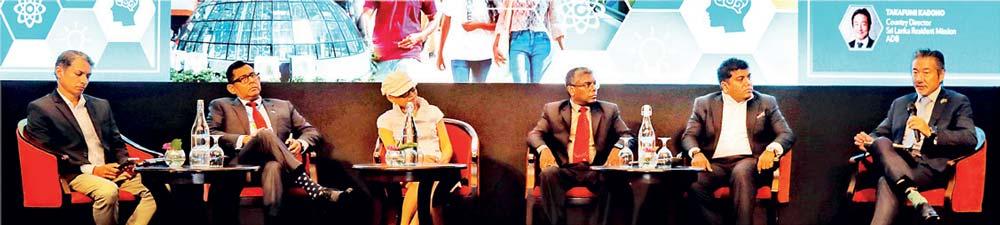
From left : Executive Director TRACE / Cofounder 3H Heminda Jayaweera, HNB Managing Director/Chief Executive Officer Damith Pallewatte, Nanyang Technological University Associate Professor of Entrepreneurship (Singapore) Lerwen Liu, Senior Advisor to the President of Sri Lanka on Science and Technology Gomika Udugamasooriya, Hatch Co-Founder Jeevan Gnanam and ADB Country Director Takafumi Kadono
By Nishel Fernando
Sri Lanka’s new national research and development (R&D) policy has been finalised and is set to be implemented from 2025, a strategic move by the government to pivot the nation towards a production-based economy, driven by value-added products and services.
Joining a panel discussion at the Asian Development Bank’s Serendipity Knowledge event in Colombo last week, Senior Advisor to President on Science and Technology Prof. Gomika Udugamasooriya announced that the proposed new policy has been drafted and is currently undergoing an evaluation process and would be implemented within this year.
The new policy aims to create a centralised and cohesive R&D ecosystem, addressing the long-standing issues of fragmented research efforts and a disconnect between the research outcomes and national economy.
“The current government is mainly focusing on a production economy. One of the best ways to reach there is by developing value-added products and services, which come from R&D,” said Prof. Udugamasooriya.
He acknowledged the immense challenges faced by researchers in Sri Lanka, particularly the lack of financial support and a proper mechanism to integrate their work into the economy.
To rectify this, the government plans to establish a powerful centralised commission and administrative institute to govern the entire R&D system.
The proposed centralised R&D commission will be structured into six interconnected divisions to address systemic flaws. These divisions include policy development tasked with creating and updating national R&D policies, research prioritisation aimed at aligning research with national economic and social development needs, targeted funding which will direct financial resources to prioritised research areas to prevent wastage and facilitation and monitoring – responsible for regulating and overseeing all funded research projects.
Additionally, a commercialisation division will support intellectual property protection and connect the researchers with the private sector investors, while knowledge dissemination will focus on sharing research findings and integrating the lessons learned back into the policy cycle.
Prof. Udugamasooriya emphasised that the policy would encompass a broad spectrum of fields beyond traditional science, including humanities, social development, arts and culture.
Recognising the urgent need to support the economy, a special unit has already been established under the President’s Secretariat.
“The President has allocated Rs.1 billion from the budget for a core national initiative for R&D commercialisation,” he noted.
This initiative will focus on providing the “gap-filling” funding for the nearly completed research with high commercial value, matching the finished projects with the investors and resolving the legal or bureaucratic hurdles for the researchers.
“We are trying to set up an investor-friendly environment. We tell investors, ‘Please, come without any fear. We don’t ask for any commissions or anything. It’s clean’,” Prof. Udugamasooriya added, highlighting the efforts to streamline the processes and offer specific tax benefits.
However, the path to a vibrant innovation ecosystem is fraught with challenges, as pointed out by the other panellists. Hatch Co-Founder Jeevan Gnanam highlighted the critical issue of underfunding.
“As a country, we should be doing about 5 percent of GDP in funding (for start-ups). Last year, we did about US$ 14 million, which is about 0.014 percent. The ecosystem here is underfunded,” Gnanam said, underscoring the massive financial gap that needs to be bridged for the R&D projects to survive and scale.
3-H Innovations Co-Founder and Director Heminda Jayaweera delved into the deep-seated cultural and educational barriers, hindering innovation. He argued that Sri Lanka’s highly competitive education system discourages the “innovation mindset”.
“We think that we shouldn’t copy. But globally, innovation ecosystems start with copying something and building something better,” Jayaweera explained.
He also lamented the lack of collaboration, a direct consequence of an education system that prioritises individual achievement over teamwork.
“Globally, innovation happens when people get together as a team,” he said, pointing out the failure of universities to foster interdisciplinary research.
“Faculties don’t talk with another faculty. We talk about interdisciplinary research but it never happens in universities at a significant scale.”
Jayaweera also cautioned against premature regulation, particularly concerning intellectual property.
“The moment you start with ‘first you have to protect your IP’, that itself stops the innovation part,” he warned. He cited Elon Musk’s decision to make Tesla’s electric battery patents public as a prime example of fostering a wider ecosystem.
“If you want an innovation ecosystem, don’t start with the controls. Controls can come later, once you flourish.”