Reply To:
Name - Reply Comment
|
Anil Jayantha Fernando |
Nearly one in four Sri Lankan workers are exposed to generative artificial intelligence (AI), with professional and office-based occupations facing the greatest risk of disruption, prompting the government to place AI at the centre of its economic transformation strategy.
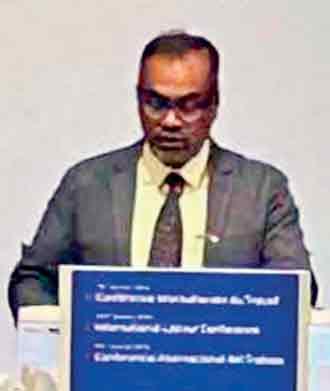
Addressing the 114th Session of the International Labour Conference in Geneva this week, Labour Minister and Deputy Minister of Finance and Planning Anil Jayantha Fernando said research conducted by the Institute of Policy Studies (IPS) using International Labour Organization (ILO) methodologies found that approximately 22.8 percent of Sri Lanka’s employed population is exposed to generative AI.
The findings highlights the growing challenge facing labour markets worldwide as advances in AI increasingly affect occupations once considered relatively insulated from technological disruption.
“Crucially, this exposure sits heavily upon professional ‘office jobs’ traditionally deemed safe paths for upward mobility,” Fernando said.
The minister noted that workers in agriculture, craftsmanship and elementary and informal sector occupations remain comparatively less exposed, highlighting how AI is expected to reshape white-collar employment before significantly affecting many manual occupations.
AI as a threat to workers, he said Sri Lanka intends to position the technology as a driver of productivity and economic growth, Fernando said.
“Sri Lanka proposes a shift in this paradigm to start viewing technology and AI as a catalyst to re-architect our production relations to enhance productivity and value generation for shared prosperity,” he said.
The government is pursuing what Fernando described as an “AI-first” approach, embedding digital technologies into public institutions and economic planning as part of a broader national digital transformation agenda.
Under the strategy, AI is expected to serve as a productivity multiplier for businesses, support workers transitioning into higher-value roles and improve efficiency in sectors traditionally characterised by lower productivity levels.
“We are positioning AI as a ‘multiplier’ to make professional businesses more productive, a ‘catalyst’ to transition workers into high-value roles, and a ‘transformative’ force to make traditional agriculture and informal sector highly productive and attractive,” Fernando said.
The government sees digital transformation as a key pillar of its efforts to expand export earnings and create a stronger technology-enabled workforce, particularly as emerging economies compete to capture a larger share of the global digital economy.
“As an emerging economy, Sri Lanka is building an AI-first mindset directly into our institutions from the outset,” Fernando said, adding that digital transformation has been identified as a national priority under President Anura Dissanayake’s administration.
While accelerating AI adoption, the minister stressed that labour protections would remain central to policy reforms.
Fernando announced that Sri Lanka ratified ILO Convention No. 190 on violence and harassment in the world of work in May, with legal frameworks currently being finalised, while discussions are underway on ratifying Convention No. 188 covering the fishing sector.
He said an expert committee is also consulting stakeholders on wider labour reforms aimed at balancing worker protection with inclusive and sustainable economic growth.
Fernando called for greater international cooperation to bridge the digital divide and ensure that the economic gains generated by AI are shared more broadly across societies.
“Let us choose to harness AI not to replace humanity, but to elevate it,” he said.