Reply To:
Name - Reply Comment
Sri Lanka’s tourism authorities have announced an ambitious minimum target of three million tourist arrivals for 2026, looking to capitalise on the 15 percent growth recorded over the past year.
Speaking at a press conference held at the Foreign Affairs Ministry in Colombo yesterday, Foreign Affairs, Foreign Employment and Tourism Minister Vijitha Herath outlined a strategic roadmap focused on aggressive regional promotion and policy reforms, to sustain the industry’s upward trajectory.
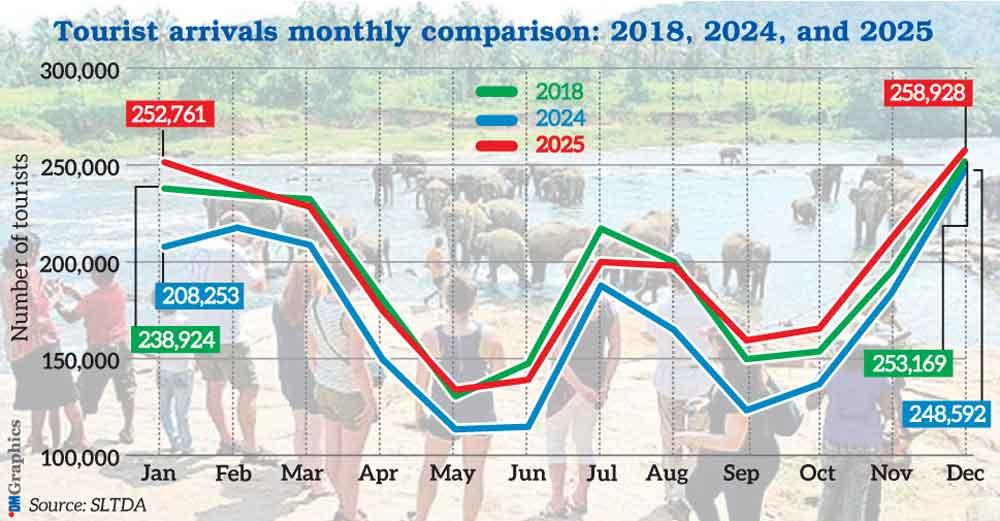
According to the latest data released by the Sri Lanka Tourism Development Authority (SLTDA), the island nation welcomed a total of 2,362,521 visitors in 2025, a significant 15.1 percent increase, compared to 2,053,465 arrivals recorded in 2024. The momentum continued through the end of the year, with December 2025 seeing 258,928 arrivals, up 4.2 percent, from 248,592 recorded in the same month the previous year.
India solidified its position as the largest source market, contributing 531,511 arrivals in 2025, a substantial rise from the 416,974 visitors recorded in 2024. A notable shift in market dynamics was observed in the second spot; the United Kingdom overtook the Russian Federation, with 212,277 arrivals, while Russia moved to the third place, with 186,580 visitors. In 2024, Russia held the second position. Germany and China remained key markets, rounding out the top five for 2025.
To achieve the three million target for 2026, the SLTDA is launching a series of targeted promotional activities, with a heavy emphasis on the Indian market, which saw the largest number of cancellations following the recent adverse weather conditions. The officials revealed the plans for extensive roadshows, specifically in Mumbai, where they intend to engage with over 100 major tour operators to secure future bookings. These efforts will be bolstered by collaborative visits involving the Travel Agents Association of India, aiming to deepen trade ties and ensure a consistent visitor flow from the neighbouring giant.
In a major policy push to facilitate smoother entry for the travellers, the government also plans to roll out the much-delayed visa-free entry scheme within the first quarter of this year. This initiative is expected to significantly reduce the barriers for key source markets and increase the destination’s competitiveness in the region.
Beyond the Indian sub-continent, the strategic framework involves a pivot toward the wider Asia Pacific region and Americas. The authorities plan to aggressively target Singapore, Malaysia and Taiwan by leveraging the “Buddhist circuit” to attract the regional travellers.
Furthermore, to maintain the momentum during the traditional off-peak season, special promotional campaigns are being designed to target Eastern Europe and other emerging markets, ensuring a steady stream of arrivals year-round. Concurrently, new niche products are being introduced, focusing on “religious and spirituality” tourism as well as “marine tourism”, to diversify the island’s appeal beyond its traditional beach and nature offerings.
On the supply side, the SLTDA is moving to regulate the accommodation sector more strictly. While the country has 58,000 registered rooms, an estimated 100,000 rooms currently operate without registration. The authority plans to bring these small and medium enterprises onto the official platform this year. Additionally, to address the regional disparities, development priority is being given to the Eastern province, particularly Trincomalee, where the officials noted that high tourist demand is currently constrained by the limited room inventory.
Addressing logistics, the tourism officials assured that the island remains fully accessible despite the recent adverse weather conditions. While acknowledging specific disruptions to the rail network, particularly the popular route to Ella, they confirmed that the road network remains open and safe for travel to all major attractions, ensuring that the tourists can complete their planned itineraries without hindrance. (NF)