Reply To:
Name - Reply Comment
World Bank Vice President for South Asia Martin Raiser concluded a three-day visit to Sri Lanka today, underscoring the need for urgent action to reverse the deep crisis through long overdue reforms.
|
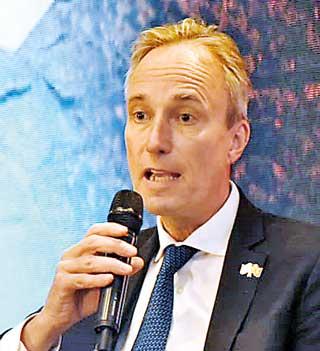
Martin Raiser addresses SL Economic Summit 2022 held earlier this week |
He prioritised debt relief, reform actions based on consensus and well-targeted measures to protect the poor.
During the visit, Raiser met with President and Finance Minister Ranil Wickremesinghe, Prime Minister Dinesh Gunawardena and other senior officials to discuss the government’s priorities for Sri Lanka’s recovery and key areas for the World Bank support.
“This deep crisis is an opportunity for fundamental reforms and it should not be wasted. The international financial institutions can help but quick and decisive action is needed on debt relief,” said Raiser.
“While the government reform action is urgent, its success will depend on strong economic, social and political consensus, as the reforms will require everyone to adjust – companies, workers and taxpayers. We also must not forget about the people who will need help with the adjustment and protect the poor and vulnerable.”
A high-level roundtable organised by the Office of the President, focusing on the government’s reform agenda and sustainable and equitable economic growth for the country, was also part of the visit..
The discussion focused on key reform priorities to inform future collaboration and support from international partners, including the World Bank, International Monetary Fund, Asian Development Bank, Asian Infrastructure Investment Bank and other development partners.
During his remarks at Sri Lanka Economic Summit 2022, organised by the Ceylon Chamber of Commerce, Raiser emphasised improved economic governance, stronger private sector competition and better targeted social protection as three priorities for Sri Lanka to reset from turmoil to opportunity. He highlighted private sector job creation as an important driver of growth and stressed the importance to preserve human capital as the main asset of society.
Raiser also met with the representatives of the civil society, private sector and development partners and visited a World Bank-supported agriculture project in Divulapitiya. To date, the US $ 125 million Agriculture Sector Modernisation Project has benefitted close to 128,000 Sri Lankans and generated about US $ 150 million in new export earnings and foreign exchange savings from import substitution for Sri Lanka.
The World Bank was one of the first to respond to Sri Lanka’s economic crisis. The bank’s emergency response repurposed US $ 325 million from existing projects to protect the poor and vulnerable. Of these funds, US $ 241.3 million have already been disbursed to support close to one million vulnerable Sri Lankans with cash transfers, six million liquid petroleum gas (LPG) cylinders for households and small businesses, US $ 22.3 million worth medicines and medical supplies to sustain essential services and 132,500 metric tonnes of urea fertiliser to support smallholder paddy farmers in the Maha harvesting season. The ongoing projects are also providing support for school meals and tuition waivers for children from vulnerable households.