Reply To:
Name - Reply Comment
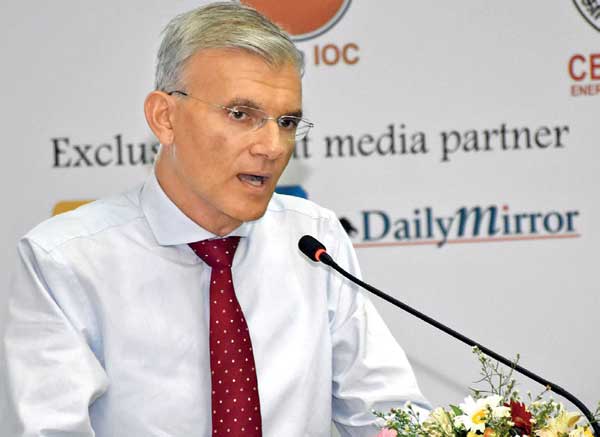 Prof. Razeen Sally Pic by Kushan Pathiraja
Renowned economist and Institute of Policy Studies Chairman Professor Razeen Sally said that the government has so far failed to formulate a credible plan for economic reforms, just one day after Prime Minister Ranil Wickremesinghe alleged that journalist s were attempting to sabotage the country’s political economy.
“So far the government hasn’t come up with a credible plan for reforming the economy whether it be on taxation and expenditure as well as on other important issues like freeing up the business climate domestically and liberalizing Sri Lanka’s trade and foreign investments,” Prof. Sally said. A key economic advisor to the premier, Prof. Sally was speaking late last night at the inauguration of Association of Management Development Institutes in South Asia Conference 2016. “Bad news now is on the economy.
Also given expectations, not least by the aspirational classes who voted the President and then this government in, there is rising disappointment and frustration that actually, not much has changed. In some respects we’ve seen some things get worse,” he said. He said that the macroeconomic m a n a g e m e n t d i s a s t e r s experienced under the Rajapaksa regime have continued. “ T h a t h a s continued to be the case, with two very bad budgets last year. With a t a x s y s t e m t h a t ’s almo s t collapsed, with public spending increases, salary increases and more expenditure entitlements along the way, which make Sri Lanka more reliant on debt, including foreign commercial borrowings,” he said. He said that this would be dangerous, given the rising interest rates, but noted that the International Monetary Fund relief gives some breathing space for reforms. However, he said that p o l i t i c a l p o s t u r i n g continues to hound the current r e g i m e .
“There is cohabitation between the president and the prime minister, there’s an unwieldy national unity government. There have been several bad appointments, decision-making has been rather messy and not as coordinated as it should be, and for these and other reasons, there have been blockages on economic policies,” he added. He noted that without quick responses, Sri Lanka could continue to drift aimlessly as it had done since independence, despite currently having the best window of opportunity for reforms in over 40 years.
“That opportunity has not been taken advantage of in the last 18 months. I hope it won’t be squandered. There is still a lot to play for,” Prof. Sally said. He noted that there are some positives, with much more political liberalism, and a subdued atmosphere of ethnic tension, even though only symbolic gestures have been made by the current regime without addressing underlying issues or providing procedural justice.
“The media criticizes freely, but the media is under pressure as we see, still,” he added. He went on to say that the foreign policy is much more balanced than before, with China still being a friend, but the relationships with the West and India also being cultivated. However, he noted that most of the positives are affecting the ‘chattering class’ of Colombo and not the rural aspirational class that voted the government in. “It could get worse and unravel.
Because if the economy doesn’t perform, and if especially Sri Lankans outside Colombo continue to be frustrated, if things get worse, if there’s no investment, if jobs aren’t created, then other things could unravel too, including relationships with the minorities and the more liberal atmosphere Sri Lanka has enjoyed in the last year and a half. And that is something the country should avoid at all costs,” he said.