Reply To:
Name - Reply Comment
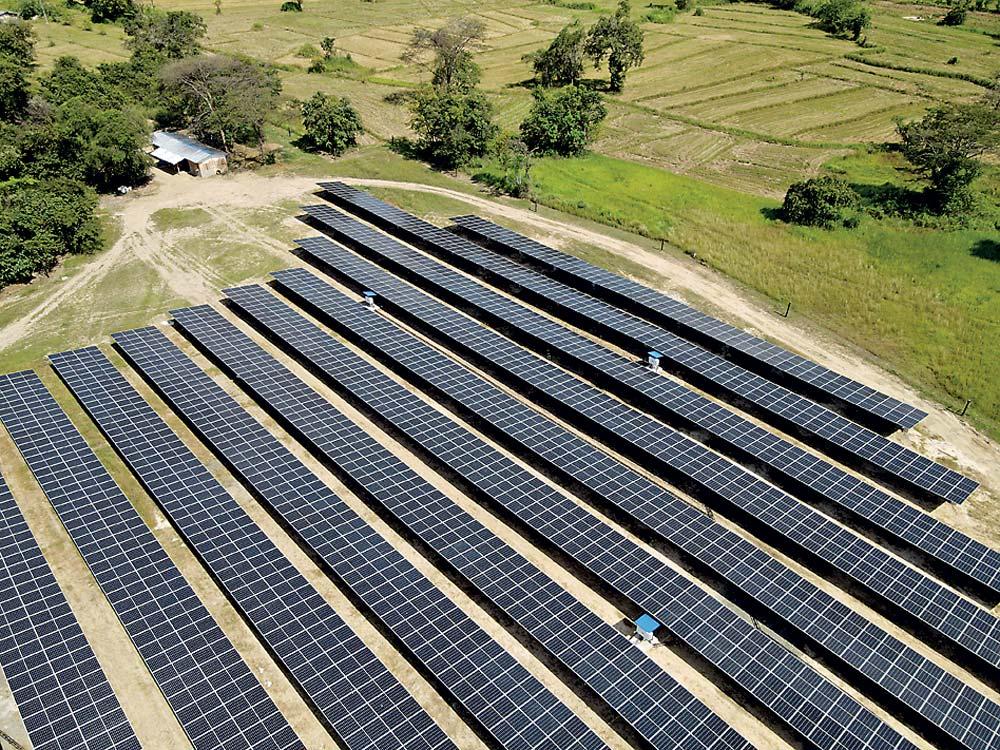
Arial view of Damana solar power project
|
Resus Energy Managing Director |
Resus Energy PLC recently connected a 5 MW ground-mounted solar PV power plant to the national grid.
Built at a cost of over Rs.750 million, with state-of-the-art equipment encompassing tier-one solar PV panels and top-of-the-range auxiliary equipment, the plant is expected to generate about 10 million units of electricity (10 GWh) annually.
Located in Damana, in the Ampara district, the power plant is connected to the Ampara grid substation. Along with the existing 3 MW operational power plants, Resus Energy now feeds 8 MW in aggregate to the Ampara grid substation, expanding its footprint in rural electrification.
The development rights of these projects were secured from the government’s Soorya Balasangramaya tender, floated to procure 90 x 1 MW solar PV projects.
This is Resus Energy’s third solar PV site to date. Together with its first sites in Siyambalanduwa and Mahiyanganaya, Resus Energy now supplies 15 MW of solar power to the national grid.
The power plant was developed under challenging conditions when development had to be abandoned for a couple of years post economic crisis. Having withstood these barriers, with the newest facility, Resus Energy now operates 11 utility-scale power plants across the country, with a total 30 MW capacity and an annual energy generation of nearly 75 GWh.
“Being a signatory to the 2015 Paris Agreement on climate change, renewable energy is critical to meeting Sri Lanka’s promise to the world. Through our Nationally Determined Contributions, set out under the Paris Agreement, we are obligated to reduce emissions by 30 percent, with 20 percent to come from the energy sector.
This project therefore comes at a pivotal time when it is essential for us to expand our renewable energy portfolio. It is also aligned with meeting the government’s 70 percent renewable energy generation target by 2030,” said Resus Energy Managing Director Kishan Nanayakkara.
He added, “As a nation battered by multiple power crises, initially resulting from insufficient generation capacity and subsequently from a thermal power dependent generation-mix, an improved level of renewable energy integration is critical to sustain an energy secure nation. Sri Lanka paid dearly for its renewable energy shortage in the recent past, with blackouts impacting people’s lives and businesses, while thermal plants idled because of fuel shortages.
Our economy was in a perilous state for having to pay astronomical prices to fuel thermal plants.
Resus Energy’s newly connected solar PV station affords the nation a significant economic benefit, supplying electricity substantially below the Ceylon Electricity Board’s average selling price. Not to mention the production cost of fossil-fuel burning thermal power plants over the next 20 years.”
With a passion for the well-being of people and the planet, as emphasised in its vision, Resus Energy believes in creating shared value that benefits all its stakeholders. The company strives to ensure that its carbon footprint remains minimum or negative, as it expands its business portfolio.
Designed and developed using expert local knowledge and the latest technology, Resus Energy projects are planned and executed sustainably and responsibly. All project development budgets include considerable allocations to develop infrastructure and welfare of the surrounding communities of its projects.