Reply To:
Name - Reply Comment
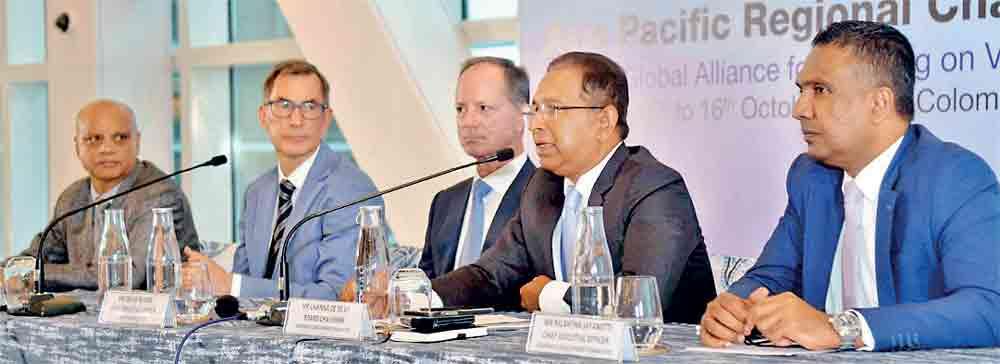
From left : Regional Rep for GABV Upendra Poudyal, Sunrise Banks CEO David Reling, GABV Executive Director Martin Rohner, Sarvodaya Development Finance PLC Chairman Channa de Silva and SDF CEO Nilantha Jayanetti - Pic by Pradeep Pathriana
Leaders from Sarvodaya Development Finance (SDF), a member of Global Alliance for Banking on Values (GABV) highlighted significant regulatory barriers that are stifling critical financial inclusion initiatives in Sri Lanka, including restrictions on foreign funding and policy hurdles in expanding financial infrastructure such as mini-ATMs to underserved rural areas.
The concerns were raised at a press briefing held in Colombo for the Asia Pacific Chapter meeting of the Global Alliance for Banking on Values (GABV), a network of the world’s leading sustainable banks.
The meeting, running from October 15-16, brings together top executives from 20 countries to discuss how ethical and sustainable financial practices can drive community and economic impact. However, the discussion quickly turned to local challenges hindering such progress.
A key point of contention is the inability of financial institutions to roll out essential infrastructure to bridge the urban-rural divide. SDF CEO Nilantha Jayanetti revealed a recent setback in their efforts to expand financial access. He noted that current outdated regulations do not permit finance companies to establish proposed mini-ATMs in these underserved rural outskirts.
This regulatory hurdle directly impacts the nearly 50 percent of the Sri Lankan population that, according to Jayanetti, remains outside the formal financial system.
He underscored the tangible benefits of such initiatives by citing a successful ATM installation in Ketsirigama, a remote village in the Ampara district. The facility saves farmers in 15 surrounding villages significant time and money, amounting to over two million rupees per month in collective savings. This, he argued, is the essence of values-based banking - going beyond simple financial transactions to add real value to communities.
Beyond infrastructure, regulations on capital are also seen as a major constraint. Sarvodaya Development Finance PLC Chairman Channa de Silva pointed out that current rules cap on borrowing from overseas impact lenders at 30 percent of total assets. He argued that more access to international financiers and partners is crucial for meaningful progress.
“There is a policy response which is required, and it is a drastic policy response and a pragmatic policy response,” de Silva stated, emphasising that marginal changes are insufficient. He warned that without modernising the framework around development banking, collateral-based lending, and grace periods for loans, Sri Lanka’s financial institutions will be hamstrung. “Policymakers don’t need to tie the financial institutions into a level that we can’t move.”
The GABV meeting provided a backdrop for this call to action. GABV Executive Director Martin Rohner described the alliance’s philosophy, noting its 71 member banks are united by a commitment to serving the real economy rather than the speculative financial economy. “GABV members, they focus first and foremost in their business model on social and environmental impact,” Rohner said. “They are anchored in the communities that they serve.”
CEO of Sunrise Banks in the United States David Reling, added that GABV members represent some of the “most innovative banking that you can imagine,” creating authentic solutions for community problems.
The consensus among the speakers was that while Sri Lanka has a highly literate population and a banking sector ready to embrace technological change such as QR codes and mobile wallets, its potential is being capped by an outdated regulatory environment.
(NF)