Reply To:
Name - Reply Comment
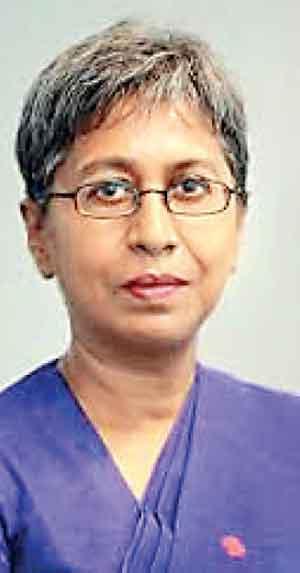 |
| Dr. Dushni Weerakoon |
By Shannine Daniel
The proposed para-tariff reductions are an important signal of changing policy thinking in the country, asserted Institute of Policy Studies Executive Director Dr. Dushni Weerakoon.
Dr. Weerakoon noted that the planned reductions over the next three years signals a significant shift in the country’s industrial policy, moving away from decades of trade protectionism towards a greater focus on competitiveness and productivity.
According to her, for decades, industrial policy in South Asia, including Sri Lanka, relied heavily on tariff protection to encourage domestic production.
“Sri Lanka has been incrementally offering more protection to domestic producers as a means of incentivising them to increase production, when it has not worked,” Dr. Weerakoon said.
The comments were made at a recent discussion organised by the World Bank to mark the release of its latest report on South Asia’s economic outlook.
“It is now, I think for the first time, that we are seeing industrial policy and tariff reductions being spoken of as the way forward and to me, that is the most positive message I am getting from policy makers,” Dr. Weerakoon opined. There was an “optimistic view on what the para-tariffs can deliver”, she added.
She elaborated that the proposed tariff reforms should be viewed in the broader context of Sri Lanka’s post-crisis economic recovery and its efforts to sustain growth through structural reforms rather than short-term stabilisation measures.
Moreover, Dr. Weerakoon noted that Sri Lanka has performed better than expected in recovering from the 2022 economic crisis, recording around 5 percent GDP growth over two consecutive years.
She added that the country is expected to return to its pre-crisis economic levels soon.
“The story so far has been very positive.”
She said that the recovery had been supported by improved macroeconomic fundamentals.
However, she cautioned that the current momentum remained largely cyclical and would need to transition into growth driven by productivity gains and stronger competitiveness.
Dr. Weerakoon also highlighted a notable institutional change behind the reform proposal; unlike the previous tariff adjustments, which were largely driven by the Finance Ministry, with a focus on revenue generation, the latest Cabinet proposal had been prepared by the Industries Ministry.
She said that this shift suggested a stronger emphasis on building external competitiveness rather than merely managing the fiscal outcomes.
While acknowledging that the current external economic shocks could slow the pace of reforms or affect employment and GDP growth, Dr. Weerakoon asserted that the intention behind rationalising tariffs and reducing para-tariffs was a positive development for Sri Lanka’s long-term growth strategy.