Reply To:
Name - Reply Comment
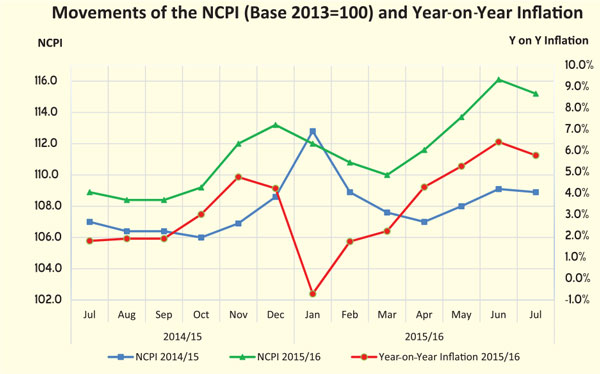
Sri Lanka’s national headline inflation, which captures the price movements across all provinces, slowed to 5.8 percent during the 12 months to July from 6.4 percent in June as food prices declined with the government imposing price controls on selected food items and the Supreme Court suspending an increase in valueadded tax (VAT).
On a month-on-month (MoM) basis, the July prices dropped 0.8 percent against a 2.1 percent increase in June. From June to July, the food prices declined 1.6 percent after rising 4.7 percent in June as the prices of many commodities, such as sugar, fresh fish, coconut and vegetables, dropped among others. The vegetable prices decreased sharply during the month, probably due to the increased supply compared to the previous months, as the crops were affected by the floods in May and June.
T h e g o v e r n m e n t imposed price controls on 15 essential items during the month. On a year-on-year (YoY) basis, the food inflation rose 6.7 percent, slower than 7.6 percent in June. The non-food inflation also slowed down in June albeit at a lesser pace than the food inflation. The MoM non-food inflation contracted 0.2 percent in July against a 0.2 percent expansion in June. Healthcare and telephone charges pulled down the non-food prices in July as the VAT was removed from laboratory tests and telephone charges.
Notably, in the non-food category, the transport-related expenditure items showed increases in prices. Items such as vehicle purchases, lubricants and car insurance all showed increases in prices. Meanwhile, on a YoY basis, nonfood inflation slowed down to 5.0 percent in July from 5.6 percent in June. The 12-month moving average inflation rose 3.4 percent in July, accelerating from 3.1 percent in June.
Sri Lanka’s headline inflation in the capital Colombo measured through the Colombo Consumer Price Index (CCPI) moderated to 5.5 percent in the 12 months to July from 6.0 percent recorded in June. The National Consumer Price Index (NCPI) is generally released with a 21-day lag from the date of the CCPI release. Worried over the rising trend in inflation, new Central Bank Governor Dr. Indrajit Coomaraswamy in July raised the key policy rates by 50 basis points to ward off any price pressures stemming from the demand side as the demand for private credit is remaining high. “The Monetary Board considers that further tightening of the monetary policy is required to curb excessive demand in order to pre-empt the escalation of inflation pressures,” Central Bank Director Economic Research K.M. Siriwardene told the reporters soon after the hike in rates. In June, Sri Lanka breached the International Monetary Fund’s inner band headline inflation target of 4.9 percent set for the month by recording an inflation of 6.0 percent – 32 months high and closer to the upper band of 6.4 percent—triggering staff consultation. The Central Bank wants to maintain the inflation at mid-single digit levels in the medium term.