Reply To:
Name - Reply Comment
Ravi Karunanayake
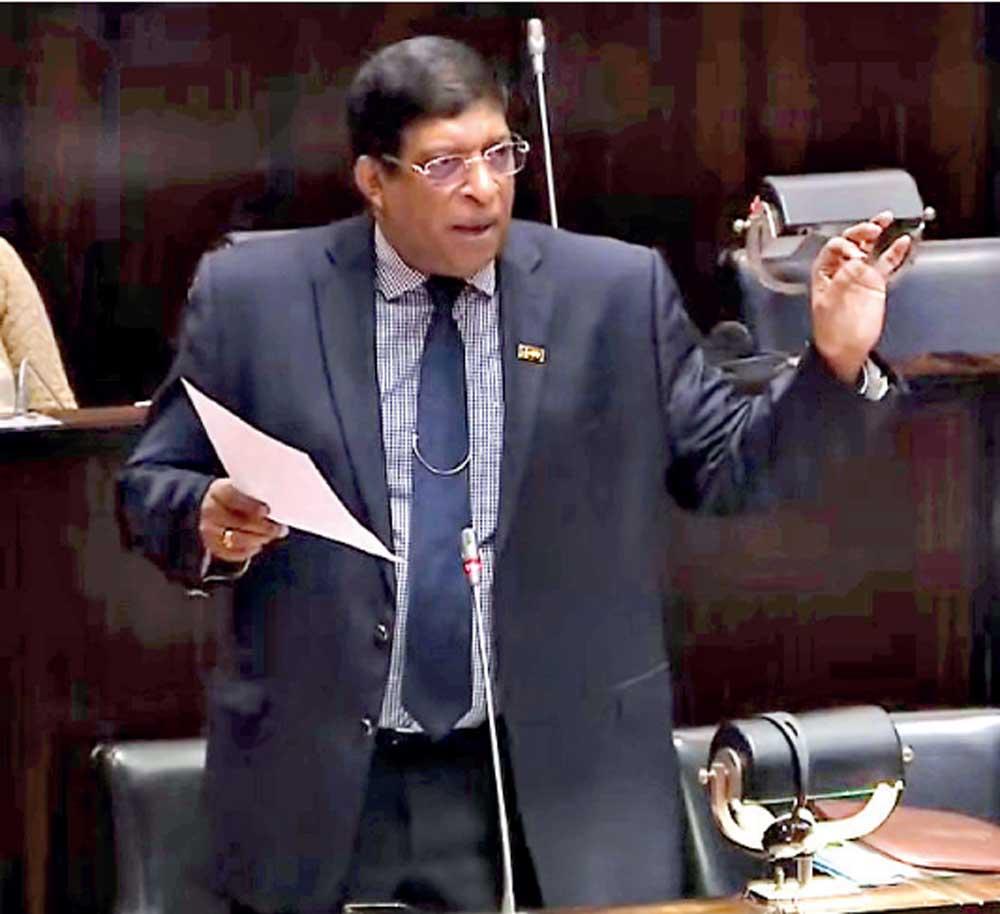
Former Finance Minister and Member of Parliament Ravi Karunanayake this week launched a scathing critique of the Central Bank of Sri Lanka, holding its Bank Supervision Department accountable for the Rs.13.2 billion internal fraud at National Development Bank (NDB).
Speaking in Parliament just days after the bank’s initial disclosure, Karunanayake questioned the effectiveness of the regulator’s oversight mechanisms and accused the Central Bank officials of hiding behind depositor protection protocols to mask the regulatory failures.
While assuring the public that the broader financial sector remains secure, the lawmaker pointed to the speed at which the financial impact escalated.
“I would say, as a responsible Member of Parliament and former Minister of Finance, there is no need for any run on any bank at all,” Karunanayake said, stressing that his focus was on the regulator.
“My intention is purifying the Central Bank. On April 6, they reported a breach – a 300 million fraud. Now that 380 million by Monday became 13 billion.”
He commended the bank for disclosing the fraud, noting, “This is one bank that... must be congratulated for without fear bringing it out” but sharply criticised what he described as systemic regulatory failures that allowed the manipulation to persist.
A key point of contention was the regulator’s recent appearance before the Parliamentary Committee on Public Finance.
“We had them coming before our Committee on Public Finance and the information they gave us was absolutely paltry and it was dangerously placed, with no responsibility being taken by them,” Karunanayake said.
He further accused the regulator of withholding critical details from the lawmakers, stating, “That’s the same Central Bank that today says they can’t answer the members in Parliament on certain matters, simply because they want to protect the depositors. I am looking at protecting the banking aspect of this entire country.”
Placing the incident in a broader historical context, Karunanayake drew parallels with the past regulatory failures, including the collapse of Pramuka Bank and Seylan Savings as well as the sovereign default in April 2022. He argued that despite having online supervisory capabilities for several years, the Central Bank had failed to detect sustained internal collusion and breaches of basic banking rotation principles.
“The normal thing is that the banks are very concerned that no one person can go through the same thing. So, there’s a rotational principle. Now this particular one has been breached!” he said. Karunanayake also cited the bank’s own published data as evidence of red flags that may have been overlooked by both regulators and auditors.
Referring to the annual reports, he noted that certain gross financial assets rose sharply from Rs.3.1 billion in 2024 to Rs.12.2 billion in 2025.
“Where are the oversight committees? There are board members, who are independent. Where are the audit committees? Who is the external auditor?” he asked, suggesting the anomalies were visible.
Adding to his critique, he referenced the International Monetary Fund’s (IMF) 2023 Governance Diagnostic Assessment.
“Even the IMF had concerns, saying that the Central Bank’s internal bank supervision is very weak,” he said.
He also pointed to a potential conflict of interest, noting that the Central Bank manages the Employees’ Provident Fund (EPF), which is a major institutional investor in NDB.
“Now, the same Central Bank that handles the EPF is investing in the same NDB Bank. On that basis, the independence of the Central Bank is basically utilising the money and going and banking on them,” he argued.
Karunanayake called for a reassessment of the Central Bank’s independence under the current legislative framework.
“The independence of the Central Bank, this government must seriously relook at. I am saying for the collective good, you have given them independence without any collective responsibility,” he said.
Calling for urgent structural reform, he added, “The Central Bank Supervision Department has to be strengthened or if not, close it down and get a better system operative.” (NF)