Reply To:
Name - Reply Comment
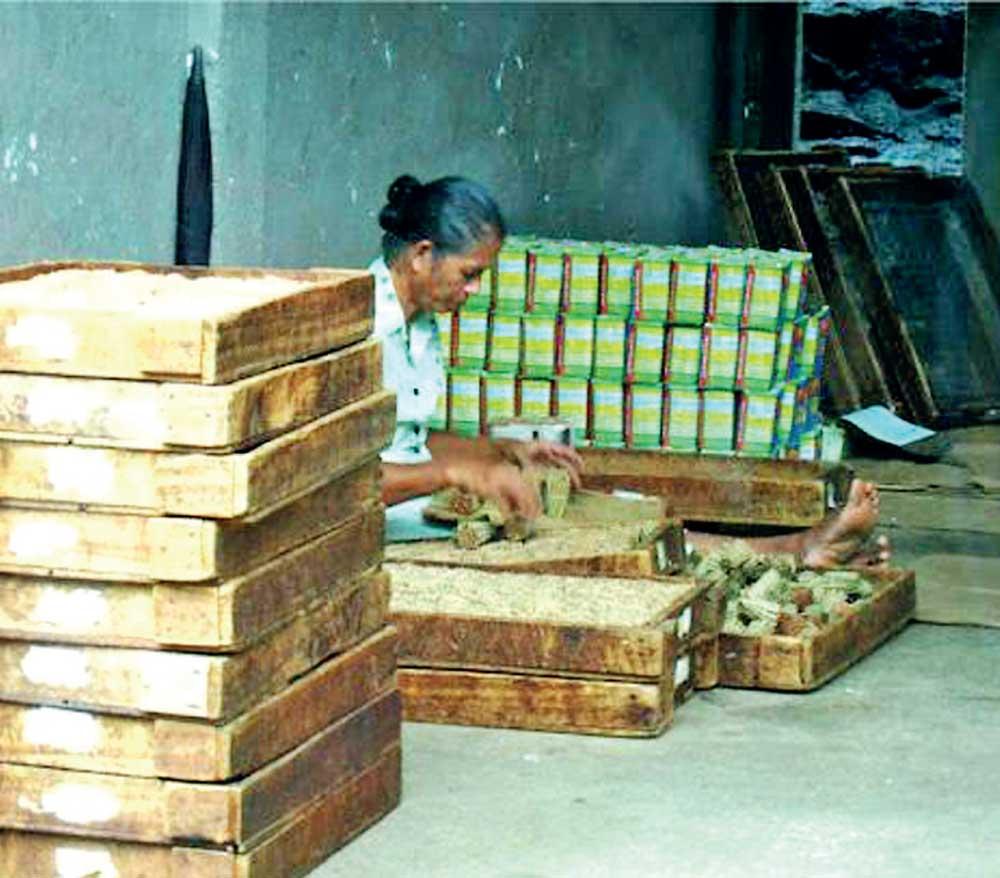
Village women making beedi
BY Jeewa Siriwardena
Despite being the fastest growing combustible tobacco product in Sri Lanka, the Excise Department laments a significant revenue drop from beedis this year.
Being market leader with a 67 percent share of the tobacco industry in Sri Lanka, beedis puffed up only Rs. 469 million in earnings for the first half of 2025 and will likelyfall short of last year’s collection of a mere Rs. 1 billion. There is a huge disparity between revenue and market dynamics.
This comes in the backdrop of a growing illicit cigarette trade with 39 percent market share, as legal cigarette volumes dropped below 2 billion sticks last year.
Tax effect
With over 6.5 billion beedi sticks smoked annually in Sri Lanka, the drop in earnings establish that higher taxes on beedi is driving a segment of registered producers underground. Only a handful of beedi manufacturers in Sri Lanka are registered and the number of registrations are seemingly declining on the back of the introduction of tobacco tax on sticks. To make bad matters worse, an even smaller share pay taxes. This was highlighted at a meeting of the parliamentary Committee on Public Finances (COPF), as the Excise Department pointed to rising illicit trade and lowering registrations as attributing causes of ailing tax revenue from beedi, following the tax increase.
Authorities cannot comprehend the true extent of Sri Lanka’s beedi trade and its complex network. In a report published in 2019, the Social Development Network (SDN) revealed over 8,000 families manufacture beedi, when volumes were just over 2.5 billion sticks.
The total number of manufactured beedi was estimated at over 6 billion sticks in a 2021 report by Don S. Jayaweera, titled “A Study on the Beedi industry: The End-to-End Value Chain in Sri Lanka”, an indication that this so-called ‘cottage industry’ is now a wildfire burning out of control fanned by smuggling.
During publication, Customs Department officials told SDN “in every countrythere are goods that are priority for detection and control and others that are not, whereby we pay little attention to them. Beedi falls into the latter category.”
Despite increased detections, it is likely beedis and Tendu leaves – used for manufacturing – are still treated the same.
Commendably, the government raised Tobacco Tax on each beedi stick manufactured locally from Rs. 2 to Rs. 3 in April this year. Whilst government projects this would drive earnings from beedi up, experience on the ground suggest otherwise. There is no penalty on producers for not declaring wares, as government has no functional record of who or how many persons or establishments arereally engaged in production and sales. A quick glance at reported tendu leaf imports and stick volumes amply demonstratesthe gap in the market.
Despite greater allowance with significantly higher volumes and pricing, even at Rs. 3 a stick we are not close to Rs. 10 billion in earnings. Atax on beedi must comearmed with a thorough database of producers, tendu leaf imports and retail outlets to ensure compliance.
Beedis took over Sri Lanka due to disproportionate pricing Vis cigarettes and disinterest in regulation of the product.
Similarly, cigarette prices have more than doubled over the past five years, and the quantity of legal cigarettes sold have plummeted. However, the illicit trade grows unabated with a Rs. 80 price advantage in some places. Hardly a point to ponder for cost-conscious consumers
Official estimates turn a blind eye on beedi when discussing smoking incidence in the country. Alarmingly, beedis are still classified as a cottage industry, despite being the largest share of tobacco products sold.
Revenue potential
The government is not tapping even a quarter of its revenue potential from beedi, which at bare minimum was Rs. 7.5 billion in 2019.
A report published later by the Institute of Policy Studies pointed to an Indian study that suggested a 10 percent price increase on beedi can reduce consumption by 4 percent. IPS suggested that a one-rupee tax on beedi in Sri Lanka would reduce consumption by 8 percent. However, despite the introduction of a Rs. 2 tax consumption has only gone up. Even at Rs. 3 tax per stick, beedis pose a more attractive prospect to consumers over cigarettes due to price.
License renewal
The Excise Department states only 840 manufacturers have renewed licenses this year, compared to 1,140 previously. This is to be expected when there is no system of checks and balance or records on the ground. As reported in the Daily Mirror, “higher taxes may drive legitimate businesses underground,” Customs told COPF, and urged policymakers to reconsider the structure of tobacco taxation curb illegal activity and protect revenue streams. They pointed to large-scale beedi smuggling and insufficient enforcement action, as tax hikes push legal businesses out of the formal economy.
However, the very same COPF, despite several published reports and customs official data being in place turn a blind eye to the existence of smuggled cigarettes and continue to advocate for higher, unsustainable increased in taxes on cigarettes.
The swift acceptance of the illegal beedi problem on the back of a tax increase is evidence of the fact that increases in taxes does naturally drive an increase in smuggling.
Year-on-year sharp increases in excise on cigarettes have extrapolated this effect on the cigarette industry resulting in nearly half the cigarettes that are consumed in the market being smuggled into the country. This deprives the government of precious revenue that could support economic activity. The legal industries must be provided with space to be able to secure sustainable government revenue and play their part in the local economy. This is only possible with the prevention of continuous increases in taxes that will, as evidenced, drive a consumer to a cheaper, smuggled alternative.