Reply To:
Name - Reply Comment
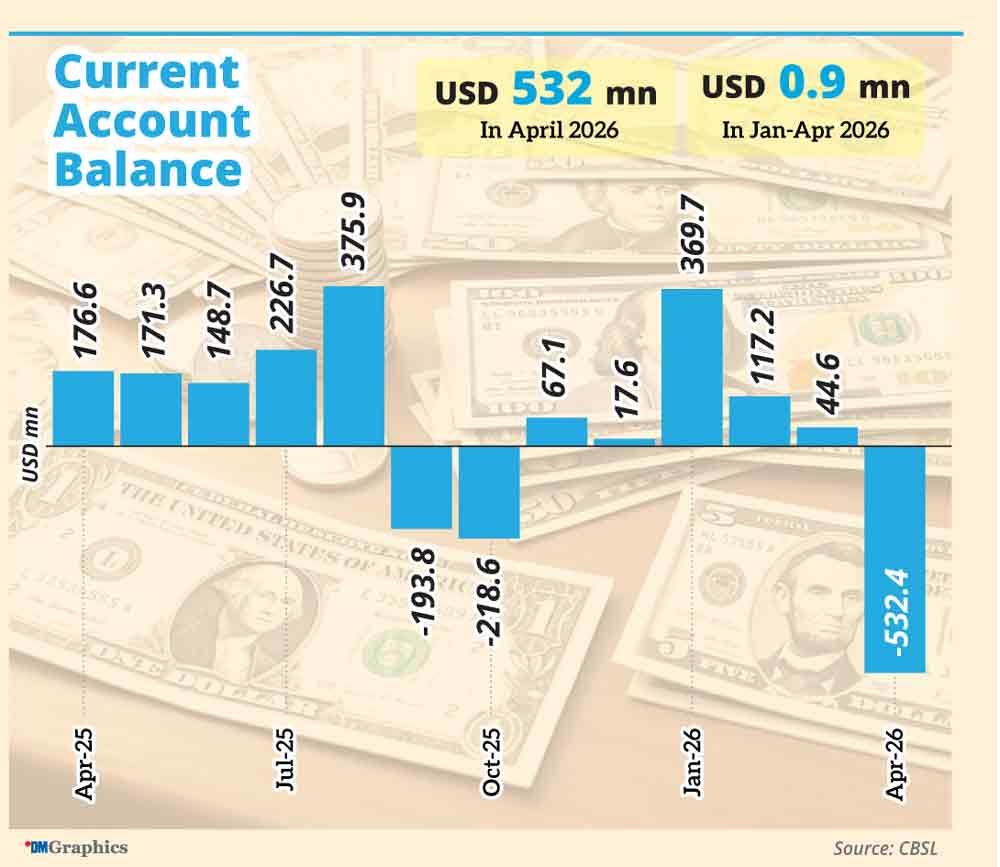
Sri Lanka’s external sector faced severe renewed pressures in April 2026, with the current account slipping into a deficit of US$ 532 million, largely driven by the escalating conflict in the Middle East.
According to the latest data from the Central Bank of Sri Lanka, this reverses the positive trend observed during the first quarter of the year. Notably, this marks the first monthly current account deficit the island nation has recorded since October 2025, which saw a shortfall of US$ 218.6 million.
Furthermore, historical quarterly data indicates that the April contraction stands as the most significant current account shortfall since the height of the economic crisis in early 2022, which saw a massive deficit of US$ 1,331 million in the first quarter.
The April contraction dragged the cumulative current account balance for the first four months into a marginal deficit of US$ 0.9 million, a sharp turnaround from the robust surplus of US$ 1,124 million recorded in the corresponding period of last year.
The deteriorating current account position was primarily fuelled by an aggressive expansion in the merchandise trade deficit, which widened to US$ 1,383 million in April 2026 compared to US$ 717.7 million a year earlier. While merchandise exports showed a resilient growth of 10.9 percent year-on-year to hit US$ 1,074 million, the gains were completely overwhelmed by a sharp 45.7 percent surge in import expenditure, which climbed to US$ 2,457 million. Cumulatively, the trade deficit for the January-April period widened to US$ 3,693 million from US$ 2,257 million in 2025.
A major driver of this import spike was the global energy crisis sparked by the Middle Eastern geopolitical tensions, which pushed Sri Lanka’s monthly fuel import bill up by 149.9 percent year-on-year to US$ 886 million. In addition, a resurgence in vehicle imports further strained foreign exchange outflows, with expenditure on motor vehicles reaching US$ 208 million in April, bringing the four-month total to US$ 821 million.
This dramatic rise in import costs caused a notable deterioration in the country’s terms of trade, as import prices significantly outpaced export price gains.
The services sector, which usually provides a crucial buffer, saw its net surplus contract by 37.8 percent year-on-year to US$ 229 million in April. This decline was primarily triggered by a slump in the tourism industry, where arrivals fell for the second consecutive month to 135,643, marking a 22.3 percent contraction as regional tensions deterred travelers.
Consequently, monthly tourist earnings plunged 38.8% to US$ 157 million, while cumulative earnings for the first four months dipped by 19.4 percent to US$ 1,111 million. Other key segments, including computer and IT/BPO services, also faced headwinds, with cumulative inflows falling by 10 percent to US$ 237 million.
Providing a vital lifeline to the external balance, workers’ remittances maintained their positive momentum, increasing by 18.8 percent year-on-year to US$ 768 million in April. The Central Bank noted that this figure may include additional inflows received in the aftermath of Cyclone Ditwah.
On a cumulative basis, remittances for the first four months surged by 24.5 percent to US$ 3,063 million. Conversely, capital markets showed mixed results; the Colombo Stock Exchange suffered a net foreign outflow of US$ 16 million during April, while the government securities market managed to attract a marginal net inflow of US$ 2 million.
Gross official reserves stood at US$ 6.8 billion at the end of April 2026, a figure that includes the ongoing swap facility with the People’s Bank of China. This buffer was maintained despite substantial external debt service payments and net foreign exchange sales by the central bank to manage market volatility.
Reflecting these intense external pressures, the exchange rate for the Rupee depreciated by 5.4 percent against the US dollar on a year-to-date basis by the end of May 2026. However, macro-critical support arrived on May 27, when the International Monetary Fund Executive Board successfully completed the combined fifth and sixth reviews under the Extended Fund Facility, granting Sri Lanka immediate access to roughly US$ 695 million to shore up economic policies and reforms. (NF)