Reply To:
Name - Reply Comment
 In a significant move for Sri Lanka’s technology sector, Mats Hultin, the former CIO of global telecommunications giant Ericsson, has joined the Board of Directors of Rootcode, one of the nation’s most promising advanced technology firms. This strategic partnership signals a new phase of ambitious global expansion for the company. With a distinguished career spanning over three decades at the pinnacle of the tech industry, Hultin brings a wealth of experience in scaling large organizations and navigating the complexities of the global market. His decision to invest his expertise in a Sri Lankan company underscores the growing recognition of the nation’s tech talent and potential. Rootcode, founded by CEO Alagan Mahalingam, has already carved a niche for itself by tackling complex, high-stakes technology projects for international clients, including several European governments—a feat rarely achieved by firms from the region. Mirror Business sat down with Mats Hultin and Alagan Mahalingam for an exclusive discussion. Hultin shared his impressions of Sri Lanka’s evolving tech landscape, his strategic vision for Rootcode, his insights on the transforming role of the CIO, and his blueprint for helping Rootcode achieve a multi-billion dollar valuation. Below are the excerpts of the discussion.
 QMats, welcome to the Rootcode board. Having last visited Sri Lanka 15 years ago, what are your impressions of the country’s technology landscape today, and what potential do you see?
Mats Hultin: Thank you. It’s wonderful to be back. I’ve always had very good experiences in Sri Lanka, but the change I see now after 15 years is significant. Previously, I observed a lot of service-oriented build-up in the tech industry here. What I see now, especially through my engagement with Rootcode, is a very modern, front-edge technology company. This isn’t just about services anymore; it’s about pioneering with advanced technology, which is thrilling.
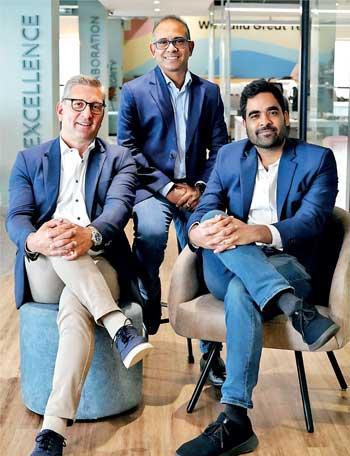 |
| From left: Mats Hultin, Mangala Perera (Rootcode Partner and COO) and Alagan Mahalingam |
Knowing the high skill level that exists in Sri Lanka, seeing a company like Rootcode operate at this front-edge tech level is incredibly exciting from a national perspective. It signals a huge opportunity for the country to position itself not just as an outsourcing destination, but as a hub for genuine tech innovation.
QWhat do you identify as the primary strengths of Sri Lanka in terms of its talent pool, innovation, and agility?
Mats Hultin: What I’ve experienced is a foundation built on very good universities that produce great people with initiative, drive, and a deep interest in technology. That is the fertile ground you need to build upon. Of course, you then need entrepreneurs like Alagan to channel that talent into something that truly works and creates value on a global scale.
Beyond just technical skills, I feel that Sri Lanka has a generally quite broad set of skills, which reminds me of my home country, Sweden. This broad skill set has helped Sweden produce numerous successful companies. I see that same potential here. It’s the ability to not only execute on pre-defined processes but to evolve, develop, and innovate. It’s about having teams that can drive projects, deliver exceptional customer experiences, and work together to achieve common goals. Looking at Rootcode, I see how their teams are built with the right culture, empowering them to drive their own success in close integration with customers and leadership. That capability is a powerful asset for Sri Lanka.
QTo fully realize this potential, what are the key challenges that Sri Lanka must overcome as an industry and a nation?
Mats Hultin: In any tech development journey, there are always numerous challenges. It’s similar to what I’ve seen in Sweden. You need to have many forces playing together harmoniously. You have the educational assets, but that’s just the start. You need to actively drive innovation. This means finding and supporting entrepreneurs—not just financially, but also politically. The right infrastructure must be in place to support this growth, and critically, you need to be able to bring that local knowledge and capability into the global arena.
If we look at the region, India has grown immensely from what I would call traditional outsourcing. Now, they face the challenge of moving towards more technology-driven development because automation and AI are becoming even cheaper than traditional outsourcing for many tasks. Robots won’t be doing advanced, creative development work anytime soon. This is where Sri Lanka has a golden opportunity. By focusing on high-end, complex development, as Rootcode is doing, the country can spearhead a new kind of value proposition that is resilient and highly sought after.
QOn that note, what specific technologies should Sri Lanka focus on? Is it AI, or something else?
Mats Hultin: I believe the focus should be exactly on what Rootcode does: advanced, complex development work. If a company approaches me today offering standard services, it’s not compelling. There are hundreds of established global players in that space. But if someone comes and demonstrates that they are using the latest technology, that they are proficient in AI, and that they are building modern, sophisticated systems—backed by great customer references like Rootcode has—that commands attention. There is a huge demand for this in the market. To deliver that in an affordable, high-quality, and customer-centric way is very rare, and that is the niche Sri Lanka should aim to dominate.
QWhat specific role should policymakers and industry leaders play to foster this growth?
Mats Hultin: There are two critical things. First, it’s essential that policymakers have direct access to technology advisors. You cannot create effective policies for the tech industry without a deep understanding of the technology itself. For many years, my role as a CIO was to be that technology leader and advisor within a company. Governments need a similar function to ensure policy is informed and enabling.
Second, policies must be designed to support and simplify the journey for entrepreneurs. This involves everything from simplifying regulations to actively supporting local companies in the global arena. It’s about nurturing the entrepreneurial community that already exists and helping it to flourish.
QWhat personally compelled you to join Rootcode’s Board of Directors and work with Alagan?
Mats Hultin: It was a combination of circumstances and what I discovered as I got closer to the company. We were introduced through mutual acquaintances, and when Alagan and I met, I felt a really strong connection to his leadership, the culture he is driving, and the company’s vision. When I learned about some of their customers and heard the testimonials, I was truly impressed. I felt that if I could be a small part of helping this company grow and contribute to Alagan’s journey, I would love to do that.
QYou mentioned impressive work. Can you share an example that stood out to you?
Mats Hultin: I’m impressed by several projects, but the one that truly stands out is their work with the Estonian government. Being from Europe, I know a bit about how that country and government operate. They are extremely tech-forward, demanding, and at the forefront of digital governance. For a Sri Lankan company to not only break in but to deliver major projects for them is one of the best “proof in the pudding” moments you can have. Rootcode succeeded by providing an exceptional user experience with the right technology, delivering on time, and maintaining a very competitive cost structure. That entire relationship is an amazing customer case.
Alagan Mahalingam: To add to that, I think we might be the only Sri Lankan company currently executing European Union government contracts. We work with Estonia, Portugal, and the Czech Republic on projects that are generally reserved for very large European and American firms. Looking back, it’s even a surprise to us that we managed to pull it off. But what customers appreciate is exactly what Mats mentioned: our focus on user experience and our commitment to ensuring our clients—even governments—succeed by solving some of the toughest technological problems that exist. We don’t do simple work; we only take on complex, advanced technology challenges.
QMats, what will your role be at Rootcode, and how do you plan to help the company achieve its vision?
Mats Hultin: I hope to help primarily by expanding the company’s network and by being a strategic advisor and sounding board for Alagan and the leadership team. I can bring some of my experience to the table. I have a huge network in the tech industry, particularly in Europe, and I want to leverage that to open new doors for Rootcode.
Alagan Mahalingam: Mats has led companies with 40,000, 60,000, even 80,000 employees. That’s the scale we eventually want to reach. He will be that crucial advisor for me and the company as we navigate that path to becoming a multi-billion dollar entity.
QShifting topics, the role of the CIO has changed dramatically. How do you see its transformation, and what is the function of a CIO today?
Mats Hultin: It’s an interesting topic. We now have a plethora of acronyms: CDO (Chief Data Officer or Chief Digital Officer), CIO (Chief Information Officer), Chief AI Officer. I believe every company still needs a CIO, but I’ve started proclaiming that the title should perhaps mean Chief Integration Officer.
The CIO’s role is evolving from simply delivering IT services to the business to ensuring seamless integration—between departments, with customers, and among partners, all orchestrated through technology. Specialized functions like AI and data shouldn’t be siloed in one department; they need to be everywhere. The CIO’s crucial role is to integrate these capabilities in a safe, meaningful, and interoperable way. They are the orchestrator, providing the platforms that enable end-to-end automated solutions, which is where the real value of technology is unlocked.
QHow critical is that ‘Chief Integration Officer’ role for a developing country like Sri Lanka?
Mats Hultin: It’s extremely important. Whether in government or large corporations, you need someone who is aware of technology but doesn’t just talk technology. They must talk about how technology can be used to solve real-world problems. Their job is to prevent a scenario where each department builds its own little solution that doesn’t work with anything else. The most intelligent and valuable services are those that are integrated across multiple parts of an organization or a government administration. This integrated approach is vital for any country aiming to be globally competitive.
QWhere do you see Rootcode in the next five to ten years?
Mats Hultin: I see huge growth, grounded in a continued commitment to customer excellence. That is paramount. I also see them continuing to embrace what Alagan mentioned: not stepping back from a challenge and tackling the hard questions. It’s about having a mindset to “imagine possible” rather than being constrained by today’s reality.
Alagan Mahalingam: Our ambition is to grow 5 to 10 times, or even more. The world needs more organizations capable of complex, advanced development. While much of the traditional software engineering and outsourcing industry may struggle with the rise of AI, we are well-positioned. We have always focused on complex work that is genuinely hard for AI to replicate. We will continue to innovate, taking on bigger and more interesting challenges that will solidify our place as a leader in the industry.
QAlagan, does this journey include a focus on Sri Lanka’s public sector?
Alagan Mahalingam: Absolutely. We have been in discussions with key stakeholders executing Sri Lanka’s digital transformation, sharing our experience from doing similar work for European governments. We have pledged our full support. However, we have made a policy decision: we do not want to take on paid engagements with the government. We grew because of Sri Lanka, and we want to give back. Our plan is to contribute our expertise on a pro bono basis, helping the nation in its transformation journey in any way we can.
QFinally, any closing thoughts on this new chapter?
Mats Hultin: I must say, I am genuinely glad. When I decided to step back from my operational roles after more than 35 years, I knew I wanted to work with growth companies. Working with Rootcode provides great energy and is a fantastic experience for me. I am very positive about the future opportunities. And on a personal note, Sri Lanka is a beautiful country, and I truly enjoy being here and supporting its growth.
Alagan Mahalingam: I am personally thrilled that global tech leaders like Mats are willing to help not only companies like ours but Sri Lanka as a whole to reach the next level. Having him as part of our journey is an incredible honour, and we are very excited about what we will build together.