
Reply To:
Name - Reply Comment
BY Nishel Fernando
Reporting from Mumbai, India
|
Vala Afshar |
The global business landscape is currently undergoing a seismic shift, driven by a technological evolution that is fundamentally rewriting the rules of corporate engagement, software architecture and productivity. We are entering an era that transcends traditional automation, moving rapidly into a space where software possesses reasoning logic, adaptability and autonomy.
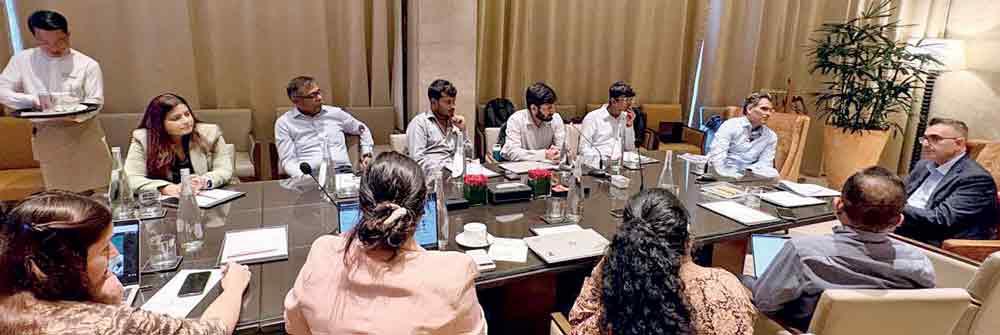
Capturing the sheer gravity of this moment during a recent media roundtable in Mumbai, Salesforce Chief Digital Evangelist Vala Afshar delivered a stark assessment.
“This is the 10x impact of the Industrial Revolution at 1/10th the speed,” he observed, urging corporate leaders to recognise that artificial intelligence (AI) is no longer a peripheral IT experiment but the foundational infrastructure of the next economic era.
For the mid-sized economies and agile corporate sectors like Sri Lanka’s—particularly across capital markets, tourism and real estate—the advent of agentic AI presents a unique opportunity for strategic leapfrogging. When questioned directly on how a mid-sized country such as Sri Lanka could strategically utilise agentic AI to its advantage, Afshar reframed the geographical and economic scale of a nation not as a limitation but as a distinct competitive advantage.
He noted that the true power of this technology lies in democratising access and doing it at scale. Because enterprise-grade cloud platforms provide the exact same foundational architecture to all users, a local enterprise has access to the same technological plumbing as a massive global conglomerate.
“You as a small business can now compete with the largest competitor in your space,” Afshar explained.
“It’s the same plumbing. So, you have no disadvantage based on the size of your business if you’re using our platform. We scale to your needs. And so, I think the greatest gift in all of this is a small business can have all of the incredible powers that a large enterprise has because you’re now using digital labour.”
Indian blueprint for scale, stem and start-ups
To understand the velocity of this transformation in the South Asian region, one only needs to look across the Palk Strait. When assessing the readiness of a market to adopt agentic workflows, Afshar pointed to India as a formidable blueprint for regional growth. The macroeconomic indicators are staggering but it is the underlying digital infrastructure and talent pipeline that are truly accelerating AI adoption.
“You’re going to be a US $ 5 trillion economy sometime next year. By 2030, one-fifth of that, a trillion of that economy, was going to be digital economy,” Afshar noted, contextualising the sheer scale of the market.
But the real engine of this growth is human capital.
“You’re graduating 10 million in total out of your colleges and universities annually. That’s three times more than the US.”
This massive influx of STEM talent is directly fuelling an explosion in innovation. Afshar highlighted that India boasts 131 unicorns, making it the third-largest start-up ecosystem in the world, trailing only the US and China. Critically, of the hundreds of start-ups being monitored by tech giants, a massive proportion are natively focused on AI.
This regional momentum serves as a powerful indicator for Sri Lankan corporates. The geographical proximity to the world’s most aggressive AI proving ground means that regional business models, integration partners and talent pipelines are evolving right on our doorstep.
Powering regional growth through Salesforce economy
The tangible impact of this technological shift is perhaps best illustrated by the immense economic footprint companies like Salesforce are establishing in the region. The transition to digital labour is not just a software upgrade; it is the creation of entirely new macro-economies. “According to IDC, the Salesforce economy alone will add US $ 89 billion of new revenue to India by 2028,” Afshar revealed.
This staggering projection is supported by an aggressive grassroots democratisation of tech education.
“We work with 3,000 colleges and universities in India. We have three million learners on our Trailhead platform. We have two million developers in India that are using the Salesforce platform.”
By building an army of certified developers and practitioners, Salesforce is ensuring that the transition to agentic enterprises is supported by local, highly skilled talent—a strategy that mid-sized markets like Sri Lanka must aggressively emulate to build domestic capabilities.
Understanding technical architecture of autonomy
To truly grasp the magnitude of the agentic wave, tech leaders must understand the fundamental redefinition of software architecture. For decades, the technology industry built applications and handed them to humans strictly as tools. The agentic wave radically alters this, presenting software that you can onboard as a digital colleague.
However, the deepest technical shift lies in how these agents interact with core systems. Afshar detailed a profound architectural evolution involving the removal of the traditional human user interface. He drew a compelling parallel to the physical AI evolution seen in autonomous vehicles.
While early iterations of self-driving cars, like those from Waymo, still feature steering wheels and pedals—a legacy of human-first design—the latest iterations, such as Amazon’s Zoox or Tesla’s Cybercab, are built with no steering wheel, no gas or brake.
Enterprise software is undergoing the exact same AI-first design transition.
“We removed all the human user interfaces with our announcement a couple of weeks ago,” Afshar stated, referencing the launch of Headless Agentforce 360.
“Because 25,000 customers using agents, those agents need to connect to our platform through an API, use Model Context Protocol, MCP servers and we’ve got about 60 MCP servers and those agents can get the information they need and the rules they need to execute tasks for their companies.”
This means tomorrow’s enterprise applications are being built explicitly for machine-to-machine consumption. Agents will communicate directly via APIs and MCP servers to orchestrate complex workflows across sales, marketing and service silos without a human ever logging into a dashboard.
Relational transformation and preparing beyond pilot
A critical pitfall for many enterprises is overestimating short-term AI gains while severely underestimating the profound organisational changes required prior to adoption. The integration of digital labour is not merely an IT procurement exercise; it demands a fundamental restructuring of how a business operates.
Addressing the tendency of companies to seek quick wins without long-term structural alignment, Afshar warned that the messy beginning, middle and ongoing journey is a relational transformation.
“This wasn’t a technology journey,” he explained.
“How do humans and intelligent hardware, software coexist? What is the notion of digital labour? Can we really view software as a colleague?”
To prepare for this shift, corporates must move beyond the safety of isolated research and development testing.
“One thing I’m going to say is you do need to have long-term thinking about this. This is not success in a pilot,” Afshar stressed.
“It’s nice that a pilot works. But you score points when it’s in production.”
Companies that succeed are those that understand the concept of a minimum viable agent, ensuring the AI has demonstrated enough contextual understanding of the specific business data and governance rules to operate with determinism rather than probabilistic guesswork. This requires redesigning processes, reskilling the human workforce, redeploying talent to higher-value tasks, restructuring the company hierarchy and recalibrating performance metrics.
Recalibrating productivity through tokenomics and real-world impact
As corporates integrate these headless systems, measuring productivity requires a complete recalibration. In the world of AI, computational tokens have become the new currency of corporate efficiency.
“Tokens are the Lego building blocks of how to use language models to actually empower agents to complete tasks,” Afshar detailed.
“Salesforce last year retired 12.3 trillion tokens in the course of all of last calendar year. We might reach that number in two months this year.”
However, raw token volume is meaningless without execution. Salesforce tracks Agentforce work units, which are instances where a token is actively used to autonomously execute a discrete business task. The real-world impact of these work units is already staggering.
Afshar shared a defining metric from Salesforce’s own internal operations, noting that “3.5 million cases at help.salesforce.com have been opened and closed with zero human intervention. This is only a year-old capability. With a 77 percent first contact resolution”.
For any executive who has managed a call centre, a 77 percent resolution rate handled entirely by digital labour is a paradigm-shattering statistic. It represents the ultimate cognitive transfer—shifting high-volume, low-impact work to software so human employees can be redeployed to higher-value, strategic roles.
Boardroom of tomorrow with AI CEOs and super agents
As agentic capabilities mature, the relational transformation extends far beyond customer service bots and enters the upper echelons of corporate governance. We are rapidly approaching a reality where the traditional hierarchy of human management is completely reimagined. Afshar introduced the concept of super agents and hierarchies of digital labour, where management agents are responsible for overseeing subordinate agents. This structural evolution inevitably leads to profound questions about executive leadership.
“Will we see a CEO agent? Will we see board members that are agents? Certainly, in our lifetime. My opinion,” Afshar stated, offering a provocative glimpse into the future of corporate governance.
The groundwork for this reality is already being laid in today’s executive suites.
“I already know that most senior executives of companies that I advise have personal agents. They pressure test their forecasts, competitive intelligence, business partners, investments in start-ups and it’s remarkable to see.”
For Sri Lankan boards and C-suite executives, the message is clear that digital labour will soon transition from operational execution to strategic advisory, fundamentally altering how multi-million-rupee decisions are evaluated and executed.
Cooks versus chefs in overcoming cultural barrier
Despite the clear operational advantages, the primary barrier preventing companies from embracing this shift is rarely technological; it is deeply cultural. To successfully integrate intelligent software as a colleague, companies must undergo a complex relational transformation.
“I think that you need to have a safe space with emerging technology,” Afshar explained.
“People are not afraid of failure; they’re afraid of blame.”
This transformation requires a fundamental shift in how workforces approach problem-solving. Afshar utilised a powerful culinary analogy to describe this necessary mindset, differentiating between a cook and a chef. A cook relies entirely on a provided recipe, executing functional specifications flawlessly but floundering if the instructions are removed. A chef operates from first principles, tasting ingredients, mixing them with courage and experimenting to create something new.
For too long, businesses have operated like cooks using outdated legacy IT models. To survive the agentic era, Sri Lankan corporates must cultivate workforces that think differently.
“Please don’t be a cook. We all have to be chefs,” Afshar urged.
“And that means having the courage to throw away old recipes. And that’s going to be the hardest part because humans are reluctant to change.”
Trust layer and governance in AI era
As consumer-facing industries lead the charge in AI adoption, the issue of trust becomes paramount. An enterprise can spend decades building a reputation, only to see it unravel through a single, poorly governed automated interaction. For enterprise-grade agentic AI to function effectively, it must be built upon an absolute foundation of governance.
Afshar outlined the rigorous scientific and ethical guardrails required. Enterprise systems must deploy sophisticated trust layers that scrub input and output prompts for toxicity and bias.
“Humans have 150 biases. So, we look for bias detection,” he noted.
Crucially, they must employ stringent data security measures.
“We look for data masking. So, I’m not going to have your email, your telephone number, your home address and we have zero retention. We may want to have certain information about you to give you a certain service but once that service is complete, we erase all knowledge of you.”
“I’m not going to delegate my brand and my promise to software unless I’m convinced that it can operate not just as good as our human but even better,” Afshar concluded.
The path forward for Sri Lankan enterprises aiming to ride this technological surge is unambiguous. With foundational elements such as API protocols, headless agents and expansive computational scaling already reshaping neighbouring markets such as India, the necessary infrastructure for constructing autonomous businesses is fully accessible.
To successfully transition into this nascent economic period, local firms must now prioritise adopting the rapid pace of digital labour, fostering a mindset of bold innovation and implementing rigorous digital trust protocols.