Reply To:
Name - Reply Comment
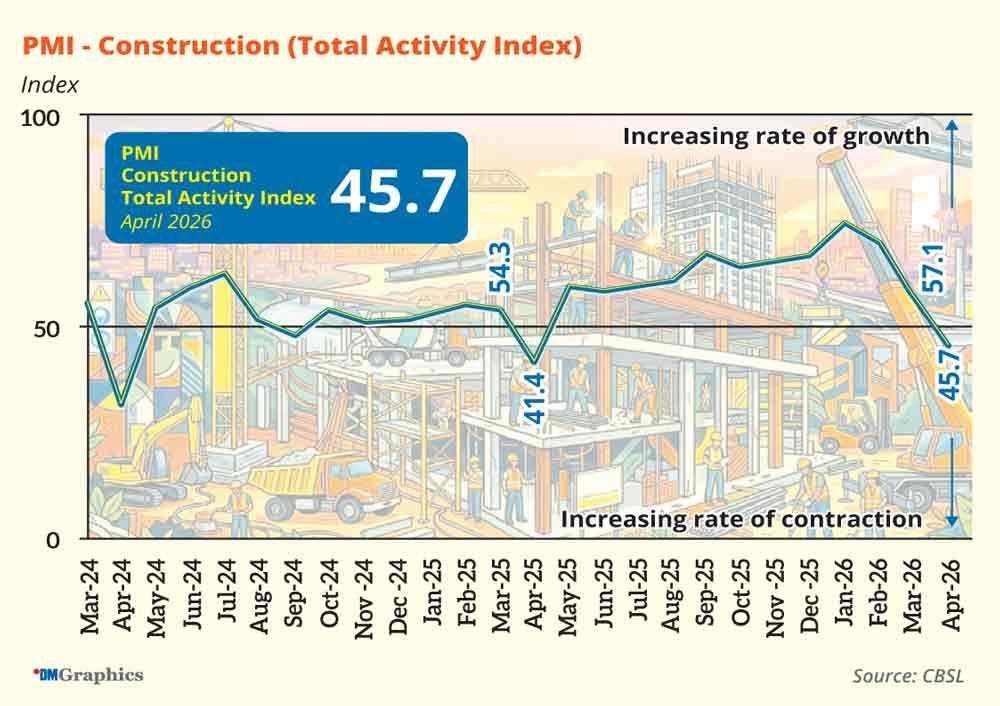
The construction sector in Sri Lanka experienced a sharp contraction in April 2026, with the Purchasing Managers’ Index (PMI) for Construction, measured by the Total Activity Index, plunging to 45.7 from the 57.1 recorded in March.
According to the latest report issued by the Statistics Department of the Central Bank of Sri Lanka, the deceleration was primarily driven by the seasonal slowdown associated with the Sinhala and Tamil New Year holidays. However, the domestic industry is increasingly grappling with compounding external headwinds, particularly rising material costs and supply chain disruptions linked to geopolitical tensions.
A major concern highlighted by industry stakeholders is the escalating cost of raw materials, largely fuelled by the ongoing conflict in the Middle East. Construction firms reported acute shortages of key inputs, particularly petrochemical-based raw materials, which are challenging the timely execution of planned work.
These rising costs are threatening to disrupt future project pipelines, as multiple survey respondents noted that several new projects could face delays because surging raw material prices are forcing contractors into price renegotiations. Reflecting this slowdown in procurement and lower levels of overall activity, the Quantity of Purchases Index dropped significantly to 42.6 in April from 55.7 in the previous month.
This sudden reversal from expansion to contraction closely mirrors seasonal trends observed in previous years, illustrating the significant impact of the April holiday season on local economic operations.
For instance, historical data shows that in April 2025, the index experienced a similar contractionary drop to 41.4 from 54.3 in March 2025.
While the current drop to 45.7 is slightly less severe than the festive dip of the previous year, the operational environment remains pressured by logistics as the Suppliers’ Delivery Time Index continued to lengthen, holding steady at an elevated 71.4 across both March and April 2026.
Despite the temporary drop in headline activity, the underlying demand for construction infrastructure remains resilient. Most firms reported a steady availability of projects, heavily supported by ongoing road rehabilitation activities, which kept the New Orders Index in expansion territory at 62.9, albeit down from 67.2 in March.
This project pipeline also sustained the Employment Index in expansion territory at 55.9, indicating that firms are still actively recruiting. However, actual execution continues to face a major structural challenge, with widespread shortages reported across almost all skilled labour categories.
Sri Lanka’s construction slowdown aligns with a broader international downturn, as the global outlook for the sector remains weak. Major European economies, including the United Kingdom, Germany, France, Italy, Ireland, and the broader Eurozone, all reported falling construction activity at a higher rate.
Looking ahead, local construction firms maintain a positive business sentiment for the next three months, anchored by the consistent flow of domestic projects. Nevertheless, the Central Bank noted that this medium-term optimism remains heavily clouded by lingering anxieties over volatile geopolitical developments. (NF)