Reply To:
Name - Reply Comment
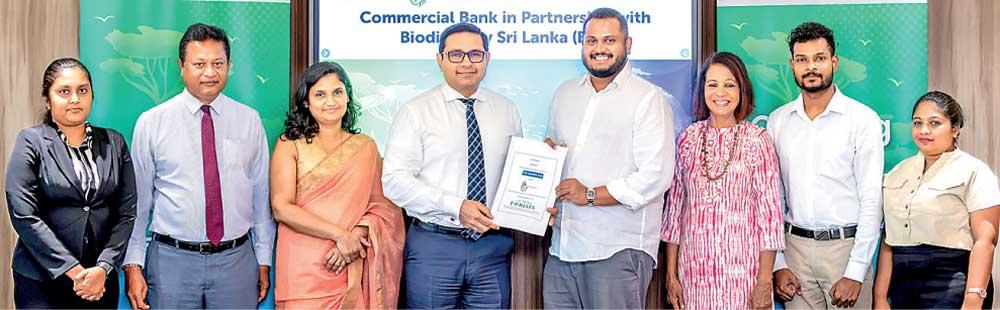
Sanath Manatunge, Managing Director/CEO of Commercial Bank and Dmitri Cooray, Director Biodiversity Sri Lanka and Managing Director - Jetwing Hotels, exchange the agreement in the presence of senior representatives of the two institutions
Driven by its commitment to creating a sustainable future, the Commercial Bank of Ceylon has embarked on a significant new chapter in its sustainability journey, undertaking the restoration of a degraded section of the Kanneliya Conservation Forest in Galle, and reinforcing its commitment to environmental stewardship and nature-positive growth.
To be executed in partnership with Biodiversity Sri Lanka (BSL), a private-sector-led organisation dedicated to advancing corporate environmental stewardship, the initiative forms part of the wider ‘LIFE to Our Forests’ programme, an ambitious, multi-stakeholder effort to rehabilitate degraded forest ecosystems across Sri Lanka. Monitoring and evaluation of the Kanneliya project is to be provided by the International Union for Conservation of Nature (IUCN), ensuring that the restoration aligns with globally recognised scientific standards and best practices.
In parallel with the celebration of World Earth Day 2026, the signing of this agreementpaves the wayfor the launch of the project to restore one hectare of degraded rainforest within the Kanneliya Forest Reserve, a UNESCO-designated biosphere reserve and one of South Asia’s richest floristic regions.
The selected site, currently overrun by the fern species Dicranopteris linearis (locally known as ‘Kekilla’) which has potential invasive characteristics, will undergo a comprehensive, science-based rehabilitation process, the Bank said.
Structured over a six-year period from 2026 to 2032, the initiative will commence with an initial phase spanning 2026 to 2028, encompassing site preparation and early-stage restoration, followed by long-term ecological monitoring and enhancement.
The restoration strategy integrates the systematic removal of kekilla fern, the establishment of nurseries, the planting of native and pioneer species, and interventions to improve soil quality and habitat conditions. Measures to prevent forest fires and ensure continuous ecological monitoring will further strengthen the resilience and sustainability of the restored ecosystem.
BSL is currently leading the implementation of the project, actively carrying out restoration and monitoring activities in line with the guidelines and scientific methodology provided by IUCN.
A notable feature of this initiative is the attempt to develop a National Biodiversity Credit Accrual System in Sri Lanka, representing an innovative step towards integrating conservation outcomes with market-based financing mechanisms. The restoration of this critical rainforest habitat is expected to generate far-reaching environmental benefits, including enhanced biodiversity, improved water retention, strengthened soil stability, and increased ecological connectivity.
Beyond its environmental impact, the project also contributes to socio-economic development within surrounding communities. By engaging local villagers as part of the workforce for restoration and monitoring activities, the initiative generates meaningful employment opportunities and supports livelihood enhancement. This inclusive approach ensures that conservation efforts are closely aligned with community development, fostering a sense of ownership while delivering long-term social and economic benefits to the region.