Reply To:
Name - Reply Comment
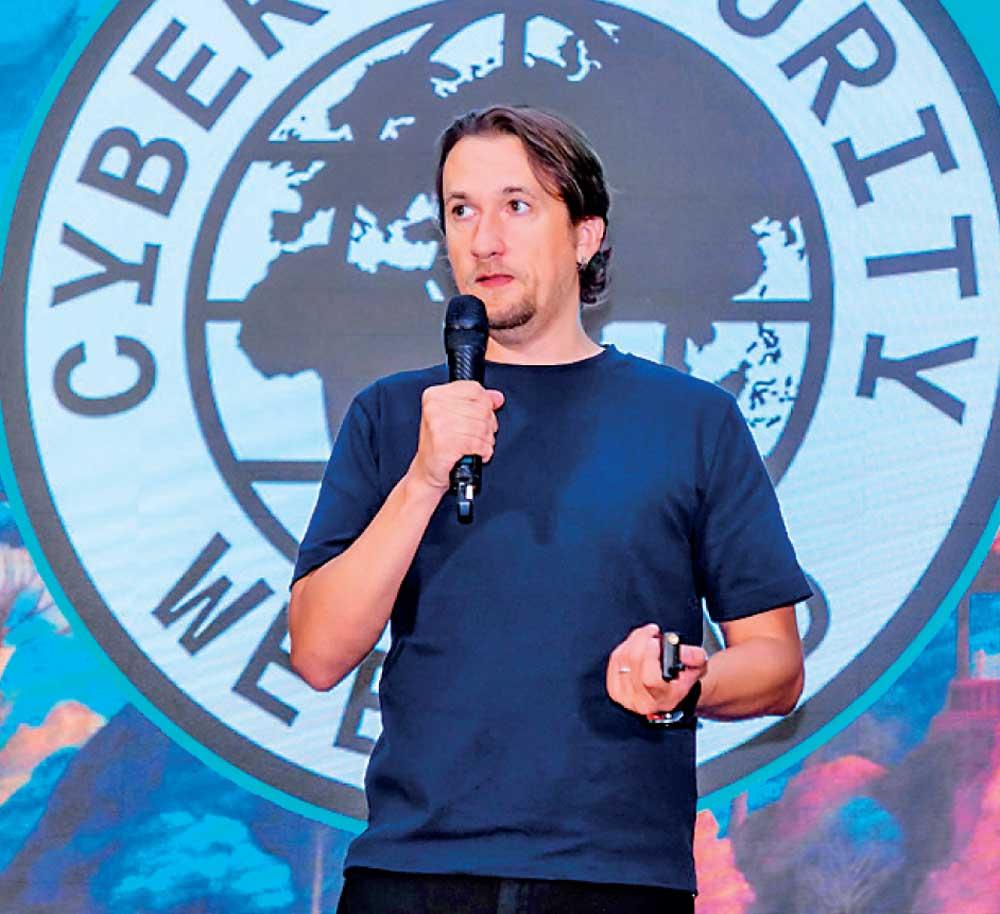
Head of Kaspersky’s Global Research and Analysis Team for META and APAC Sergey Lozhkin
 In the bustling halls of the recent Kaspersky APAC Cyber Security Weekend, a presentation by one of the company’s top researchers casts a long, futuristic shadow over the proceedings.
Quantum computing is rapidly becoming a tangible reality, not a distant science fiction concept. The Asia Pacific (APAC) region is proving to be a fertile ground for this revolutionary technology, a point emphasised during a discussion that powerfully conveyed both the excitement and serious implications of the quantum era.
According to Kaspersky, the APAC quantum computing market is on a steep growth trajectory, projected to soar from US $ 392.1 million last year to US $ 1.78 billion by 2032.
“This is both exciting and worrying,” said Sergey Lozhkin, Head of Kaspersky’s Global Research and Analysis Team for META and APAC.
“Organisations here should remember that quantum computing is the next cyber frontier. It could unlock groundbreaking innovations but also usher the region to a new era of cybersecurity threats.”
Lozhkin, whose elite GReAT team was established in 2008 and now comprises over 30 experts globally, laid out a future where the very foundations of digital security are at risk. For businesses, governments and entire nations, the question is no longer if they need to prepare but how they will survive a post-quantum world where today’s encrypted secrets could become tomorrow’s open books.
Silicon Ceiling: Moore’s Law and end of an era
For over half a century, the digital world has been propelled by the relentless pace of Moore’s Law, the principle that the density of transistors on a microchip would double approximately every two years. This exponential growth fuelled a virtuous cycle of innovation, making our devices smaller, faster and more powerful. However, this engine of progress is sputtering.
“Basically, we are now almost at the end of the transistor density,” Lozhkin explained in his speech.
“The companies who produce microchips, processors, they would double the amount of transistors. But right now, we are coming to the point where the processors are reaching the final stages.”
The reasons are a matter of fundamental physics. Transistor sizes now approach the atomic scale, making further miniaturisation profoundly challenging. This physical barrier is compounded by two other critical limitations:
Thermal Ceilings: High-performance processors have become “super hot”, as Lozhkin put it, generating so much heat that cooling them effectively is a major engineering hurdle. “Silicon tech has hit thermal and size limits.”
Performance Plateaus: The once-dramatic increases in processor clock speeds have levelled off, stabilising around the 3 to 5 GHz mark for the better part of a decade. As Lozhkin humorously pointed out, “Remember 15 years ago, you need to buy a new something every year... But right now you don’t need to upgrade it.”
This slowdown is more than an inconvenience; it represents a bottleneck for scientific research, economic modelling and artificial intelligence—fields that hunger for ever-greater computational power. This is the wall that quantum computing promises to tear down.
Quantum leap: A new computing dimension
Quantum computing is not merely a more powerful version of a classical computer; it operates on an entirely different set of principles. A classical computer processes information using bits, which exist in one of two states: 0 or 1. A quantum computer, however, uses qubits. As Lozhkin simply described it, a qubit “could be both zero and one at the same time” in a state of superposition.
This property, combined with another quantum phenomenon called entanglement, grants quantum computers an almost unimaginable processing advantage for certain types of problems. The world has already seen glimpses of this power. Between 2019 and 2022, research teams achieved “quantum supremacy”, where a quantum device performed a calculation that no classical computer could feasibly complete. Notable examples include Google’s 53-qubit Sycamore quantum processor and China’s photonic quantum computer Jiuzhang.
However, the technology remains in its infancy. “Remember the computers of the... 1950s... they were big boxes fit into the room,” Lozhkin analogised.
“Same with the quantum processes. Now, they are huge boxes, with a lot of cooling systems, sterile environment, very complicated.”
These early capabilities exist largely in laboratory settings, making the timeline for both threats and benefits uncertain.
The key challenge lies in scaling. To become a true cryptographic threat, a quantum computer will need “thousands of logical, millions of physical qubits”. Today’s best machines have only hundreds. The timeline? Lozhkin estimates it is “theoretically within 10-15 years”. But he adds a crucial caveat: “Who knows what can happen with the help of AI? Maybe we will get something in five years or even less.”
A new breed of cyber threat
The immense power of quantum computing is a double-edged sword. At his talk, Lozhkin identified three of the most urgent quantum-related risks that demand immediate attention. The very properties that make it a scientific holy grail also make it a potential cryptographic apocalypse.
1. End of modern encryption
The most direct threat is that quantum computers could be used to compromise the traditional encryption methods that protect data across the globe. This is driven by algorithms such as Shor’s Algorithm, which is frighteningly efficient at factoring large numbers—the very problem underpinning the widely used RSA encryption standard. A sufficiently powerful quantum computer could break 2048-bit RSA encryption in minutes or hours, a task that would take a classical supercomputer millions of years. This poses a direct threat to global cybersecurity infrastructures, enabling the real-time interception and decoding of sensitive diplomatic, military and financial communications.
2. Store now, decrypt later: Key threat of coming years
Perhaps the most insidious current risk is the ‘Harvest Now, Decrypt Later’ strategy. Threat actors are already harvesting encrypted data today with the intention of decrypting it in the future, once quantum capabilities advance. This tactic could expose sensitive information years after it was originally transmitted, including diplomatic exchanges, financial transactions and private communications.
3. Sabotage in blockchain and cryptocurrency
Blockchain networks are not immune. Technologies like Bitcoin and Ethereum rely on the Elliptic Curve Digital Signature Algorithm (ECDSA), which is especially vulnerable to quantum attacks. Since a Bitcoin public key is exposed after the first transaction, a quantum computer could potentially derive the private key from this public information, allowing an attacker to drain the corresponding wallet. This threatens not only the currencies themselves but also the security of crypto wallets and the very integrity of the blockchain’s transaction history.
Looking ahead, a new front may open with the development of quantum-resistant ransomware. In this scenario, ransomware operators would adopt post-quantum cryptography to protect their own malicious payloads, making data recovery without paying a ransom nearly impossible by either classical or future quantum computers. It’s crucial to note, however, that at present, quantum computing does not offer a way to decrypt files locked by current ransomware.
Kaspersky’s preparedness for a post-quantum world
Faced with this paradigm-shifting threat, cybersecurity leaders such as Kaspersky, a global company founded in 1997 that now protects over a billion devices, are not standing still. The company’s GReAT team is actively researching and preparing for a post-quantum world.
This preparation revolves around the critical transition to Post-Quantum Cryptography (PQC)—a new generation of encryption algorithms designed to be secure against attacks from both classical and quantum computers.
“There are already existing quantum resistant algorithms,” Lozhkin noted, referencing vetted standards from bodies like the US National Institute of Standards and Technology (NIST), including KYBER, DILITHIUM and FALCON.
The global push for adoption is already underway, driven by government mandates like the White House memorandum in the US. Kaspersky’s role is not only to future-proof its own products but to guide its over 200,000 corporate clients through this complex migration and to foster coordination between the cybersecurity community, IT companies and governments.
National readiness
For a nation such as Sri Lanka, situated in the heart of the quantum-focused APAC region, the threat is not abstract. To safeguard its burgeoning digital economy, proactive preparation is a strategic necessity. Drawing on global best practices, Sri Lanka can forge a robust quantum-readiness strategy.
Sri Lanka could establish a National Quantum Working Group under the proposed Cyber Security Agency or the proposed Digital Authority in order to assess risks and develop a strategic roadmap. This involves conducting a cryptographic inventory of government and critical infrastructure systems, adopting international PQC standards such as NIST’s and fostering quantum-literate talent through university curriculum development. A phased, agile migration strategy for PQC implementation, including pilot projects and integrating “crypto-agility” into IT procurement, could also become crucial.
Verdict
The quantum transition is a marathon, not a sprint. But as Lozhkin emphasised, preparations must begin today because the most critical risk is already here.
“While practical quantum computers capable of breaking current encryption don’t yet exist, the threat is real because malicious actors can store encrypted data today and decrypt it once the technology matures,” he warned.
“The security decisions we make today will define the resilience of our digital infrastructure for decades. Governments, businesses and infrastructure providers must begin adapting now or risk systemic vulnerabilities that cannot be retroactively fixed.”