Reply To:
Name - Reply Comment
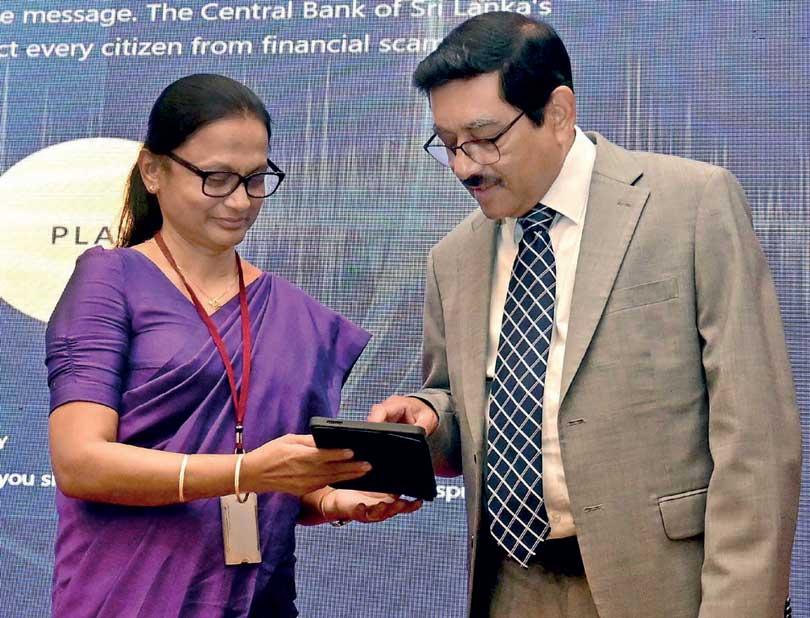 CBSL Governor Dr. Nandalal Weerasinghe (right) officially launching the ‘Be Scam Proof’ awareness campaign in Colombo
Pic by Kithsiri de Mel
The Central Bank yesterday warned that financial scams are emerging as a broader threat to confidence in Sri Lanka’s formal financial system.
It went on to warn that illegal investment schemes, pyramid operations and increasingly sophisticated digital fraud are eroding household wealth, weakening trust in regulated institutions and creating risks that extend beyond individual financial losses.
Launching the Central Bank’s month-long national ‘Be Scam Proof’ awareness campaign, Governor Dr. Nandalal Weerasinghe said financial fraud had evolved into a challenge with wider economic and social consequences, particularly for vulnerable communities with limited financial literacy and access to reliable information.
“These schemes and operations undermine the very trust in formal financial institutions that we have worked so hard to build,” Weerasinghe said.
The Central Bank, along with financial sector stakeholders, has been stepping up efforts to deepen financial inclusion and rebuild confidence in the financial sector following years of economic turbulence. While digital banking, mobile payments and online financial services have expanded rapidly, the regulator said fraudsters are increasingly exploiting both technological advances and gaps in public awareness.
The Governor noted that financial fraud in Sri Lanka is not solely a consequence of greater digital connectivity but is also driven by a persistent lack of public understanding of what constitutes a regulated financial institution and what falls outside the country’s legal and regulatory framework.
He observed that many consumers remain unable to distinguish between licensed financial institutions and illegal schemes, while even digitally savvy users continue to fall victim to phishing attempts, fraudulent links and scams involving one-time passwords.
According to Weerasinghe, financial scams are flourishing in the space between regulation and public awareness, allowing fraudsters to target both rural populations with limited access to financial information and urban consumers who increasingly rely on digital platforms for financial transactions.
The Central Bank identified illegal plantation schemes, deceptive high-return investment offerings, pyramid schemes and unauthorised deposit-taking operations among the major threats facing consumers.
The Governor warned that the damage caused by such schemes extends well beyond individual investors.
“They destroy the accumulated savings of entire communities and set back poverty reduction by years,” he said.
He noted that global evidence from institutions including the World Bank and the Financial Stability Board shows that financial fraud and consumer abuse not only erode household wealth but can also weaken trust in the financial system and undermine broader economic resilience.
The Governor further cautioned that periods of uncertainty often create favourable conditions for scammers.
“When people are desperate, when their defences are lowered, when they urgently need financial relief, those are the situations that scammers wait for,” he said.
At present, many households continue to navigate elevated living costs and economic pressures despite improvements in key macroeconomic indicators.
Weerasinghe stressed that financial consumer protection has become an increasingly important pillar of modern financial inclusion policy, a principle reflected in Sri Lanka’s National Financial Inclusion Strategy.
The Governor also called for a coordinated national response involving financial institutions, fintech operators, telecommunications providers, law enforcement agencies, cybersecurity authorities, media organisations and digital content creators.
He said banks and financial institutions carry a responsibility not only to serve customers but also to protect them, while telecommunications networks must remain vigilant against being used as channels for fraudulent activity.
Addressing the media, Weerasinghe urged the media to move beyond merely reporting incidents and play a more proactive role in educating the public on emerging fraud risks and prevention measures.
The month-long campaign will include a nationwide multimedia awareness drive targeting schools, universities, workplaces, rural communities, senior citizens and low-income households through traditional and digital media platforms.
The Central Bank said the initiative forms part of a broader effort to strengthen financial literacy, reduce consumer vulnerability and preserve public confidence in Sri Lanka’s financial system as financial services become increasingly digitalised.