Reply To:
Name - Reply Comment
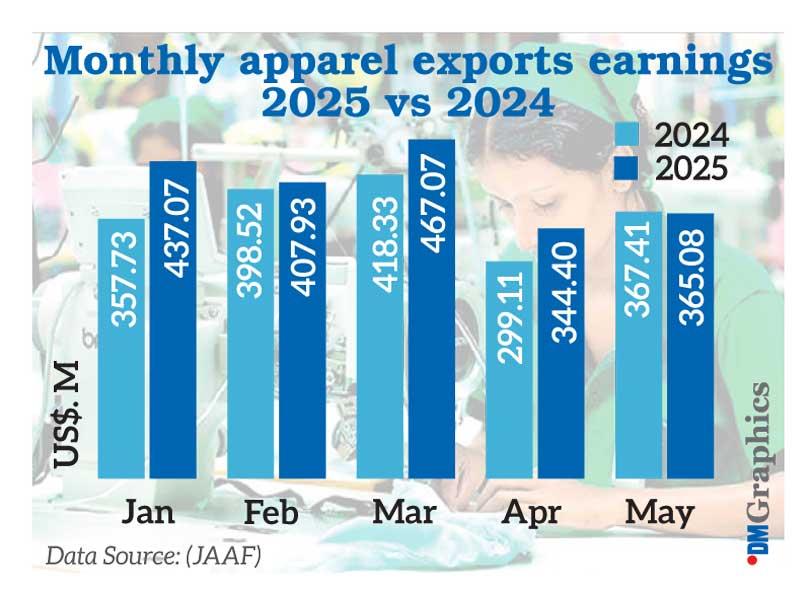
Sri Lanka’s apparel export earnings remained relatively stable in May 2025, experiencing a marginal dip of 0.63 percent to US$ 365.08 million compared to the same period last year.
The slight downturn was largely cushioned by significant growth in shipments to the European Union and other non-traditional markets, even as exports to the United States and the United Kingdom contracted.
In May, exports to the EU saw a healthy increase of 5.15 percent, while shipments to other international markets surged by a notable 11.1 percent. However, these gains were offset by declines in two of the nation’s primary markets, with exports to the United States (U.S.) ailing by 7.59 percent and to the UK by 6.81 percent. This mixed performance highlights the “ongoing demand volatility in Western consumer markets.”
Despite the flat performance in May, the cumulative data for the first five months of 2025 paints a picture of strong recovery. From January to May, total apparel export earnings grew by 9.8 percent, reaching US$ 2.02 billion.
Year-to-date, growth has been driven by a significant 15.36 percent increase in exports to the EU (excluding the UK) and a 13.12 percent rise in non-traditional markets. The US and UK markets also showed moderate cumulative gains of 6.52 percent and 3.74 percent, respectively, over the five-month period.
In a statement, the Joint Apparel Association Forum (JAAF) expressed encouragement over the industry’s trajectory. “The industry’s year-to-date performance demonstrates resilience and adaptability, driven by strategic market shifts and continued investment in value-added products,” a JAAF spokesperson said.
“We are encouraged by the momentum, particularly in emerging and EU markets.”