Reply To:
Name - Reply Comment
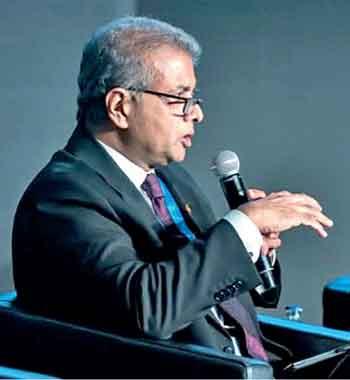 |
| Dr. Hans Wijayasuriya |
Sri Lanka called on the smaller and lower-income nations to secure access to ‘Sovereign AI’ capabilities as the country moves ahead with an artificial intelligence (AI)-first digital transformation agenda designed to expand access to public services, knowledge and economic opportunities.
Speaking at the World Summit on the Information Society (WSIS) Forum 2026, in Geneva, Chief Advisor to President on Digital Economy Dr. Hans Wijayasuriya said countries must be able to localise AI technologies without compromising data privacy, policy autonomy or national resilience.
Addressing the global technology and communications leaders during a high-level panel discussion on making knowledge accessible, Dr. Wijayasuriya cautioned that AI could reinforce the existing inequalities if its development is driven solely by the market forces.
“While the internet has democratised access to information, language, literacy and connectivity continue to distribute its benefits unequally,” he said.
He warned that the AI systems risk becoming concentrated around commercially attractive and data-rich populations unless deliberate efforts are made to ensure broader inclusion.
Dr. Wijayasuriya said Sri Lanka’s own digital transformation agenda was being designed to address that challenge through a whole-of-economy Digital Transformation Blueprint that incorporates language equalisation capabilities as part of its Digital Public Infrastructure framework.
As an early implementation step, Sri Lanka plans to prioritise citizen services through an AI-powered Government Information Centre that will allow the citizens to engage with government systems using natural conversation.
Under the proposed model, the farmers would be able to interact with specialised agricultural AI systems while the students could access AI-powered educational tutors through context-rich dialogue. The platform is also expected to incorporate features tailored to persons with disabilities.
Dr. Wijayasuriya said multilingual and inclusive AI systems were particularly important for countries such as Sri Lanka, where linguistic diversity and varying levels of digital access continue to shape how the citizens benefit from technology.
Governments worldwide are racing to incorporate AI into public administration, education and economic development strategies while grappling with concerns over data governance, technological dependence and unequal access to emerging technologies.
The WSIS Forum, organised under the auspices of the United Nations, is regarded as one of the world’s leading platforms for discussions on digital cooperation and technology policy.
The session featured communications and technology regulators and policymakers from Algeria, Libya, Türkiye, Gabon, Madagascar and Costa Rica as well as the chief executive of the Internet Corporation for Assigned Names and Numbers (ICANN).