Reply To:
Name - Reply Comment
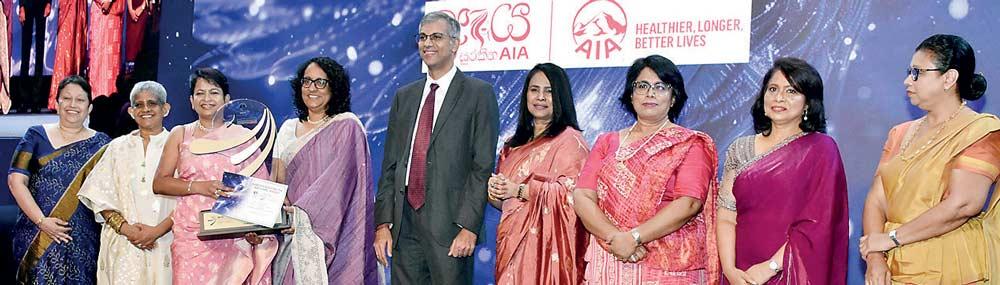
WCIC Prathibhabhisheka – Women Entrepreneur of the Year 2025 Worldlink Shipping Colombo Founder/Managing Director Vera Wickramasinghe (third from left) receiving her award from Prime Minister Dr. Harini Amarasuriya, while senior officials of the WCIC and AIA (platinum sponsor) look on - Pic by Nimalasiri Edirisinghe
By Shabiya Ali Ahlam
Sri Lanka’s economic recovery and long-term growth prospects hinge on dismantling systemic barriers that limit women’s participation in enterprise, leadership and decision-making, Prime Minister Dr. Harini Amarasuriya said. Women-led businesses remain an underutilised engine of productivity and resilience, even as women’s economic contribution has dipped to just 29 percent.
The Prime Minister noted women’s participation in paid work and senior decision-making roles remains significantly below potential, not because of a lack of talent or ambition, but due to deeply embedded structural constraints.
“This is not a problem of capability or ambition. It is the system,” she said.
Dr. Amarasuriya presented her views while addressing the Women’s Chamber of Industry and Commerce (WCIC) Prathibhabhisheka – Women Entrepreneur Awards 2025 in Colombo yesterday.
She pointed to patriarchal barriers, unequal access to capital and markets, exclusion from influential networks and institutional cultures that continue to privilege male leadership norms as factors shaping economic outcomes.
Her remarks framed women’s economic inclusion as a macroeconomic imperative rather than a social objective, at a time when Sri Lanka is seeking to rebuild productivity, restore investor confidence and strengthen institutional capacity under ongoing reform efforts.
Dr. Amarasuriya asserted it is time leadership models themselves evolve if economic reform is to be sustained as traditional definitions of authority often fail to account for the realities women navigate in professional life.
Women, she said, are frequently expected to manage multiple roles and responsibilities while meeting the same performance benchmarks, often with fewer resources and less institutional support.
Research increasingly challenges conventional assumptions about executive effectiveness, she said, pointing to evidence that women leaders often demonstrate strong communication, empathy and collaborative decision-making.
“Studies increasingly show that women leaders often demonstrate higher levels of emotional intelligence, including strong communication, empathy and collaborative decision making.
“These qualities contribute to healthier work environments, stronger teams and more resilient organisations.”
Such leadership capacities are essential in a rapidly changing economic environment, yet remain undervalued because they disrupt narrow definitions of authority, she said.
The Prime Minister also highlighted uneven access to opportunity within the women’s enterprise ecosystem, warning that while a segment of women entrepreneurs has gained visibility and recognition, many others continue to operate without institutional backing, access to finance or market reach.
Acknowledging the public support she has received in recent weeks after she became a target of gender based insults, Dr. Amarasuriya said she was acutely conscious that many women in leadership and enterprise roles lack similar platforms, often forcing them to endure structural disadvantage in silence or to withdraw from leadership pathways altogether.
“Solidarity is not symbolic. It is structural,” she said, calling for collective action to ensure women are not competing for limited space but are enabled to lead collectively.
In this context, Dr. Amarasuriya acknowledged that platforms such as the WCIC serve as strategic economic interventions rather than simple professional networks.
By strengthening women-owned and women-led enterprises, such institutions expand women’s control over resources, decision-making and economic outcomes.
Women entrepreneurs shine as WCIC marks largest award edition to dateSri Lanka’s Women’s Chamber of Industry and Commerce (WCIC) recognised 31 women entrepreneurs at its Prathibhabhisheka Women Entrepreneur Awards 2025 last evening, the largest and most competitive edition to date, highlighting the growing impact of women-led enterprises on the national economy. WCIC President Gayani de Alwis said the awards, now in their 15th edition and fourth year as an annual event, had become the country’s leading platform for women entrepreneurs, extending even to the SAARC region. “WCIC Prathibhabhisheka is not just an event or an award, it has gained strong momentum and credibility, firmly establishing itself as the national platform recognising women entrepreneurs in Sri Lanka, with an outreach that extends even to the SAARC region,” she said. De Alwis highlighted the scale and resilience of applicants, “It’s encouraging to see the combined revenue of the applicants is 8.5 billion and 38 percent of the award applicants are from micro and startups and 29 percent from small categories. We see younger women venturing into entrepreneurship, this augurs well for our country’s future.” WCIC Prathibhabhisheka Co-Chair Tusitha Kumarakulasingam, speaking on behlaf of Co-Chair Nilani Seneviratne, explained the awards’ rigorous nine-month process, independently validated by Ernst & Young, with applications assessed on My Story and Finance & Governance criteria. “Final award recipients are determined solely on the cumulative marks awarded through this process. And until tonight they only know that they have an award, but not what the award is,” she said. “Those honoured receive far more than an award; they gain a gateway to future opportunities,” Kumarakulasingam added, noting that past winners had leveraged the recognition to scale their businesses. Powered by AIA Insurance and supported by long-standing corporate partners, the awards reaffirm WCIC’s role in empowering women entrepreneurs and strengthening their contribution to Sri Lanka’s economy. |