AI SUMMARY GENERATED ONLY FROM THIS ARTICLE'S TEXT.
NISHAN DE MEL MADE THESE OBSERVATIONS AT A FORUM ORGANISED BY THE SRI LANKA-KOREA BUSINESS COUNCIL
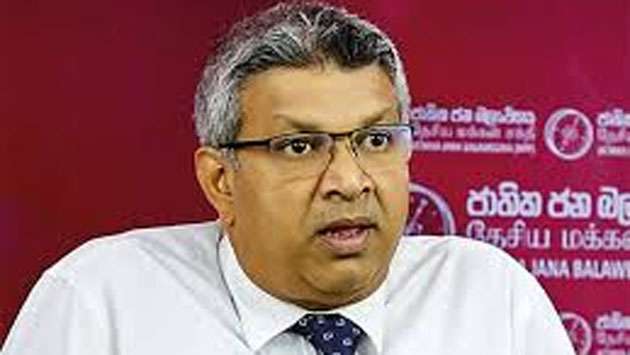
Nishan de Mel Pic by Nisal Baduge
By Nishel Fernando
Sri Lanka’s political and bureaucratic leaders should reassess the current debt sustainability plan with a fresh Debt Sustainability Analysis (DSA) to establish a realistic path out of the debt crisis, a top economist said, whilst also urging governance reforms to tackle corruption vulnerabilities.
Speaking at a forum organised by the Sri Lanka-Korea Business Council in Colombo on Wednesday, Verité Research Executive Director Nishan de Mel warned that Sri Lanka’s current debt sustainability path is not based on sound data and pragmatic analysis, putting the country at risk of finding itself ‘on the edge’ once again.
The IMF Debt Sustainability Analysis (DSA) assumes yields of 7-10 percent, with one-year yields at 7 percent and ten-year yields at 10 percent, maintaining a 300 basis point spread. Currently, Sri Lanka is at 10.25 to 13.50 percent, over 300 basis points higher. At these yields, revenue to GDP would need to exceed 27 percent.
“Even if you get everything properly done, yields are going to build up your debt. IMF DSA path is a knife edge. It tells you can get debt down, originally they thought 90 percent, then they revised to 94 percent, now they think 93 percent, they think we can go up to 95 without falling over,” he said.
He pointed out that the current debt restructuring effort is rather shallow, which diminishes the likelihood of achieving debt sustainability.
“When you look at countries that have restructured debt three or more times, they end up with an average Net Present Value (NPV) reduction of about 30 percent. In contrast, countries that restructure only once typically achieve a 60 percent reduction in NPV. The basic principle is that the deeper the restructuring, the more sustainable the outcome is,” said de Mel.
Sri Lanka is currently pursuing a relatively shallow restructuring, and there’s a possibility the island nation could develop a better debt sustainability plan and restructure more effectively. The issue however is that the NPV decreases as the GDP improves, but GDP must improve because, without it, Sri Lanka will not succeed, he added.
He also stressed the necessity of undertaking a new DSA to establish realistic targets.
“If you do it again, you have a chance of doing it better. There’s no global analyst that I know who thinks very highly of the IMF’s DSA—maybe it was done in a hurry, maybe they didn’t have the right data. Even if the IMF doesn’t do it, we should do it again. Perhaps then, you can ask your bilaterals and even multilaterals to give you better terms.
“Getting it from private creditors can be quite tough, but at least you can renegotiate some aspects of GDP-linked cuts that private creditors are doing, which can hurt your chances of coming out of this,” said de Mel.
Regardless of where Sri Lanka ends up in its debt restructuring efforts, the government must update its targets based on a new DSA to ensure the country moves toward stability instead of teetering on the brink.
“These are eminently doable—any sane leader should undertake these measures. There’s no reason not to have a sensible plan; the analysis isn’t rocket science. A reasonable approach can be implemented. What’s needed is a bit of sanity in both the political and bureaucratic spheres, along with some truth-telling to get us there,” De Mel said.
Looking ahead, he emphasised that fiscal proposals and projections must include notes that justify the figures, instead of continuing the current practice of willful misrepresentation in the budget.
Meanwhile, De Mel criticised the Finance Ministry for consistently failing to provide transparency in its budget proposals and projections. He urged the government to publish at least a three-page document for each budget proposal, detailing the methodology behind the calculations.
“If they were required to explain their math, it would compel them to produce more accurate figures,” he said.
Highlighting the issue, De Mel noted that for the past five to six years, independent analysts have made projections far more accurate than those of the Finance Ministry.
“If we can do it from outside the Ministry, it’s clear that it’s not difficult. This points to a willful misrepresentation of the budget,” he added.
Comments - 4
Comments - SL urged to reassess debt plan and strengthen governance
Professional Assistance with Action Plan Needed Saturday, 17 August 2024 12:01 AM
Any comments from the current regime especially from Ranil and Siyambalapitiya. Without proper economic qualifications, these 2 are painting a picture all’s under control. Need a reputable private firm using professional economist to carry out a forensic audit on the current financial situation and prepare an Action plan. By Listing out the situation, people will know officially how much debts there are both local and international, how long the debt payments will take and how it’s being paid. Current government expenditures including on themselves, senior military officers, senior police officers and other government agencies are extremely high. If elected, Nothing major will change with this team continuing for another 5 years. Current debts needs to paid during this time and the people will be further impacted at the rate things are at if no proper trimming and guidance is laid out.
83
sach Saturday, 17 August 2024 12:54 AM
And Ranil increased state sector salaries by 25000
05
Janleon Reynolds Saturday, 17 August 2024 09:34 PM
I do not think they have a sufficient knowledge in economics to drive the country towards right direction. It looks like that they just want to be in there position as far as they can be . I don't see the government have any plan for revenue generation. Country will end up in a bigger disaster very soon. Majority of Sri lankns are not educated enough to see the reality.
05
Vive James Tuesday, 20 August 2024 06:59 AM
Reap Srilanka, reap
Voters deserve this
6.9 million voters or Idiots of Srilanka ?
Communal politicians with the majority of majority voters brought this situation.
You can't blame LTTE or India , can you?
SRILANKA GONE.
01
222
Add comment
Comments will be edited (grammar, spelling and slang) and authorized at the discretion of Daily Mirror online. The website also has the right not to publish selected comments.