Reply To:
Name - Reply Comment
By Nishel Fernando
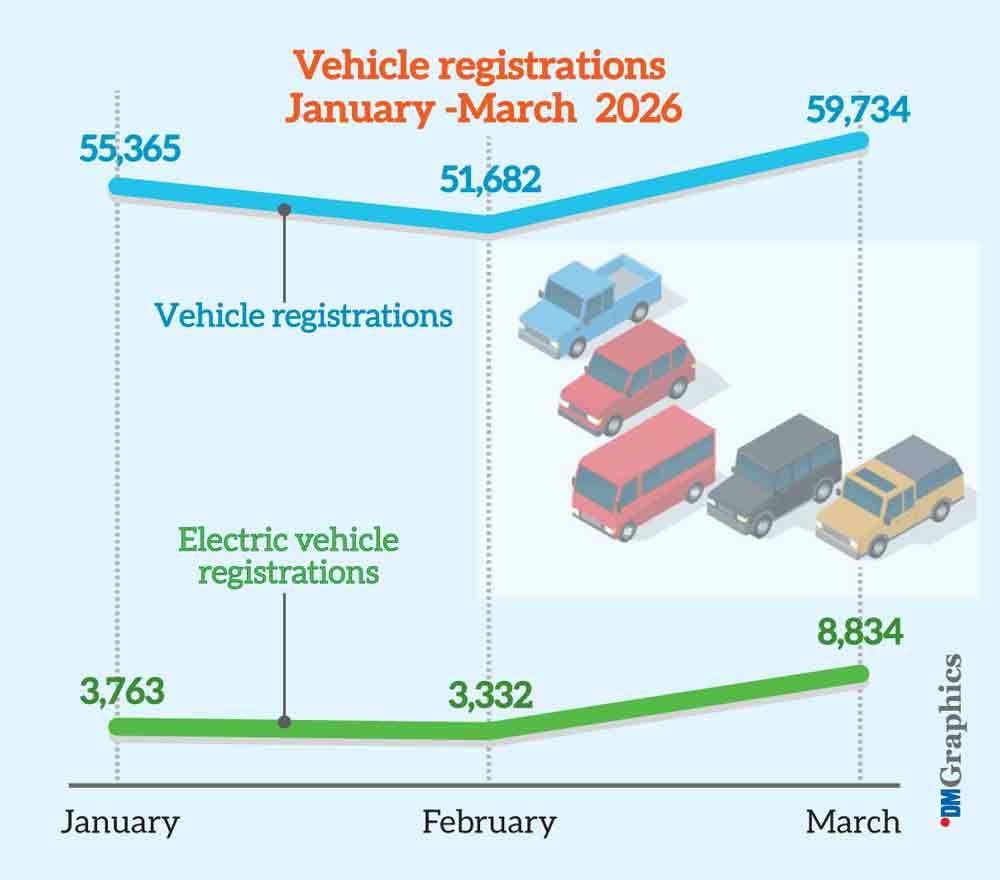
Sri Lanka’s local automotive market recorded a substantial influx of vehicle imports in March, with total motor vehicle registrations expanding by 15.6 percent month-on-month to reach 59,734 units, according to the latest registration data compiled by JB Securities.
This sharp acceleration is largely driven by a pronounced pickup in electric vehicle adoption, reflecting immediate consumer momentum as the country grapples with rising foreign exchange outflows.
A comprehensive breakdown of the March data highlights a rapidly shifting automotive landscape across all vehicle categories. Two-wheelers maintained a dominant market share, accounting for a significant 41,121 units during the month, reflecting a 20.7 percent month-on-month growth. Top performing two-wheeler brands included Bajaj, Honda, and TVS. Passenger vehicles also recorded steady volumes, with SUVs and crossovers growing by 3.6 percent month-on-month to 5,841 units, heavily favored by Toyota and Honda. Motor cars registered 4,856 units, reflecting a 16.6 percent monthly expansion with strong numbers from Suzuki and BYD. In the commercial and alternative transport segments, three-wheelers experienced a marginal 0.71 percent month-on-month decline, recording 4,031 registrations. Utility and heavy-duty categories displayed mixed momentum; pickups grew by 32.6 percent month-on-month to 606 units, medium trucks grew by 15.9 percent to 394 units, and heavy trucks expanded by 46.4 percent to 303 units. Conversely, vans contracted by 15.1 percent to 784 units, buses slipped 2.6 percent to 263 units, and hand tractors dropped 43.8 percent to 59 units, while large tractors jumped 87.3 percent to 470 units. A material trend within the March data is the exponential growth of electric mobility, led prominently by BYD. Overall electric vehicle registrations expanded by 165.1 percent month-over-month, climbing to 8,834 units in March from 3,332 units in February. Within this segment, brand new electric motor cars experienced a notable 328.9 percent growth variance. In contrast, hybrid vehicle registrations plateaued and experienced a slight decline, recording 2,512 units in March compared to 2,542 units in February.
The financial implication of this import momentum remains substantial. According to external sector data released by the Central Bank of Sri Lanka, cumulative vehicle imports cost the country US$ 441.2 million during the first two months of 2026, comprising US$ 312.2 million allocated for personal vehicles and US$ 129.0 million for transport equipment. While a month-over-month analysis revealed a brief cooling trend in import expenditure—contracting by 13.4 percent to US$ 204.8 million in February from US$ 236.4 million in January—the aggregate volume of March registrations suggests that import appetite remains exceptionally strong.
Commenting on these unfolding market dynamics, Murtaza Jafferjee highlighted the direct correlation between energy costs and shifting consumer choices in the automotive sector. He noted that higher fuel prices will inevitably drive behavioural shifts, particularly accelerating the demand for electric vehicles. Although electricity tariffs are also likely to rise—potentially through surcharges—he pointed out that self-consumption via rooftop solar photovoltaic systems makes electric vehicle ownership increasingly viable for Sri Lankan consumers.
Jafferjee critically assessed the existing regulatory environment surrounding automobile imports, advocating for immediate policy rectification to prevent further market imbalances. He stated that the current vehicle taxation remains highly distortionary, as excise duties are tied to engine capacity for hybrid and internal combustion vehicles, and to motor power for electric vehicles, creating deep inconsistencies across different technologies.