Reply To:
Name - Reply Comment
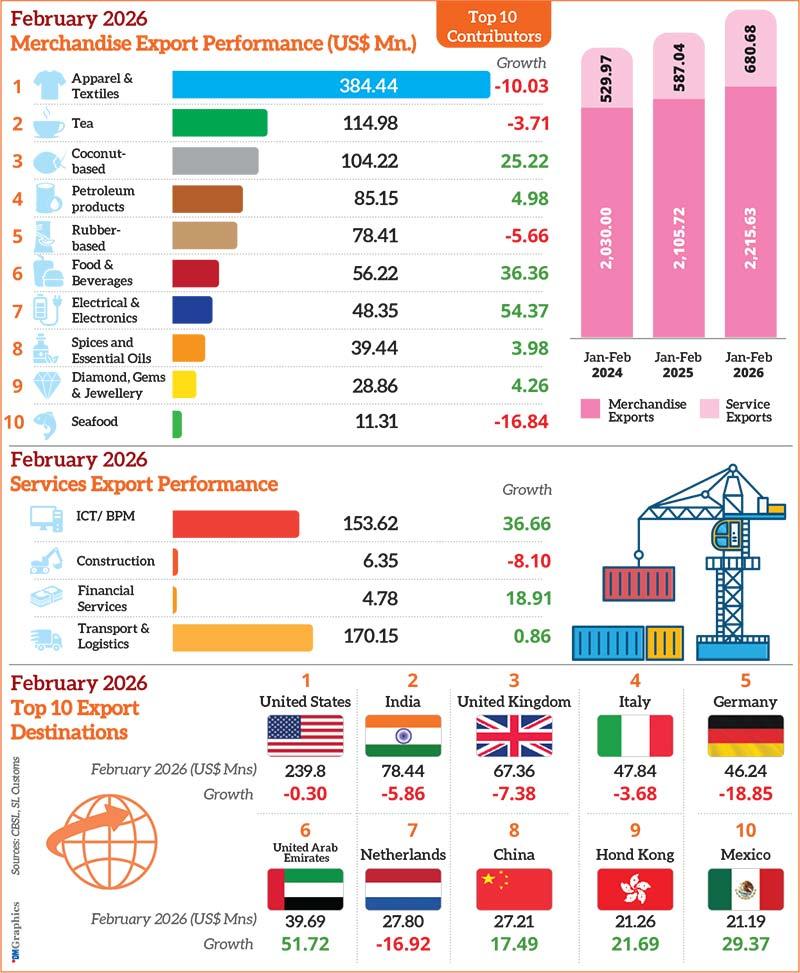
Sri Lanka’s export sector maintained a measured recovery in February 2026, with total earnings rising 4.22 percent year-on-year (YoY) to US$ 1.40 billion, as strong services momentum offset weaker performances in key merchandise categories.
The data points to a shifting export mix rather than a broad-based surge. While merchandise exports edged up a modest 1.32 percent to US$ 1.07 billion, services exports jumped 14.68 percent to US$ 334.9 million, highlighting the growing weight of the knowledge economy in external earnings.
On a cumulative basis, exports expanded 7.56 percent to US$ 2.89 billion in the first two months of the year, with services again outpacing goods, growing nearly 16 percent compared with a 5.22 percent rise in merchandise exports.
The divergence between services and goods is becoming more pronounced. ICT/BPM exports surged 36.66 percent in February alone, while financial services and logistics also recorded gains, underscoring a structural pivot towards higher-value, less volatile export streams.
In contrast, traditional export pillars showed strain. Apparel and textiles, still the country’s largest export category, contracted 10.03 percent year-on-year in February, dragged by weaker demand from the United States and a sharp 19.33 percent decline to the European Union. Tea exports, accounting for 12.8 percent of merchandise shipments, fell 3.71 percent, reflecting both volume pressures and softer demand in key markets such as Russia.
Rubber-based products and seafood exports also declined, pointing to broader demand-side fragility across industrial and commodity-linked segments.
Yet, beneath the headline softness in goods exports, several emerging sectors delivered strong gains. Coconut-based exports rose over 25 percent, with high-value segments such as activated carbon and coconut oil posting sharp increases. Electrical and electronic components surged 54.37 percent, while food and beverages grew 36.36 percent, reflecting incremental progress in value addition and product diversification.
These gains suggest Sri Lanka’s export base is gradually broadening beyond its traditional dependence on apparel and tea, although scale remains a constraint.
Export market dynamics also reveal a gradual rebalancing. While the United States, accounting for around 22 percent of exports, recorded a marginal decline, India strengthened its position as Sri Lanka’s second-largest export destination, with shipments rising 16.21 percent in the January–February period.
Meanwhile, growth in markets such as the UAE, China, Australia and Mexico points to early traction in diversification efforts, even as exports to the European Union weakened on a cumulative basis.
The February data indicates a key inflection in Sri Lanka’s export trajectory: resilience is increasingly being driven by services and niche, value-added segments, while traditional merchandise exports remain exposed to external demand cycles.