Reply To:
Name - Reply Comment
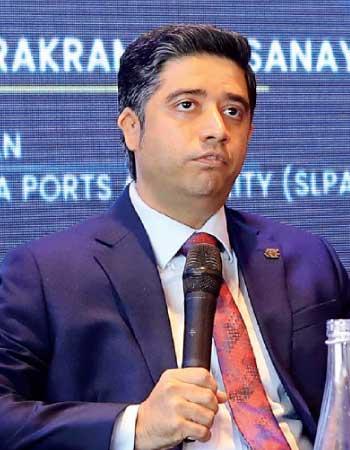 |
| Sanjay Singh Kushwaha |
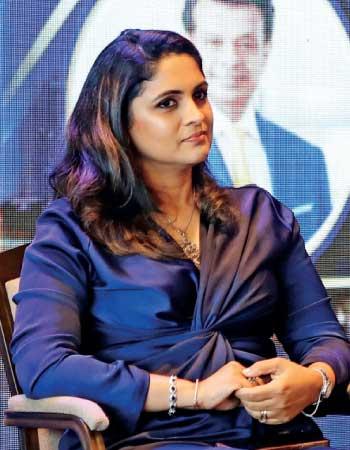 |
| Dhashma Karunaratne PIX BY PRADEEP DILRUKSHANA |
By Nishel Ferando
Despite the widespread industry concerns that India’s newly developed Vizhinjam International Seaport will drain transshipment volumes away from Sri Lanka, leading maritime experts assert that the two deep-water hubs are positioned to complement rather than aggressively rival one another.
Joining a panel discussion at Sri Lanka German Business Forum 2026, held in Colombo recently, industry leaders argued that the sheer scale of India’s economic ambitions guarantees cargo overspill, requiring the combined capacities and distinct efficiencies of both ports to manage the region’s burgeoning maritime trade.
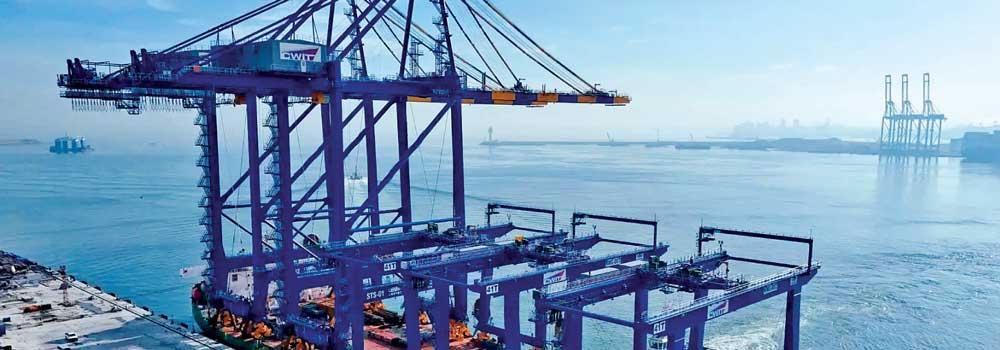
The competitive dynamics between the two ports have drawn a sharp focus recently, particularly because India’s Adani Group holds a dominant operational stake in both the Vizhinjam facility in Kerala and Colombo West International Terminal (CWIT).
Addressing these concerns, Hapag-Lloyd India, Bangladesh and Sri Lanka Managing Director Sanjay Singh Kushwaha noted that Vizhinjam’s development is a necessary step in India’s broader macroeconomic strategy to achieve developed nation status by 2047.
He argued that if Vizhinjam had not absorbed some of the regional volume, the infrastructure at the Port of Colombo might have begun to fracture under the sheer pressure of demand.
“The winner will not take it all. We can mix between India and Sri Lanka; we can actually complement each other,” Kushwaha stated during the panel discussion.
“Where India can add scale and Sri Lanka can add efficiency and that can actually accelerate the growth in itself. The whole India-EU trade deal is actually creating a market of two billion people. There will always be an overspill beyond what the Indian ports can actually carry. And Sri Lanka, because of nearshoring, becomes a natural hub.”
The ground reality of this dual-port strategy reveals that Colombo is not only holding its ground but actively outpacing its Indian counterpart in key performance metrics.
CWIT Chief Commercial Officer Dhashma Karunaratne revealed that the CWIT has already surpassed Vizhinjam in container handling volumes, despite the Indian port commencing operations earlier, with substantial state backing.
Karunaratne noted that the CWIT secured one million TEUs in less than a year, a milestone that took the previous deep-draft terminals in the region nearly 21 months to achieve, while the Port of Colombo overall is experiencing growth close to 20 percent.
“What we need to understand is the CWIT has surpassed Vizhinjam,” Karunaratne explained.
“Vizhinjam commenced much before us and obviously had the backing and blessing of the government of India and our promoters but the Colombo West has overtaken Vizhinjam. I represent the BD team of Adani too. So, we have a very clear strategy in our business development and Vizhinjam will go with certain customers and the Port of Colombo and CWIT, we have clear clarity on the customers that we manage.”
Addressing concerns from the local exporters regarding service realignments, Karunaratne highlighted the distinct infrastructural and connectivity realities of the two hubs. She pointed out that while Vizhinjam is still developing its inland rail connectivity, the Port of Colombo currently offers unparalleled global reach.
“As we speak, there are close to three to four main lines that are expanding their footprint in the Port of Colombo with connectivity to the US and also to Europe,” she noted.
Kushwaha further clarified that any recent service withdrawals from Colombo were driven by global network realignments rather than local efficiency issues, assuring that new services are actively being introduced.
Karunaratne elaborated that top-tier global carriers prioritise the CWIT for its superior schedule reliability, rapid vessel turnaround and minimal yard dwell time. The Port of Colombo’s resilience is further underscored by its ability to navigate severe global supply chain disruptions. While Colombo has historically acted as a rapid-response hub for vessels delayed by the Red Sea conflicts or Suez Canal blockages, the recent augmentation of deep-draft capacity has fundamentally shifted the playing field.
“What we have done is for multiple years the Port of Colombo has been a response to a Mayday call,” Karunaratne added.
“If there are vessels stuck on the Suez Canal, if there is a Chittagong congestion, if there is a Middle East war, they just call for as a Mayday help and the Port of Colombo is to come forward for assistance. But now, with the addition of capacity and with WCT2 and ECT, there is a different playing field for the shipping lines. They are looking at the Port of Colombo as a hub.”