Reply To:
Name - Reply Comment
By Nishel Fernando
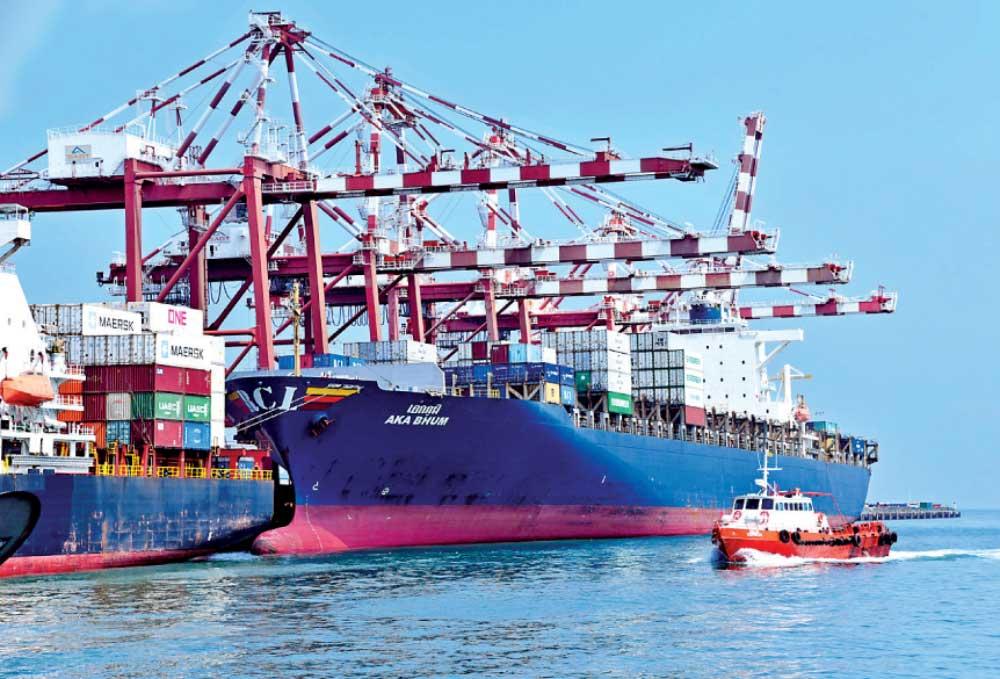
The Port of Colombo recorded a 4.8 percent year-on-year (YoY) growth in total container throughput in February, handling 636,084 twenty-foot equivalent units (TEUs), compared to 606,784 TEUs in the same period last year.
Reflecting this heightened activity, the total number of ships arriving at the port rose by 4.3 percent, increasing from 305 vessels in February 2025 to 318 vessels in February 2026.
This growth is partially being fuelled by the escalating geopolitical crisis in the Middle East, which has forced the global shipping lines to reroute the vessels and significantly alter the traditional trade flows.
The industry officials note that the current situation presents a substantial opportunity for both the Port of Colombo and Hambantota International Port, extending beyond cargo to massive prospects for bunkering.
With many major shipping lines increasingly avoiding the Middle East altogether, due to the escalating risks extending beyond the Red Sea, the vessels are taking longer routes. Consequently, the demand for bunkering in Sri Lanka has surged exponentially, presenting a major capacity utilisation opportunity.
The shipping lines are actively looking to offload their cargo in safe-haven ports, with Mediterranean Shipping Company already depositing significant volumes of rerouted cargo at Hambantota.
The ongoing disruptions have caused the freight rates to skyrocket, with the costs doubling on several alternative routes.
For instance, ports like Salalah in Oman, which currently stand as some of the few accessible major transshipment hubs outside the immediate conflict zones, have seen a massive influx of demand and surging rates, as the carriers scramble for viable drop-off points.
The industry experts project that the impact of this rerouting will become even more pronounced in the coming months, with the March figures expected to show a massive surge in both transshipment volumes and bunkering demand in Sri Lanka.
However, this sudden influx of cargo has prompted acute concerns regarding the port efficiency and capacity constraints.
During a recent meeting with the industry stakeholders, Sri Lanka Ports Authority (SLPA) Chairman Dr. Parakrama Dissanayake cautioned the terminal operators to manage the yard space carefully, warning that a buildup of empty containers could severely choke the port operations.
He emphasised that priority must be given to the existing shipping lines to maintain productivity, rather than sacrificing the long-term operational stability for a temporary surge in the ad hoc rerouted cargo.
A closer look at the port’s segment performance reveals mixed results. The overall growth was primarily anchored by the transshipment volumes, which grew by 4.7 percent YoY to reach 502,560 TEUs.
The import volumes also showed a positive momentum, expanding by 8.9 percent to 56,309 TEUs. The restowing activities saw a 9.5 percent increase, handling 25,927 TEUs during the month.
Conversely, the export volumes experienced a marginal decline of 0.3 percent, settling at 51,288 TEUs.
The terminal-level data shows that the overall growth at the Port of Colombo was entirely driven by the newly operational Colombo West International Terminal (CWIT), which handled 84,367 TEUs in February. This fresh capacity effectively masked the volume contractions experienced by the port’s established terminals.
Container handling at the state-owned terminals comprising Jaya Container Terminal, Unity Container Terminal and East Container Terminal (ECT) dropped by 14.9 percent to 176,772 TEUs.
Similarly, South Asia Gateway Terminals saw its volumes decline by 14.4 percent to 130,341 TEUs, while Colombo International Container Terminals recorded a marginal dip of 0.8 percent, handling 244,604 TEUs.
The volume decline at the state-owned facilities is compounded by severe operational bottlenecks, particularly at ECT, where the yard operations remain notably poor.
The industry sources indicate that ECT is still facing critical procurement issues that have failed to materialise, dragging down productivity just as the global shipping lines are seeking reliable transshipment hubs. In response to these lingering administrative hurdles, the government has appointed a dedicated committee tasked with establishing strict timelines to expedite the necessary procurements and restore the terminal’s operational efficiency.
PIC BY NISAL BADUGE