 Moiz Mustafa
Reply To:
Name - Reply Comment
By Moiz Mustafa
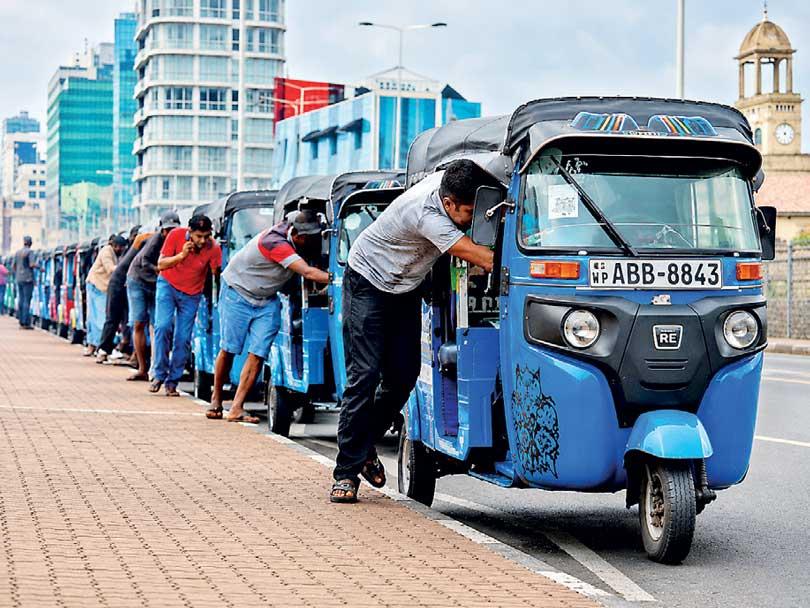
June 3rd (Daily Mirror) - Last morning, if you filled your tank with Petrol 92 at any CEYPETCO station across Sri Lanka, you would have paid Rs. 434 per litre. Twelve weeks ago, you would have paid Rs. 293. In November 2015, you paid Rs. 117.
The number on that board did not happen overnight, and it was not caused by any single decision. It is the result of three forces colliding simultaneously: a decade of structural price changes, a war that erupted in the Middle East and cut off a critical global oil route, and a Sri Lankan rupee that has lost over 5% of its value against the US dollar since January 2026.
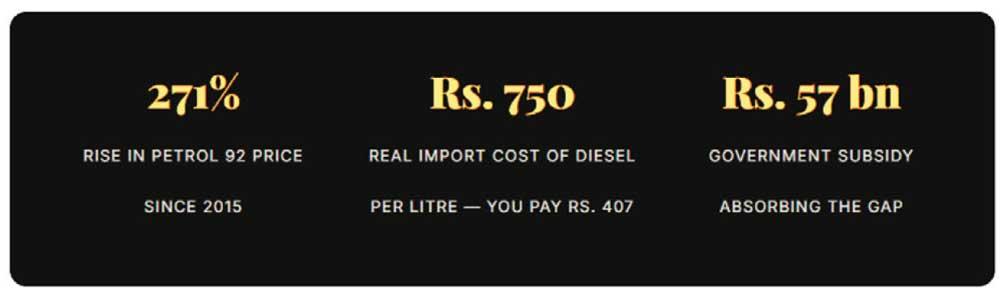
This article explains all three — with data, with context and without simplification. It also tells the story that rarely makes headlines: that without active government intervention worth Rs. 57 billion, the price of diesel at your nearest pump station would be close to Rs. 750 per litre.
Sri Lanka Fuel Price History: A Decade of Increases in Context (Table)
To understand why the price is what it is today, you need the full eleven-year picture. In November 2015, Petrol 92 was Rs. 117 per litre and Auto Diesel was Rs. 95. For years, the rise in price was gradual — by late 2021, Petrol 92 had crept to Rs. 177 and Diesel to Rs. 121. Painful, but manageable for most households.
Then came 2022. Sri Lanka’s foreign exchange crisis detonated, and prices nearly tripled in three months. Petrol 92 hit Rs. 470. Diesel reached Rs. 460. Petrol 95 touched Rs. 550 — the all-time high in this dataset. These were not global norms adjusted for local conditions. They were devastating numbers, and they were felt in the price of every meal, every bus fare, every school van.
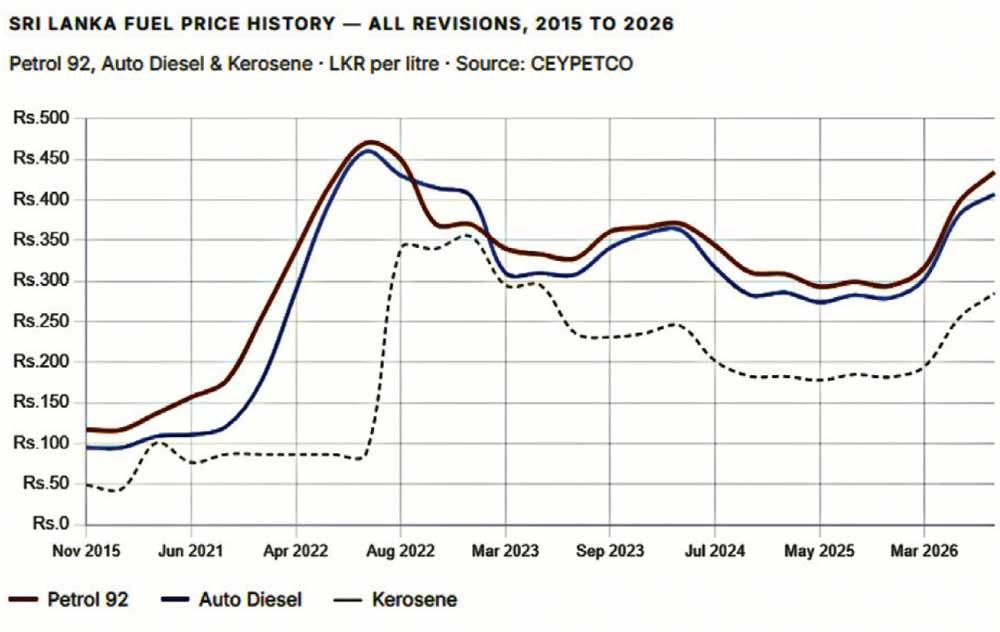
From mid-2023 through 2025, prices eased as the IMF programme took hold, the rupee stabilised and global oil prices softened. By late 2025, Petrol 92 had fallen to around Rs. 290 — real relief, and it deserves to be acknowledged. But “coming down from a crisis peak” is not the same as recovery.
Petrol 92 in November 2021 was Rs. 177. In November 2025, it was Rs. 294 — still 66% above pre-crisis levels. Then, in late February 2026, the world changed again.
How the Middle East War Is Driving Up Sri Lanka’s Fuel Prices in 2026
Why is Sri Lanka especially exposed to the Middle East conflict
Sri Lanka imports 100% of its oil. Crude oil for its refinery comes from the Middle East. Refined products arrive via Singapore, Malaysia and South Korea. The vast majority of this trade passes through or near the Strait of Hormuz, the narrow waterway through which 20% of the world’s oil exports flow in peacetime. Sri Lanka has no strategic reserves beyond approximately one month of consumption and no domestic production whatsoever.
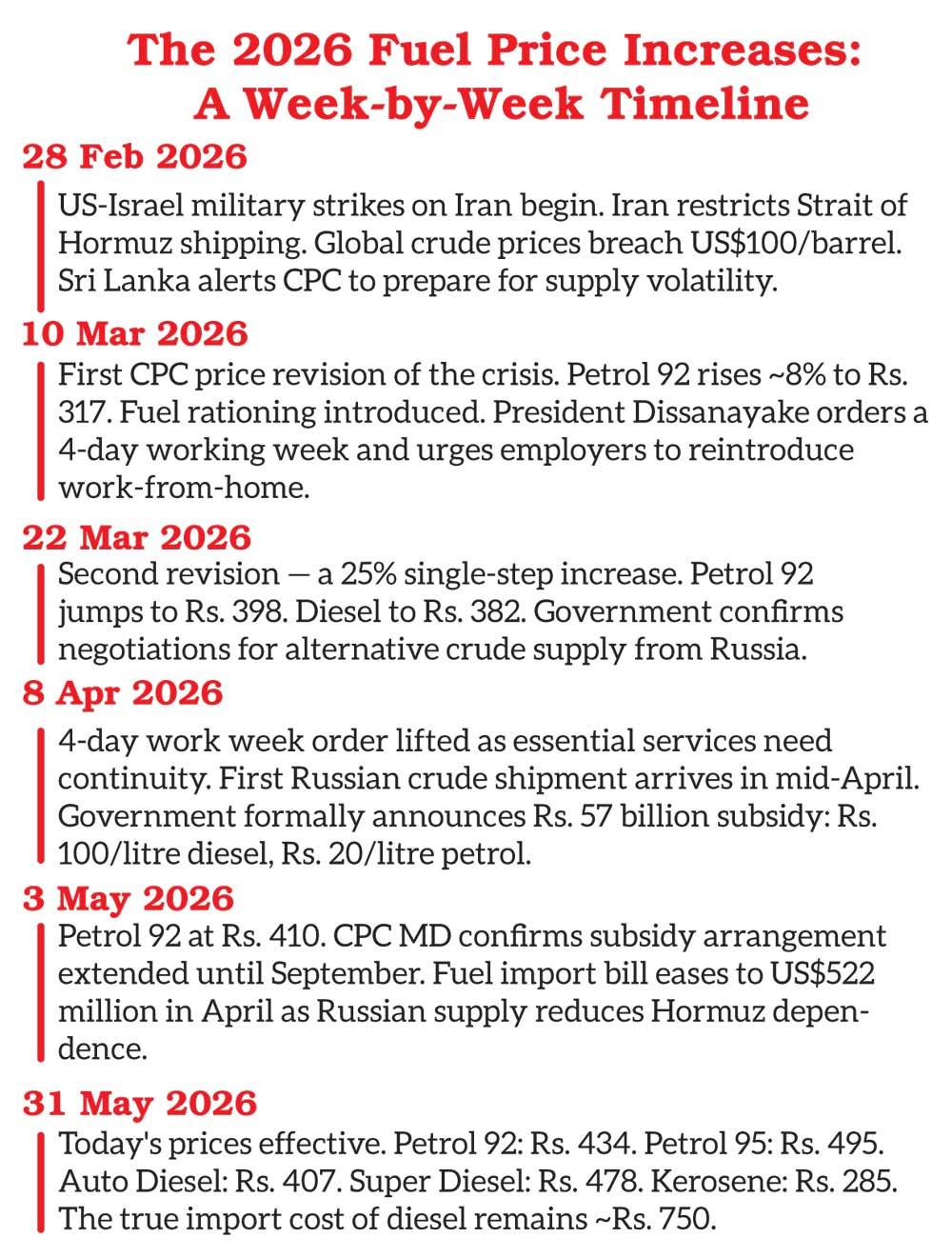
On February 28, 2026, the United States-Israel military conflict with Iran began. Within days, Iran restricted shipping through the Strait of Hormuz in retaliation. Global crude oil prices surged above US$100 per barrel. Freight costs spiked. Supply routes through Singapore and Malaysia were disrupted. The impact reached Sri Lanka’s fuel stations within two weeks.
According to data published by the UN Economic and Social Commission for Asia and the Pacific (ESCAP), global oil prices rose approximately 45% and gas prices 55% since late February 2026. In Sri Lanka, fuel prices at the pump increased by 33.8% in just the first three weeks of the conflict, the seventh highest increase globally, according to Global Gasoline Price data. Sri Lanka was not alone, but it was among the most acutely exposed.
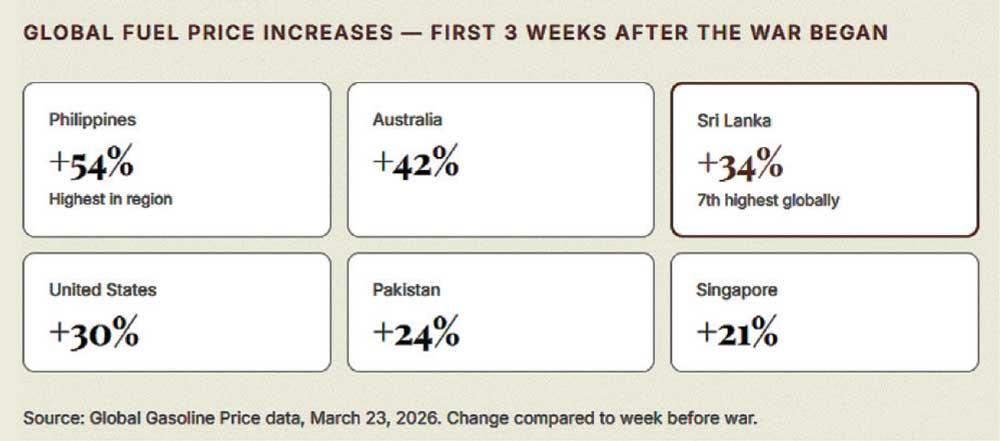
The financial impact was severe. Sri Lanka’s fuel import expenditure surged to US$630 million in March 2026 alone — a 74.7% year-on-year increase, according to the Central Bank of Sri Lanka data. In April, the bill remained at US$522 million before easing to US$324 million in May as the Government secured alternative crude from Russia, with the first shipment arriving in mid-April 2026. The IMF acknowledged the exposure directly, with spokesperson Julie Kozack stating Sri Lanka is “significantly exposed” to the Middle East conflict.
“Sri Lanka purchases most of its crude oil from the Middle East. Since the start of the war, the price of fuel has risen by 33%.” - Harbinger’s Magazine, April 2026 — Citing Ceypetco data.
The Rupee’s Role: Why a Weaker LKR Means More Expensive Fuel
Every barrel of oil Sri Lanka buys is priced in US dollars. This single fact means that even if global oil prices stayed flat, a weakening rupee raises the local cost of every litre you pump. It is a mechanism most Sri Lankans feel before they understand — and in 2026, it has been compounding the global price shock significantly.
At the start of 2026, one US dollar bought approximately Rs. 300. By the end of April, the rate reached Rs. 316, and by late May, commercial bank selling rates had climbed above Rs. 334 per dollar.
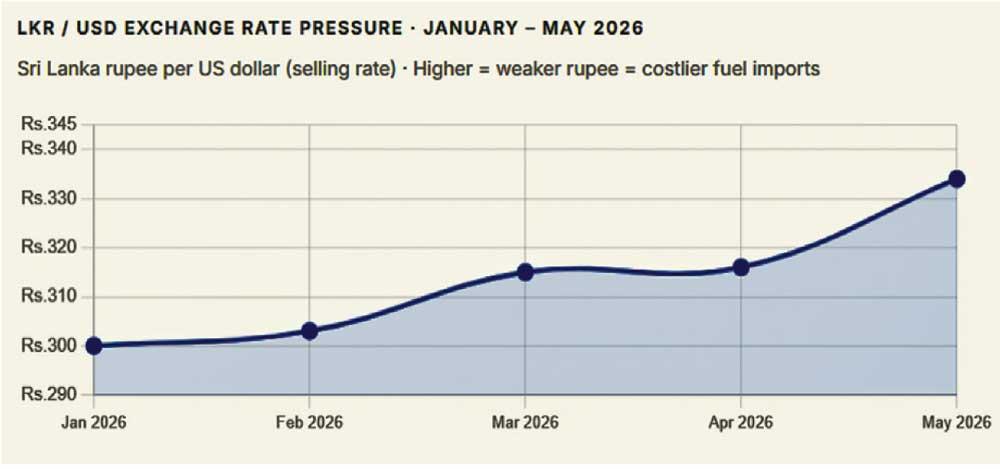
The Sri Lankan rupee has depreciated 5.4% against the US dollar on a year-to-date basis as of end-May 2026, according to EconomyNext and Central Bank data. That depreciation directly multiplies the local-currency cost of every fuel shipment.
The CPC Chairman was explicit about this linkage: increased foreign exchange spending on fuel imports directly impacts the value of the US dollar in Sri Lanka. In April alone, Sri Lanka spent US$522 million on fuel — putting direct pressure on dollar supply, which in turn weakens the rupee, making the next fuel shipment more expensive. Your fuel price and your currency’s stability are not separate stories. They are the same story, feeding each other.
The Central Bank has acknowledged the pressure. Governor Nandalal Weerasinghe noted that the country’s rebuilt reserves of US$7.28 billion (as of February 2026) and low inflation offer better insulation than in 2022. But economists at EconomyNext have warned that if oil prices sustain near US$120 per barrel, the annual fuel import bill could swell to an unaffordable US$4.5–5 billion, enough to trigger a fresh balance-of-payments crisis.
Sri Lanka Fuel Subsidy 2026: What the Government Is Absorbing on Your Behalf
This is the part of the story that rarely receives adequate attention — and it fundamentally changes how you should read the price board at your filling station.
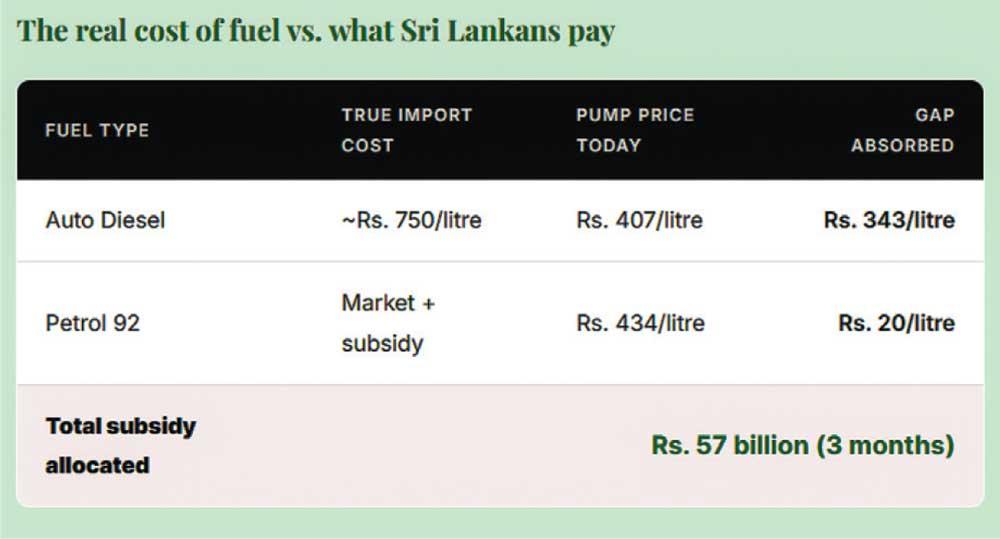
CPC Chairman D.A. Rajakaruna has stated publicly that the cost of importing and distributing one litre of diesel is approximately Rs. 750. You are paying Rs. 407. The Rs. 343 difference per litre is absorbed by the Ceylon Petroleum Corporation and the Treasury, funded by the Rs. 57 billion subsidy allocation. This includes Rs. 100 per litre on diesel and Rs. 20 per litre on petrol.
CPC Managing Director, Dr. Mayura Neththikumarage confirmed to another daily newspaper that the subsidy arrangement will continue until at least September 2026. “The present decision is to continue the subsidy arrangement until September. The CPC is bearing part of the burden, while the Government is also carrying a portion of it,” he stated.
The Government has also moved on the supply side. After Sri Lanka turned down an Iranian offer due to logistical constraints, a procurement agreement was reached with Russia following the loosening of US sanctions on Russian fuel purchases. The first Russian crude shipment arrived in mid-April, easing some pressure. The Government also declared a four-day work week in March — later lifted on April 8 — to reduce fuel consumption, and asked employers to revive work-from-home arrangements.
In May 2026, CPC Chairman D. A. Rajakaruna said that without the subsidy, diesel would cost approximately Rs. 750 per litre, adding that the Government was spending Rs. 57 billion to keep it at Rs. 407 per litre.
Kerosene Prices in Sri Lanka: The 548% Rise That No One Talks About
The fuel of Sri Lanka’s poorest households
Kerosene does not power cars or lorries. It powers the cooking stoves of estate workers, the lamps of fishing villages with unreliable electricity grids, and the small enterprises of rural Sri Lanka that depend on a single flame. In 2015, it cost Rs. 44 per litre — held deliberately low as a social safety measure. By late 2022, it hit Rs. 365. Today it stands at Rs. 285. That is a 548% increase over a decade, falling primarily on households with the least buffer to absorb it.
Unlike petrol and diesel, Kerosene’s long-held low price was a deliberate act of policy — a quiet acknowledgement by successive Governments that millions of Sri Lankan households depended on it and had no alternative. Its explosion in 2022 was not just a fuel price event. It was the unravelling of a social compact. Even today, at Rs. 285, Kerosene remains 548% above its 2015 price. Whether targeted relief for kerosene-dependent households is part of any active policy conversation is a question every elected representative should be asked.
What Sri Lanka’s Fuel Prices Mean for Your Monthly Household Budget
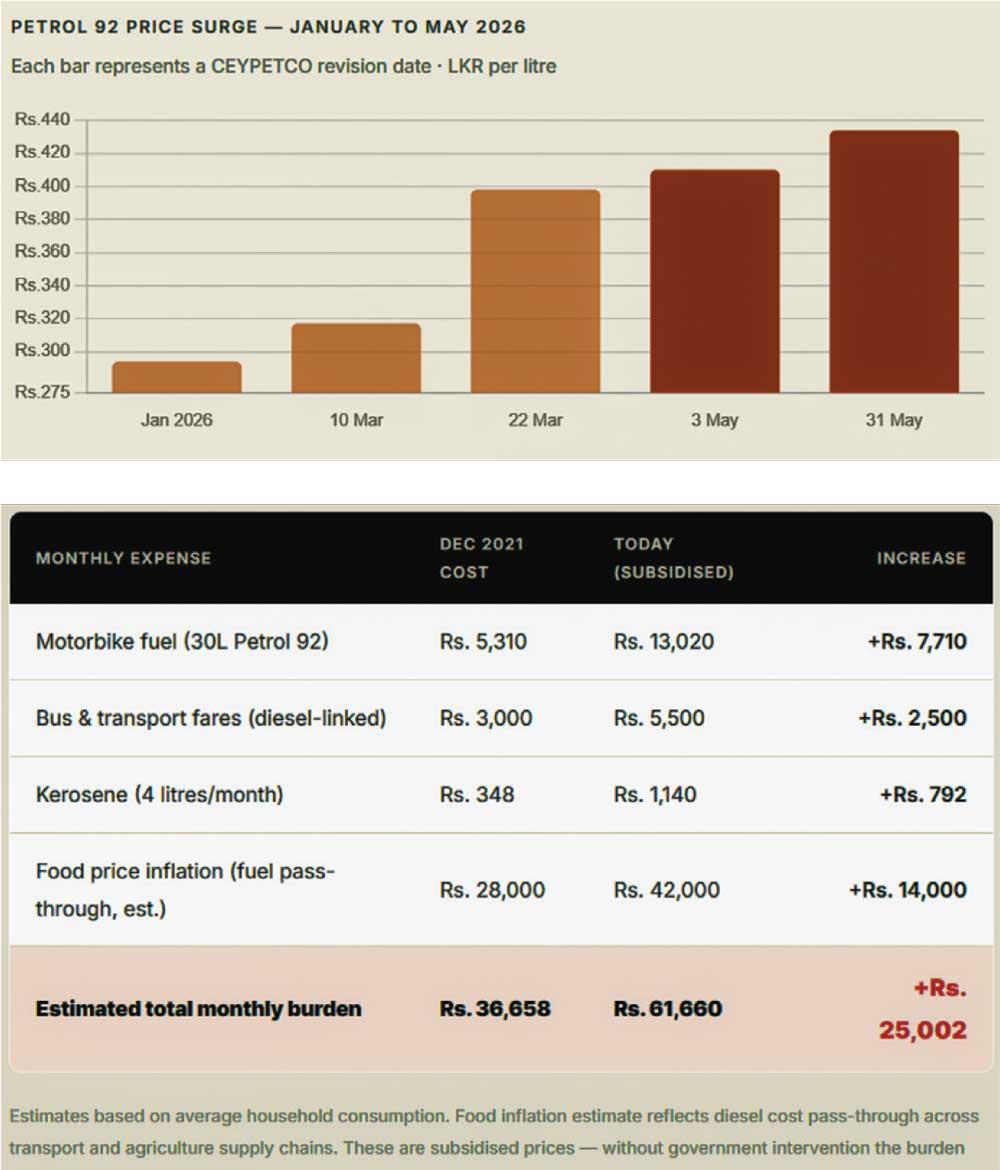
Even with the government subsidy in place, the cumulative impact of the last decade’s price increases on a typical Sri Lankan family is severe. Here is a concrete comparison between December 2021 — the last month before the rupture of 2022 — and today’s subsidised prices.
A mind-boggling Rs 25,000 a month. For a household earning Rs. 50,000–70,000 — a large portion of Sri Lanka’s working families — this is not an abstraction. It is the difference between a full plate and a reduced one. It is felt in clothing purchases deferred, school supplies cut back, and medical visits postponed. The subsidy has prevented the number from being far worse. But it has not and cannot make the number easy.
What Happens After September? The Questions Sri Lankans Should Be Asking
Five questions every informed citizen should be following
1. What happens when the subsidy ends in September?
The Rs. 57 billion allocation runs three months. If the Middle East conflict continues and global prices remain elevated, Sri Lankans need to know the Government’s plan — and whether the IMF’s fiscal discipline requirements leave room to extend it.
2. How will the rupee be protected?
The rupee’s 5.4% depreciation year-to-date compounds every oil price revision. A sustained fuel import bill of US$500 million per month drains dollar reserves and weakens the currency further. The Central Bank’s strategy to break this cycle matters as much as the fuel price itself.
3. When does Sri Lanka build real energy security?
This is the second major external fuel shock in four years. A country that imports 100% of its oil, has one month of storage, and passes through the Strait of Hormuz is permanently vulnerable. Solar, LNG, diversified storage and demand-side efficiency are not luxuries; they are a national security imperative.
4. Is Kerosene relief on the policy agenda?
At Rs. 285, even subsidised, Kerosene remains 548% above its 2015 price. Targeted relief for the households that depend on it, estate workers, fishing communities, and off-grid rural families is a moral obligation, not just a policy option.
5. Will the pricing mechanism become transparent?
The CPC Chairman has been unusually candid about real import costs. That transparency should become standard — a publicly accessible monthly breakdown of import cost, subsidy, tax, and margin at the pump — so every Sri Lankan can see exactly what they are paying for, and why.
Sri Lanka did not cause the war in the Middle East. It did not choose to be an island that imports every drop of fuel it burns. It did not engineer the pressure on the rupee. These are external forces, and acknowledging them is not making excuses, it is being honest about the world this country must navigate.
What this country can control is the quality of its response: the clarity of its communication, the fairness of its relief, the ambition of its long-term energy planning, and the consistency of its protection for citizens who cannot absorb these shocks alone.
The data shows a decade of pressure. The news shows a Government that is right now spending Rs. 57 billion to shield its people from an even harder blow. The question Sri Lankans should be asking is not whether the Government is doing something. It clearly is. The question is whether it is doing enough, and whether there is a real plan for the day the subsidy runs out.
Frequently Asked Questions: Sri Lanka Fuel Prices 2026
1. What are the current fuel prices in Sri Lanka in 2026?
+ As of May 31, 2026, CEYPETCO fuel prices are:
Petrol 92 — Rs. 434/litre
Petrol 95 — Rs. 495/litre
Auto Diesel — Rs. 407/litre
Super Diesel — Rs. 478/litre
Kerosene — Rs. 285/litre
These prices are effective across all CEYPETCO filling stations island-wide from midnight on May 30, 2026.
2. Why did Sri Lanka's fuel prices increase so much in 2026?
+ Three factors converged:
(1) The US-Israel-Iran war that began February 28, 2026, disrupted the Strait of Hormuz — through which Sri Lanka routes most of its oil imports — causing global oil prices to rise ~45%.
(2) The Sri Lankan rupee has depreciated 5.4% against the USD year-to-date, making every dollar-priced barrel more expensive in local currency.
(3) Sri Lanka's fuel prices had not returned to pre-2022 crisis levels.
3. Is the Sri Lanka government subsidising fuel prices in 2026?
+ Yes. The government has allocated Rs. 57 billion in fuel subsidies for a three-month period, including Rs. 100 per litre on Auto Diesel and Rs. 20 per litre on Petrol. The true import and distribution cost of diesel is approximately Rs. 750/litre — nearly double the Rs. 407 you pay at the pump. The CPC Managing Director confirmed the subsidy will remain in place until at least September 2026.
4. How much has Sri Lanka's petrol price increased since 2015?
- Petrol 92 has increased from Rs. 117/litre in November 2015 to Rs. 434 as of May 31, 2026 — a 271% increase.
- Kerosene rose from Rs. 44 in 2015 to Rs. 285 today, an increase of 548%.
- Auto Diesel went from Rs. 95 to Rs. 407 — a 328% increase.
The all-time highs were recorded in June 2022: Petrol 95 at Rs. 550, Diesel at Rs. 460.
5. How does the Middle East war affect Sri Lanka's fuel prices?
+ Sri Lanka imports all of its oil, with crude sourced from the Middle East and refined products from Singapore, Malaysia and South Korea. When Iran restricted the Strait of Hormuz in March 2026, supply chains were disrupted and global prices surged. Sri Lanka's monthly fuel import bill jumped 74.7% year-on-year to US$630 million in March 2026. The country has storage for only one month of consumption, making it especially vulnerable to supply disruptions.
6. What is the USD to LKR rate and how does it affect fuel prices?
+ As of late May 2026, commercial bank selling rates are approximately Rs. 334 per USD, up from Rs. 300 at the start of 2026 — a 5.4% depreciation year-to-date. Since all oil is priced in US dollars, every percentage point of rupee weakness directly increases the local cost of fuel imports, compounding any global price increases.