Reply To:
Name - Reply Comment

Valentine’s Day in Sri Lanka has steadily grown from a niche celebration to a notable cultural and commercial event, particularly in urban centers. Young adults increasingly embrace it as an opportunity to express affection, celebrate relationships, and indulge in thoughtful gifting.
Florists, cafes, and retailers capitalise on this, offering tailored products and experiences, making the occasion memorable for many. Yet, for many, it remains a moment to pause, reflect, and connect with loved ones. While some critics dismiss it as a Western import, the day’s evolution reflects Sri Lanka’s changing social fabric blending tradition with modern expressions of love.
Sparkwinn Research set out to understand how people in Sri Lanka perceive and celebrate Valentine’s Day. It conducted a quantitative survey with 300 respondents who are in relationship or married. Opinion was seekacross malls and public spaces, including both men and women and different Gen Z (ages 18–29) and Gen Y (ages 30–45), to explore differences in attitudes, behaviours, and celebration patterns. providing a clear view of contemporary Valentine’s Day trends in Sri Lanka.
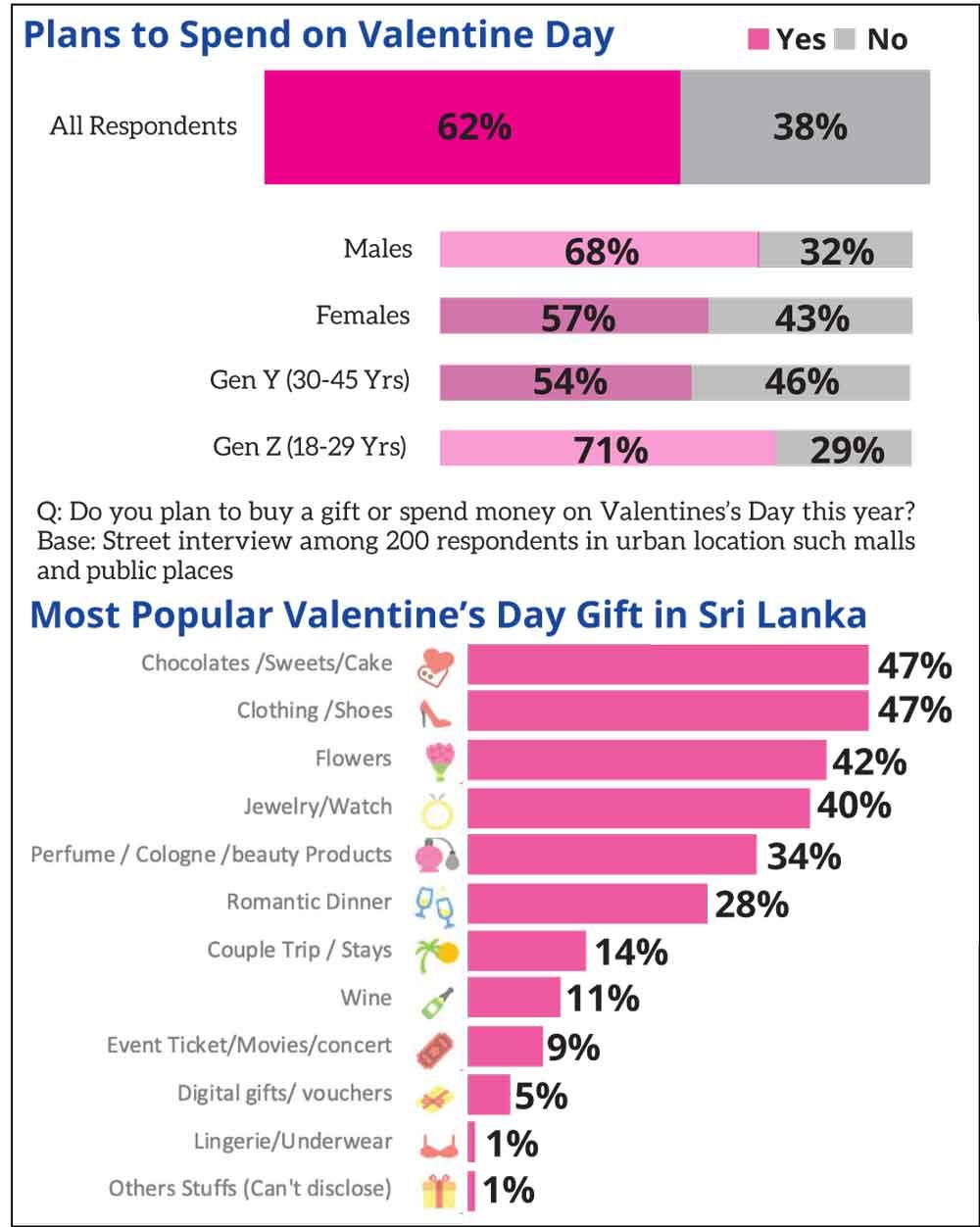
Nearly 2/3rd planned to spend on Valentine Day this year
A recent Sparkwinn Research survey shows that 63 percent of Sri Lankans in relationships or married plan to spend on Valentine’s Day, covering gifts and experiences.
Enthusiasm is particularly high among Gen Z, with 72 percent planning to splurge, compared to 54 percent of Gen Y. Gender differences are also notable: 68 percent of men intend to buy gifts for their partners, while 57 percent of women reported the same. The findings highlight far from fading, Valentine’s Day continues to be a key occasion for celebration and consumer spending among couples in Sri Lanka.
Most Popular Valentine’s day gift in Sri Lanka
Among survey respondents, the most popular Valentine’s Day gifts are chocolates or cakes (47 percent), followed by clothing and shoes (47 percent) and flowers (42 percent). The allocation of spending also reflects generational differences: younger participants (Gen Z) tend to favour tangible, visible gifts such as chocolates and fashion accessories, while Gen Y, with greater financial capacity, prioritizes experiences like dining out and leisure activities. This pattern highlights how Valentine’s Day in Sri Lanka is evolving, blending traditional gift-giving with experience-led celebrations.
When do they really make the purchase?
Most Sri Lankans tend to shop for Valentine’s Day at the last minute. The survey reveals that 44 percent purchase gifts just one to two days before the occasion, while a further 29 percent buy them on the day itself. Only a smaller segment plans ahead, with 15 percent shopping three to six days prior and just 12 percent purchasing at least one to two weeks in advance. These findings highlight a clear tendency toward spontaneous, last-minute Valentine’s Day shopping among Sri Lankan consumers.
From which channels are gifts purchased?
The survey indicates that offline channels remain the primary mode for Valentine’s Day shopping in Sri Lanka, with 65 percent of respondents purchasing exclusively in physical stores. Meanwhile, 24 percent use both online and offline channels, and only 11 percent rely solely on online shopping, highlighting the continued dominance of in-person retail experiences.