Reply To:
Name - Reply Comment
INDIA TODAY - The United States expanded its airstrike campaign against Iran early Friday, hitting bridges, electrical equipment and a tower at a key port, as President Donald Trump stepped up pressure on Tehran over its hold on the Strait of Hormuz. Iran responded with fresh missile attacks on US-allied countries in the Middle East, including Qatar, while also targeting sites in Bahrain and Kuwait.
The fighting marks a further collapse of the interim ceasefire agreed last month, with the US and Iran trading attacks for days as they vie for control of the strait. Iranian officials said US strikes have killed dozens and wounded hundreds, while attacks linked to Iran caused damage in neighbouring countries and raised fresh concern over shipping through the waterway.
Trump, speaking in a primetime address to the American public, said the war was going well. "We are likewise winning big in Iran, and you will see the fruits of that labour very, very shortly," he said.
In Iran's southern Hormozgan province, overnight US airstrikes hit bridges in Bandar Khamir, a coastal city on the Strait of Hormuz, killing at least seven people, Iranian state television reported. The highway and railway bridge strikes appeared aimed at cutting off Bandar Abbas, Iran's main port, from routes leading into the country's central region and onward to Tehran. Other routes remain open, but the strikes could still disrupt the movement of military supplies and goods.
Iran also publicly acknowledged attacks on power infrastructure for the first time during the US air campaign. Its Energy Ministry urged people in southern provinces to reduce power use, saying the areas "are currently experiencing extreme heat and attacks on power infrastructure". The ministry did not say whether the strikes hit power plants, transmission lines or other equipment. Tehran city councilman Mehdi Chamran had earlier said, "Just look at how many power facilities they hit ... and you wouldn't be asking that question."
The US military's Central Command said it struck dozens of targets in the latest round of attacks, which ended at dawn Friday and marked the sixth straight night of American strikes. Iranian state-run IRNA reported that one strike brought down a tower at Chabahar port on the Gulf of Oman, which serves as a key trade route for neighbouring Afghanistan. Iran said the tower oversaw commercial traffic into the port. Chabahar, which Iran had been operating with support from India, has been repeatedly targeted in US strikes. By 6 am Friday, the strikes had killed at least 38 people and wounded more than 400 in Iran, according to Health Ministry spokesperson Hossein Kermanpour.
Iran's retaliation widened across the region. Qatar twice warned residents to take shelter as Iranian missiles targeted the country, with explosions heard overhead as air defences intercepted the barrage. Qatar's Interior Ministry said falling debris wounded a child. Qatar, along with Pakistan, has been mediating efforts to end the war, but talks have broken down over Iran's hold on the Strait of Hormuz.
Iran also targeted Bahrain and Kuwait early Friday. In Kuwait, authorities said an attack hit a power and water desalination plant, causing widespread damage. Kuwait said the fire had been put out and work was under way to assess the damage and restore operations. Jordan's military said it intercepted three incoming missiles launched by Iran on Friday morning. In northern Iraq's semi-autonomous Kurdish region, explosions were heard in Irbil and Sulaymaniyah as air defences engaged incoming fire. The attack apparently targeted the Iranian Kurdish dissident group Komala, killing at least nine people and wounding others, an official said on condition of anonymity for security reasons. Iran did not immediately claim that attack, though it has targeted Komala in the past.
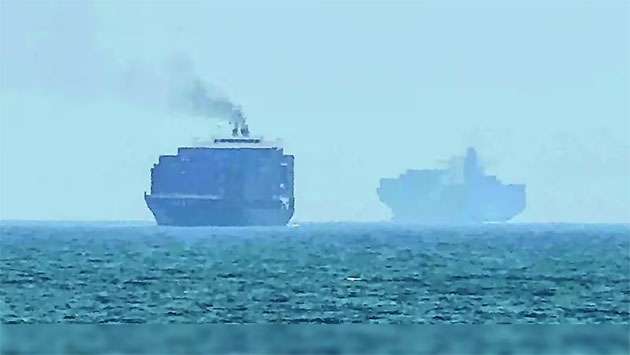
Also on Friday, a tanker travelling through the Strait of Hormuz on the route closest to Oman came under attack, according to the United Kingdom Maritime Trade Operations centre. It said the vessel suffered minor damage and no crew members were injured. Iran has been attacking tankers on that route near Oman, but did not immediately acknowledge any such strike.
The latest exchange comes as Washington and Tehran intensify their struggle over the Strait of Hormuz. After the US and Israel launched the war on Iran on February 28, Tehran effectively closed the strait to shipping, pushing oil prices higher and strengthening its position in negotiations. Trump has in recent days repeated his threat to target Iranian power stations and bridges, while the US has reimposed a naval blockade on Iranian ports to stop crude shipments. Lloyd's List Intelligence said week-to-week cargo movements through the strait fell by nearly a quarter at the start of the month, even before the recent escalation. Some ships are now crossing with their location devices turned off, while others are staying put, underlining the growing disruption around one of the world's most important energy routes.