AI SUMMARY GENERATED ONLY FROM THIS ARTICLE'S TEXT.
Central Bank says estimated US $ 10.85bn is required for implementing NDCs until 2030
Warns cost of inaction is rising as climate risks intensify
Stresses launch of Sustainable Finance Roadmap 2.0 is a critical step forward for SL
Stakeholder committee and working groups to be formed in near future
“Sustainable finance is no longer optional. It is an economic, social and environmental imperative globally and here in Sri Lanka”
- Dr. Nandalal Weerasinghe
Sri Lanka’s financial sector must gear up to mobilise an estimated US $ 10.85 billion by 2030 to meet the country’s climate commitments, the Central Bank said, while warning that the cost of inaction is rising as climate risks intensify.
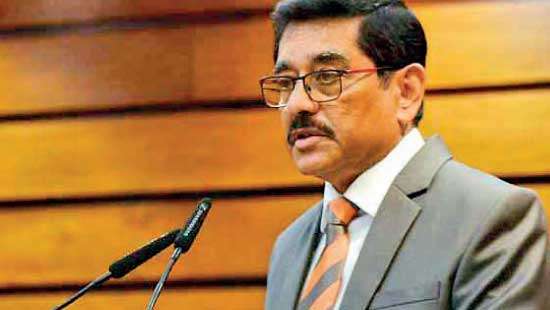
The caution was delivered by Central Bank Governor Dr. Nandalal Weerasinghe at the launch of the Sustainable Finance Roadmap 2.0 in Colombo yesterday. Dr. Weerasinghe described the initiative as a “critical step forward” in building resilience and long-term sustainability in the country’s financial sector and broader economy.
“In the Sri Lankan context, it is estimated that US $ 10.85 billion is required for implementing the Nationally Determined Contributions (NDCs) until 2030,” Dr. Weerasinghe stated.
The new roadmap integrates both environmental and social sustainability to ensure a more inclusive financial future.
The fresh push towards sustainable finance comes at a time when climate-related shocks pose a growing threat to the macroeconomic and financial stability of countries such as Sri Lanka, already grappling with recovery from a crisis that struck the economy in 2022.
Dr. Weerasinghe cautioned that the extreme weather events the island nation has witnessed are no longer anomalies but are signs of a shifting climate that would increasingly impact the country’s agriculture, energy security, infrastructure and livelihoods. “Sustainable finance is no longer optional. It is an economic, social and environmental imperative globally and here in Sri Lanka.”
The Sustainability Roadmap 2.0 builds on the foundation set in 2019 and aligns with the Central Bank’s updated mandate under its new act, which incorporates inclusiveness as a core responsibility alongside price and financial stability.
Dr. Weerasinghe noted that the Central Bank has “strategised how financial inclusion could be achieved” and that climate-related shocks must now be viewed through both monetary and financial lenses.
“Supply-side disruptions could trigger inflationary pressure, weakening price stability while building up of nonperforming portfolios following a catastrophe, which could take a toll on financial system stability through a credit crisis,” he said.
In parallel to climate resilience, the roadmap also seeks to advance Inclusive Green Financing and integrate vulnerable groups, MSMEs and gender considerations into the financial architecture. The implementation of Phase II of the National Financial Inclusion Strategy will serve as a key driver in achieving this.
As decarbonisation efforts tighten across key export markets like Europe and global disclosure norms such as S1 and S2 come into play, Sri Lanka’s financial sector must not lag behind, Dr. Weerasinghe stressed.
Meanwhile, acknowledging inter-institutional gaps and funding challenges, Dr. Weerasinghe urged the stakeholders to treat sustainability not as a checkbox but as an urgent national priority. According to him, successful implementation of the Roadmap 2.0 will position Sri Lanka at the forefront of the sustainable financing leadership in the region.
“We have challenges to overcome especially with inter-institutional coordination and alignment with a national strategy in climate financing… implementation of the actions laid down in Roadmap 2.0 is very important as it will strengthen the foundation of the financial sector to gain more resilience against climate risks while uplifting financial inclusion among society.”
Addressing the leaders of financial institutions and heads of relevant departments, Dr. Weerasinghe called for full cooperation from all parties, noting that stakeholder committees and working groups will be established soon to push forward with execution.
Central Bank launches Sustainability Roadmap 2.0
Updated roadmap emphasises actions that will support Sri Lanka to position itself as ‘investment-ready’ after its debt restructuring process
Sri Lanka yesterday saw the launch of the Sustainability Roadmap 2.0, developed by the Central Bank, with technical and financial support from the International Finance Corporation, a member of the World Bank Group, in partnership with the European Union, under the Accelerating Climate-Smart and Inclusive Infrastructure in South Asia programme.
The updated roadmap emphasises actions that will support Sri Lanka to position itself as ‘investment-ready’ after its debt restructuring process, with the key guidelines and protocols in place.
While acknowledging that scaling the contribution of the financial sector to the country’s sustainable development requires a broad multistakeholder and multisectoral approach, the Central Bank said the new roadmap primarily focuses on the actions that are under the mandate of the key financial sector regulators.
Recognising the significance of addressing climate-related risks to achieve its dual goals of price stability and financial system stability, the Central Bank embarked on its sustainable finance initiative in 2016.
The first roadmap was launched in 2019, to address the need for incorporating environmental sustainability into the financial system to mitigate the adverse impacts of climate change by promoting policy cohesiveness across the financial sector regulators. Subsequent to the launch of the first roadmap, initiatives such as Sri Lanka Green Finance Taxonomy and Directions/Guidelines for banking and NBFI sectors, which predominantly covered the green financing activities, were issued by the Central Bank.
However, according to the financial sector regulator, even after five years after the publication of Sri Lanka’s first roadmap for sustainable finance, the contribution of the financial institutions to the country’s sustainability targets remains small.
“There is, therefore, an urgent need to support the financial ecosystem to better align its funding with not only environmental challenges but also social challenges faced by Sri Lanka and to scale up its contribution to the sustainable development objectives of the country,” the Central Bank said in the publication launched yesterday.
The first roadmap highlighted financial inclusion as a core pillar but its actions were limited to developing the National Financial Inclusion Strategy for implementation.
The Sustainable Finance Roadmap 2.0 aims to address the social dimension of sustainability in a comprehensive manner, ensuring social justice for identified vulnerable groups and MSMEs to achieve financial inclusion. The 2.0 Roadmap strengthens the existing framework by taking stock of the trends in sustainable finance and progress made since the publication of the first roadmap in 2019. These include: evolutions in reporting requirements and standards, with an emphasis on those aligned with the International Sustainability Standards Board - ISSB10, improved guidance on environmental risk management for the financial sector and a stronger emphasis on biodiversity and nature finance, following the adoption of the Kunming-Montreal Global Biodiversity Framework in 2022.
Comments - 10
Comments - SL’s financial sector faces over US $ 10bn climate bill
Ram P Tuesday, 06 May 2025 08:30 AM
It is an uphil task to find $10bn by 2030 to cover a climate issue. We are in real trouble. There is one aspect that is never visited or discussed. That is the amount of oil, coal and gas used by countries like US, China
12
Aloysius Tuesday, 06 May 2025 02:18 PM
Nandalal was the deputy of Arjuna Mahendran during the bond scam.
11
Banana Rebublic Tuesday, 06 May 2025 08:38 AM
Are Sri Lankans so DUMB to listen to this man who printed ship loads of Rupees?
12
Solution to the Banana Republic Tuesday, 06 May 2025 12:00 PM
Create economic growth by reviving all the industries that were deliberately DESTROYED by the previous regimes and create jobs internally without depending on handouts from the IMF. As these loans have to be paid by further borrowing only without any growth internally. Stop further depreciating the Rupee by printing money.
Also MANY new industries can be created INTERNALLY, again providing employment opportunities.
Sri Lanka has so many resources which are untapped.
Sri Lanka CURRENTLY is like a bunch of beggars sleeping on a golden mountain and seeking handouts from IMF. Only the greedy politicians are benefitting from this. They prefer this as with this system of hand to mouth existence they can control the masses!
In the past Sri Lanka was the granary of the East but now even importing rice and coconuts- what a shame!
03
Lol Tuesday, 06 May 2025 09:09 AM
Now now Nande what were you saying a few weeks ago together with AKD or to AKD, it doesn't make a difference, about the economy of the country on the path to recovery and some such bullshit noh, when a coconut is 25O/- and the senior citizens are practically begging on the streets!!! Ane ammapa!!!!
17
Dilshan Perera Tuesday, 06 May 2025 10:23 AM
Time to investigate Nadalal for his allegiances.. climate change mitigation is important, but where would $10 bn be spent?? On what?? This is a Central Bank that aims to destroy commercial plantation companies, and timber plantations.. what sort of pro-enviornmental policies is Nandalal trying to implement, since he's well known for excesses and wastefulness?
05
Chryshan Tuesday, 06 May 2025 10:59 AM
I don't know why AKD is keeping this guy knowing he is not faithful to the govt. Now that things are stabilised time to appoint another governor to central bank.
24
Punchi Thusithaya Tuesday, 06 May 2025 08:37 PM
Voice of a global agent.
11
Umar Perera Thursday, 08 May 2025 04:36 PM
Decimating our forests and pollution will aggravate this cost. Climate costs are real. SL location is ideal for solar farms but Govts don't seem to want to fund these initiatives.
00
M Fernando Monday, 12 May 2025 11:27 PM
Solar Panels dont pay 'commis'... - one time install and you can leave them for 5-10 years. , whereas Oil and Coal supply contracts do !
01
222
Add comment
Comments will be edited (grammar, spelling and slang) and authorized at the discretion of Daily Mirror online. The website also has the right not to publish selected comments.



 SHABIYA ALI AHLAM