Reply To:
Name - Reply Comment
By Nishel Fernando
|
Ramana Jampala |
The global port optimisation experts are cautioning the Sri Lankan terminal operators against prioritising massive infrastructure investments without first addressing the underlying operational inefficiencies, warning that capacity expansion is not the immediate answer for growth.
The experts, speaking at the TT & TE 2026 conference in Colombo yesterday, argued that the incremental investment dollars required for infrastructure expansion would not yield optimal returns, if the terminals fail to first maximise the throughput from their existing footprints.
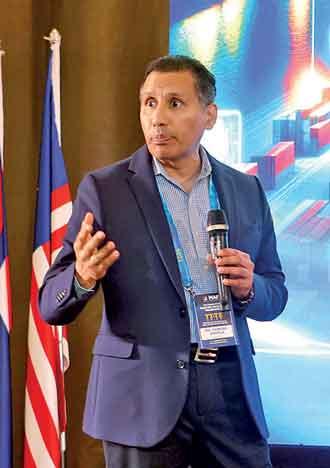
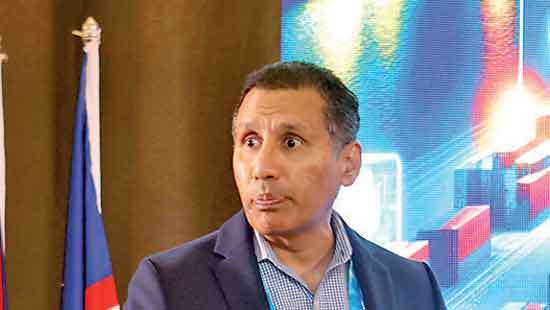
“Preceding expansion, please emphasise on efficiency,” said US-based Avlino Inc Founding President and CEO Ramana Jampala, delivering the keynote address.
“If you don’t have efficiency in your terminal operations, the incremental investment dollars you would require, in order to get incremental revenue, will not be optimal.”
Jampala stressed that the industry is witnessing a “paradigm shift”, where the traditional “local minima” approach, such as prioritising the fastest possible discharge of a delayed vessel at the expense of yard congestion, is being replaced by “runtime optimisation”. This new model uses AI to predict the state of the yard days in advance, allowing the operators to make real-time trade-offs between the throughput, equipment utilisation and turnaround times.
To illustrate the potential of operational optimisation, Jampala cited a case study from the Virginia Port Authority (VPA), with whom the Sri Lanka Ports Authority (SLPA) maintains a strategic partnership.
Six years ago, the VPA’s Virginia International Terminal faced severe gate congestion, with the trucks queuing for hours. The initial solution proposed was a capital-intensive expansion of the gate lanes. However, the data analysis revealed the root cause was not gate capacity but inefficient yard stacking. The containers were being “touched” or rehandled an average of 2.3 times before being delivered to a truck, resulting in turn times of over 7.5 minutes.
“What did Avlino do? We did not go ahead for Capex. That would have cost undoubtedly between US $ 30 to US $ 50 million,” Jampala explained.
Instead, the terminal implemented an AI-driven “housekeeping” system. By predicting the “dwell time”—how long a container would stay in the yard—the operators could pre-arrange the containers during the idle periods.
“We didn’t reduce that from 2.3 to 2.1 (touches). We reduced it by a whopping 45 percentage points,” Jampala noted.
“Today those containers are touched only 1.4 times. The truck-in truck-out time has reduced from 7.5 minutes down to four minutes.”
The reference to Virginia is particularly relevant, given the SLPA’s ongoing collaboration with the VPA. In June 2024, the two entities signed a historic Memorandum of Cooperation to exchange the expertise and technical know-how. The agreement, facilitated by the US Embassy in Sri Lanka and Colombo Plan, aims to modernise the SLPA’s operations by adopting best practices from Virginia, which is widely regarded as one of the most technologically advanced ports in the US.
The partnership focuses on areas such as semi-automated operations, data sharing and sustainable port management, directly aligning with the efficiency-first approach advocated by the experts at the forum.
Echoing the call for practical efficiency over hype, Colombo West International Terminal (CWIT) CEO Munish Kanwar rejected the notion of fully autonomous “ghost terminals” for Sri Lanka.
Speaking during the panel discussion, Kanwar noted that while CWIT is a “digital native” project, free from legacy systems, the local operating environment—characterised by unpredictable trucking habits and lane readiness—makes full autonomy risky.
“What we got in the name of AI was advanced automation but automation is good at doing repetitive and predictable things. Whereas AI is born to use for unpredictability,” Kanwar said.
He championed an “Iron Man philosophy” for CWIT, where technology empowers human decision-makers rather than replacing them.
“Iron Man is not a robot. It’s a human which has been given that high-tech suit... decision-making will still be with people but then they will have better tools,” he said.
The forum also highlighted a shift in key performance indicators from pure speed to sustainability. The panellists discussed the financial imperative of the “green move”—essentially, the move not made.
With the average cost of a single container move ranging between US $ 5 and US $ 8, reducing the unnecessary rehandles, offers massive savings. The experts estimated that for a terminal handling two million TEUs, reducing the rehandle count could save approximately US $ 15 million annually in operational expenses, proving that the environmental sustainability and financial efficiency are mutually reinforcing goals.