Reply To:
Name - Reply Comment
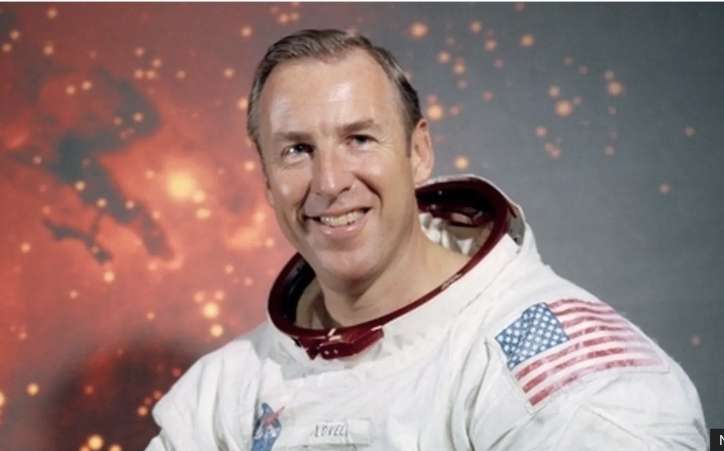
BBC- Astronaut Jim Lovell, who guided the Apollo 13 mission safely back to Earth in 1970, has died aged 97.
Nasa said he had "turned a potential tragedy into a success" after an attempt to land on the Moon was aborted because of an explosion onboard the spacecraft while it was hundreds of thousands of miles from Earth.
Tens of millions watched on television as Lovell and two other astronauts splashed back down into the Pacific Ocean, a moment which has become one of the most iconic in the history of space travel.
Lovell, who was also part of the Apollo 8 mission, was the first man to go to the Moon twice - but never actually landed.
Acting Nasa head Sean Duffy said Lovell had helped the US space programme to "forge a historic path".
In a statement, Lovell's family said: "We will miss his unshakeable optimism, his sense of humor, and the way he made each of us feel we could do the impossible. He was truly one of a kind."
Tom Hanks, who played Lovell in the 1995 movie Apollo 13, called the astronaut one of those people "who dare, who dream, and who lead others to the places we would not go on our own".
Hanks said in a statement on Instagram that Lovell's many voyages "were not made for riches or celebrity, but because such challenges as those are what fuels the course of being alive".
One Saturday, a 16-year-old hauled a heavy, three-foot tube into the middle of a large field in Wisconsin.
He had persuaded his science teacher to help him make a makeshift rocket. Somehow, he had managed to get his hands on the ingredients for gunpowder - potassium nitrate, sulphur and charcoal.
He pulled on a welder's helmet for protection. He packed it with powder, struck a match and ran like hell.
The rocket rose 80 feet into the air and exploded. Had the chemicals been packed slightly differently, he would have been blown to pieces.
For Jim Lovell, this was more than a childish lark.
In achieving his dream to be a rocket scientist, he would become an American hero. But it was not going to be easy.
James Arthur Lovell Jr was born on 25 March 1928 - just a year after Charles Lindbergh made his historic trip across the Atlantic.
"Boys like either dinosaurs or airplanes," he said. "I was very much an airplane boy."
When he was five years old, his father died in a car accident.
His mother, Blanche, worked all hours, struggling to keep food on the table. University was well beyond their financial reach.
The answer was the US Navy, which was hungry for new pilots after World War Two. It was not building rockets but at least it involved flying.
Lovell signed up to a programme that sent him to college at the military's expense while training as a fighter pilot.
Two years in, he gambled and switched to the Navy Academy at Annapolis, on Chesapeake Bay, in the hope of working with his beloved rockets.
A few months later, the Korean War broke out and his former fellow apprentice pilots were sent to South East Asia. Many never got to finish their education.
Marriage was banned at Annapolis and girlfriends discouraged. The navy did not want its midshipmen wasting their time on such frivolities.
But Lovell had a sweetheart. Marilyn Gerlach was the high school girl he had shyly asked to the prom.
Women were not allowed on campus and trips outside were limited to 45 minutes. Somehow the relationship survived.
Just hours after his graduation in 1952, the newly commissioned Ensign Lovell married her.
They would be together for more than 70 years, until Marilyn's death in 2023.
In 1958, he applied to Nasa.
Project Mercury was America's attempt to place a man in orbit around the Earth. Jim Lovell was one of the 110 test pilots considered for selection but a temporary liver condition put paid to his chances.
Four years later, he tried again.
In June 1962, after gruelling medical tests, Nasa announced its "New Nine". These would be the men to deliver on President Kennedy's pledge to put American boots on the Moon.
It was the most elite group of flying men ever assembled. They included Neil Armstrong, John Young and, fulfilling his childhood dream, Jim Lovell.