Reply To:
Name - Reply Comment
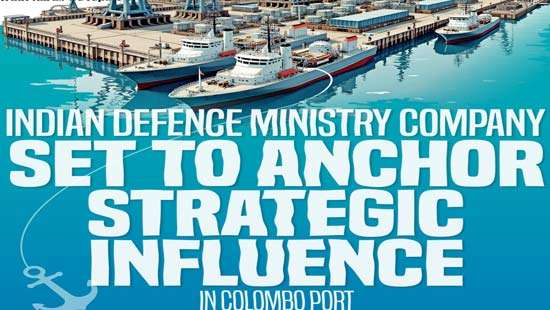

India is poised to secure another strategic investment in Sri Lanka with plans by its public sector company under the Indian Defence Ministry, ‘Mazagaon Dock Shipbuilders (MDL)’ for acquiring a majority stake in Colombo Dockyard PLC (CDPLC).
As reported by the Indian media, the company said that the board of directors has “approved the proposal for acquisition of a controlling and substantial stake of Colombo Dockyard PLC by way of an investment not exceeding $ 52.96 million.
Mazagon Dock, along with Colombo Dockyard and Japan’s Onomichi Dockyard, signed a tripartite agreement on June 27 under which MDL will acquire the Japanese company’s controlling stake in Colombo Dockyard.
The Mumbai-headquartered Mazagon Dock Shipbuilders is a public sector shipyard and is also known as the ‘Shipyard of the Nation’. It specialises in the construction of warships, submarines, and commercial vessels.
The Colombo Dockyard, which has been in a difficult position for some time, was on the verge of default. The Sri Lankan government has been requesting the Indian government to encourage Indian investors to invest in the dockyard. The Indian state-owned company was shortlisted in view of their record in shipbuilding as well as its financial strength. Both these aspects are key for the turnaround of the Colombo Dockyard. Mazagon Dock Shipbuilders’ net worth, represented by its market capitalisation, is approximately $15.12 billion USD as of June 25, 2025, as reported by WION news.
The involvement of an Indian defence manufacturing company in the Colombo port, a vital strategic asset, is bound to enhance geopolitical contestation in the region involving major powers. Sri Lanka is already sandwiched in the tussle with major western powers, along with India, having made a foray into the region in a concerted effort to counter the influence of China.
In the involvement of China even for investment projects, Sri Lanka has now been unable to make independent decisions.
The Frontline Socialist Party, a breakaway group of the JVP, which is the main party of the ruling National People’s Power (NPP), said the presence of such a company involved in the manufacturing of defence equipment would endanger the national security of Sri Lanka. The party said the entire transaction is a huge economic loss to the country.
The party said the entire process is flawed with irregularities, and action should be taken to prevent the realisation of this transaction.
India’s entry into the Colombo Dockyard allows operational proximity to China’s presence in Hambantota, and greater influence within the Colombo Port, a major transhipment hub. India will gain strategic depth through the use of soft power if it secures this project. China’s Hambantota Port lease remains a sore point for India.
India has already protested the presence of Chinese research vessels in Sri Lankan waters. China remains miffed by this action at the moment. With India now taking over, China will perceive Sri Lanka as leaning more openly toward the Indo-Pacific bloc. Japanese ownership, in fact, offered a buffer for Sri Lanka.