Reply To:
Name - Reply Comment
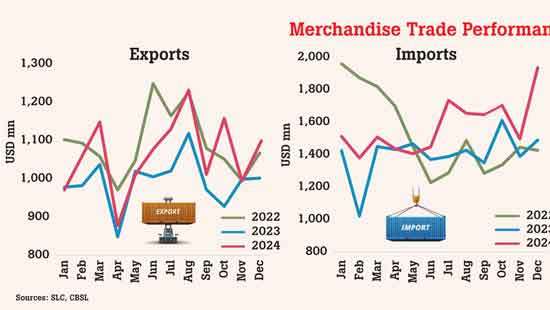
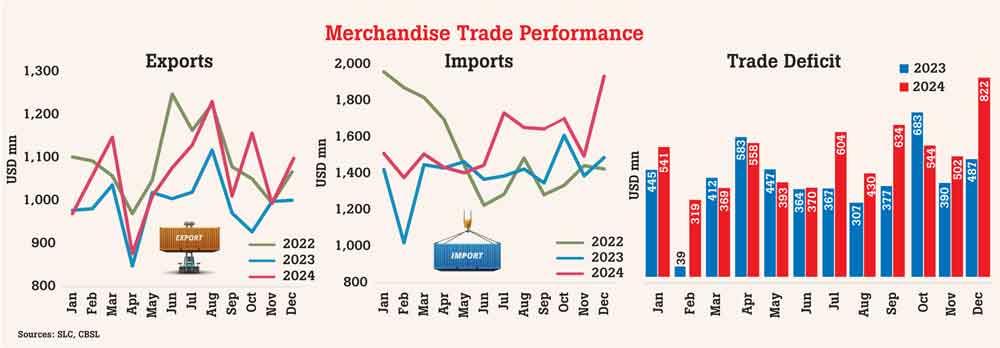
Sri Lanka’s imports raced in December last year to US$ 1,924.5 million, up 29.3 percent from the same month in 2023, reaching the highest monthly outflow for imports during 2024. This reflects the heightened year-end demand which met with the general recovery in imports as the overall economy is on a solid recovery.
Contrary, the merchandise exports recorded earnings of US$ 1,101.8 million, up 10.0 percent, supported by both industrial and agricultural exports. Higher volumes of bunkering and aviation fuel exports sent the earnings from petroleum products up while higher tea prices and the better performance from spices and coconut related products exports sent agricultural products exports higher in December 2024.
This resulted in a trade deficit of US$ 822.7 million for the month, sharply up from the US$ 486.8 million in the same month in 2023.
For the full year, the trade deficit came in at US$ 6,069.4 million in 2024 compared to US$ 4,900.4 million in 2023 on imports of US$ 18, 841.4 million and exports of US$ 12,772.0 million.
In fact, earnings from merchandise exports in 2024 was the second highest so far which was largely driven by the exports of petroleum products which earned US$ 1,063.5 million, up nearly 100 percent from the US$ 539.4 million.
Full year exports were further buttressed by the US$ 5,061.0 million earned from textiles and garments in 2024, up 3.7 percent. Last year became only the second time after 2022, the sector was able to surpass US$ 5.0 billion in exports.
In December 2024, such earnings came in at US$ 447.6 million, up 1.7 percent from a year ago.
Led by the two categories and also the exports of food, beverage and tobacco products which came in at US$ 651.5 million, which was 20.8 percent higher for the year, the total industrial exports tallied to US$ 9,946.9 million, up 7.2 percent.
Meanwhile, tea generated US$ 131.6 million in exports earnings in December, up 18.4 percent from a year ago, taking the full year tally to US$ 1,435.9 million, up 9.6 percent.
Earnings from spice exports also did well with annual earnings of US$ 454.7 million, up 15.7 percent while coconut and related products exports also came in stronger at US$ 416.5 million, higher by 23.7 percent.
This brought total exports from agriculture and related products to US$ 256.5 million for December 2024, up 24.2 percent and US$ 2,774.5 million for the full year, higher by 8.1 percent.
Meanwhile,the 2024 imports were led by machinery and equipment for which Sri Lanka spent US$ 2,363.1 million, rising 26.5 percent. This, along with the increase in the spending for other investment goods such as building materials and transport equipment reflected public and private investments which are once again coming back into the economy, as reflected by the construction sector recovery.
For textiles and textile articles, the country spent US$ 2,847.1 million, up 20.1 percent.
For fuel imports which include coal, Sri Lanka spent US$ 4,354.4 million in 2024, which was 7.4 percent less than in 2023, predominantly due to the low oil and coal prices in the global markets.
The consumer goods imports which comprise both food and beverages and non-food consumer goods rose by 13.9 percent in 2024 to US$ 3,465.7 million, reflecting the rising consumer spending.
Staples such as dairy products, cereal and milling industry products, vegetables and discretionary expenditure such as home appliances, clothing and accessories saw sharper increases towards the year-end of last year.
As Sri Lanka lifted the five-year long suspension on personal vehicle imports from February 1 onwards, the Central Bank reiterated that they are able to support even up to a billion dollar worth of vehicle imports in 2025 without causing any vulnerability to the external sector and thereby the broader economy.