Reply To:
Name - Reply Comment
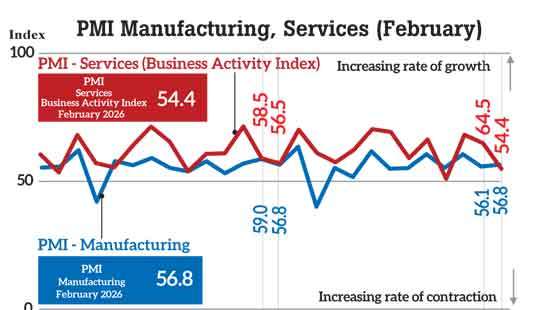
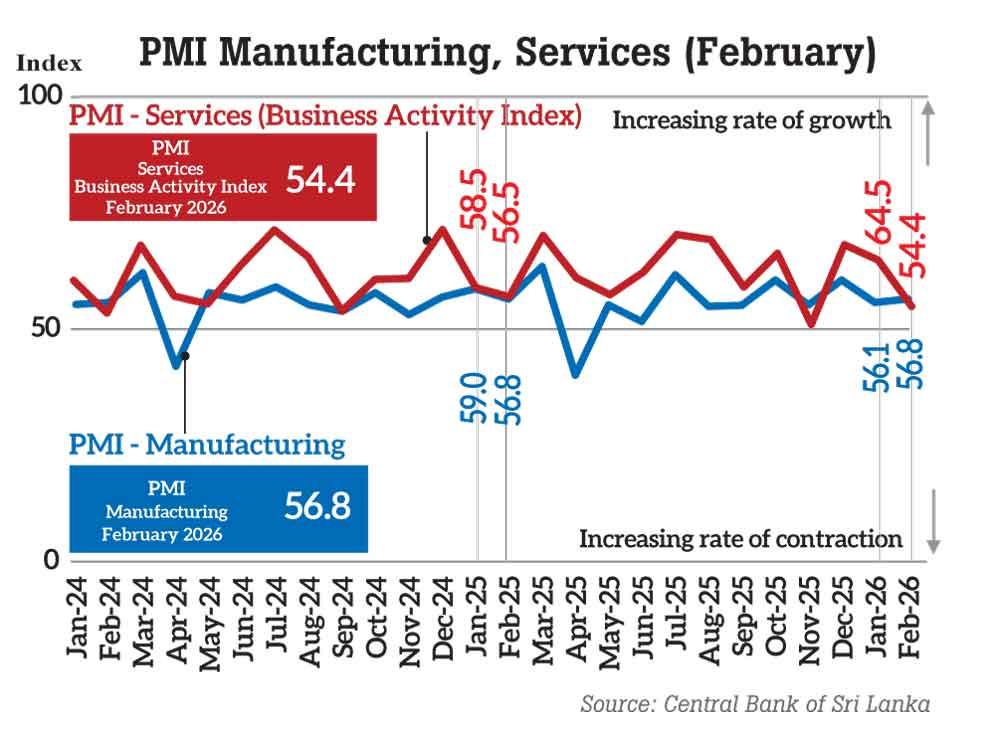
Sri Lanka’s economic activities were seen holding up in February before the war broke out at the end of the month, as seen from the Purchasing Managers’ Index (PMI) data, but the economy is currently feeling the brunt of the Iran war which broke out at the end of February.
The PMI for manufacturing activities was at 56.8 index points, slightly higher than the 56.1 index points in January but the services PMI fell to 54.4 index points from 64.5 in January indicating an expansion but at a relatively slow pace. In PMI, an activity is split between an expansion and a contraction at 50.0 index points.
The manufacturing activities expanded further in February from the January levels as the firms are getting ready for the coming New Year season as they were seen ramping up their production from February onwards.
“The New Orders and Production sub-indices expanded in February, albeit at a slower rate compared to the previous month”, the statement said.
“The Employment and Stock of Purchases sub-indices expanded further during the month, reflecting the firms’ preparations ahead of the festive season”, it added.
However these firms were seen pre-emptively stocking up in anticipation of potential supply pressures stemming from the unrest in the Middle East. In fact, today the economic activities have slowed substantially due to the shortage of fuel in the country due to limited passage of oil tankers via the Strait of Hormuz, a key waterway which carries a fifth of world’s oil due to attacks by Iran on ships passing the strait.
In a déjà vu of the conditions four years ago, people are again forced to wait in long queues for fuel and gas in Sri Lanka, despite fuel being rationed.
Back in 2022, the oil in the global market hit over US $ 140 a barrel when Russia invaded Ukraine pushing countries like Sri Lanka which were already on the brink after two years of fighting a global pandemic. Today, the oil is still hovering around US$ 103 a barrel.
Meanwhile, the services activities grew due to the robust performance in professional services and other personal services activities. Further accommodation, food and beverage, and education sectors continued to demonstrate sustained growth.
Employment too expanded in the sector as the firms hired new staff to meet rising consumer demand. But the consumer demand could be contained due to the rising prices as a result of the increase in the fuel prices by the government and also the loss of incomes by the people and businesses due to the fuel shortage.
The expectations for both manufacturing and services activities still remain positive due to coming festive demand but these expectations could be tempered by the prolonged limits on economic activities as a result of the short supply in fuel stemming from a protracted war with Iran.