Reply To:
Name - Reply Comment
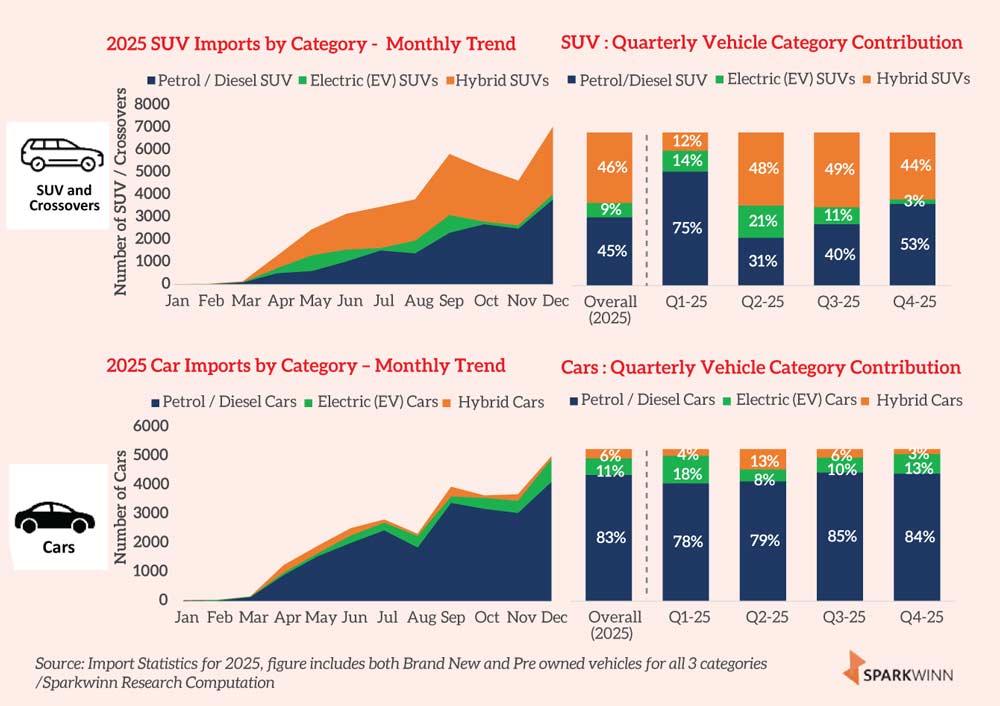
Sri Lanka’s automotive sector witnessed a significant shift in 2025, with electric vehicles (EVs) capturing 10 percent of total passenger vehicle imports following the lifting of prolonged import restrictions.
According to data from Sparkwinn Research, a total of 64,556 cars and SUVs were imported during the year, driven by a strong surge in pent-up demand that had accumulated while the market was closed.
Managing Director of Sparkwinn Research Suthaharan Perampalam noted that the market rebound was initially led by the high-end segment, which resulted in a higher proportion of EV imports immediately after restrictions were eased. Out of the total imports, 6,439 units were fully electric, while hybrid SUVs and cars accounted for a substantial 29 percent of the volume, totaling 18,709 units.
Market dynamics began to evolve towards the latter part of the year. By the fourth quarter of 2025, there was a noticeable off take in more affordable EV brands, signaling a move beyond just luxury buyers. Perampalam observed that if this trend sustains, it is likely to translate into stronger adoption among small and mid-sized car buyers in 2026, accelerating mass-market EV uptake across the island.
Current EV buyers in Sri Lanka are described as early adopters who recognise the technology’s future potential beyond its current limitations. As opinion leaders, their choices are expected to influence peers and wider communities, acting as a critical bridge between innovation and mass adoption.
However, the research emphasizes that stronger support infrastructure is now essential to send powerful signals to the “early majority” and accelerate mainstream acceptance.
Regionally, Sri Lanka’s EV adoption is notable compared to several neighbouring markets. While India’s EV share of new car registrations stood at approximately 2-3 percent in 2025 with an expected growth to 5 percent in 2026, Sri Lanka has already secured a 10 percent share. This performance places the country ahead of Malaysia, which recorded a 5 percent share in 2025, though it trails Singapore’s 43 percent and Thailand’s 15 percent share recorded in the first half of the year. (NF)