 Nishel Fernando
 Reply To:
Name - Reply Comment
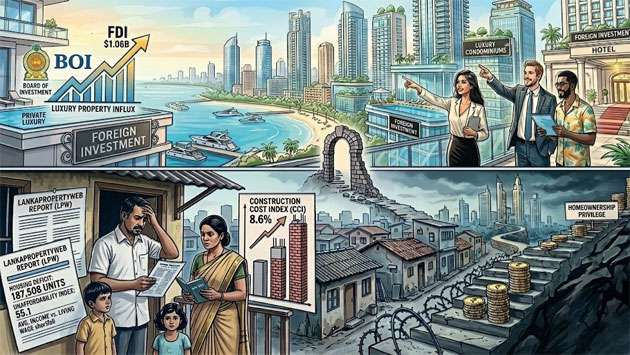
Colombo, May 14 (Daily Mirror) - The dream of owning a home in Sri Lanka is slipping further out of reach for everyday citizens, even as foreign money pours into the country's luxury property market. While the economy shows signs of recovery and international investors are eagerly funding high-end apartments and hotels, local families are left facing a massive shortage of affordable housing.
This growing divide between booming foreign investments and the daily struggles of local homebuyers has created an urgent crisis. For the country to truly move forward, there is a pressing need to make sure that homeownership does not become a privilege reserved only for the wealthy.
At the heart of the issue is a stark supply and demand imbalance that has left the local population struggling to attain homeownership. According to the Sri Lanka Real Estate Market Outlook Report 2026 published by LankaPropertyWeb, the country faces a persistent housing deficit of approximately 187,508 units, representing a 13 percent increase since 2012. This shortfall is compounded by a severe affordability crisis that has gained international attention.
According to the latest Property Prices Index by Numbeo, Colombo is ranked as the world's most unaffordable city for homebuyers, recording an unprecedented price-to-income ratio of 55.1. A separate report by The Economist similarly ranked Sri Lanka as the second most unaffordable housing market in Asia. This reflects a stark reality where stagnant wages fail to keep pace with soaring property valuations and rapid urbanisation.
The financial strain on the average citizen is evident in recent household income data. As noted in the LankaPropertyWeb report, the average monthly household income remains at roughly Rs. 76,414, which falls significantly short of the Anker Living Wage Reference Value of Rs. 84,231 required for a basic standard of living in urban Sri Lanka. With essential expenditures absorbing the bulk of disposable income, entry-level housing remains fundamentally out of reach for a vast segment of the local population. Consequently, households have been compelled to finance this shortfall through increased borrowing, contributing to a rising demand for loans across the financial sector.
Despite these domestic headwinds, foreign direct investment paints a remarkably optimistic picture for the commercial and luxury property segments. Overall foreign direct investment rebounded impressively in 2025, climbing approximately 74 percent year-on-year to reach a historic USD 1.06 billion, as recently reported by the Board of Investment. More significantly, capital channeled directly into the property sector has seen exponential growth. The LankaPropertyWeb report notes that foreign direct investment channeled specifically into housing and property development nearly tripled, surging from USD 20.5 million to USD 56.2 million. This influx indicates that international investors remain highly bullish on Sri Lanka's high-end condominiums, mixed-use developments, and tourism-related hospitality real estate.
Translating this high-level investment into affordable local housing, however, is hampered by persistently high construction costs. Following the recent economic crisis, the housing construction cost index reached an all-time high of 77.20 points in the third quarter of 2025, recording an 8.6 percent quarterly increase. The report attributes this increase to several factors, including the rising prices of construction materials due to exchange rate fluctuations, higher transportation costs, and increased labour costs resulting from skilled labour shortages. The sharp rise in the index shows that construction costs remain structurally elevated, prompting developers to be cautious in the short term and ultimately reducing the supply of new, affordable homes.
An analysis of the current landscape suggests that while the top-end of the market is well-capitalised, a sustainable real estate ecosystem requires addressing the middle and lower tiers. On a positive note, monetary easing by the Central Bank of Sri Lanka has allowed commercial banks to reduce housing loan interest rates to a more accessible range of 7 percent to 15 percent. Industry analysts capture the sector's transitional phase by noting that as the economy stabilises and confidence gradually returns, the property market is evolving with new expectations from buyers, investors, and developers. Ultimately, bridging the massive unit deficit will require innovative, cost-effective construction methods and targeted policies to ensure that homeownership does not become an exclusive luxury in Sri Lanka.