Reply To:
Name - Reply Comment
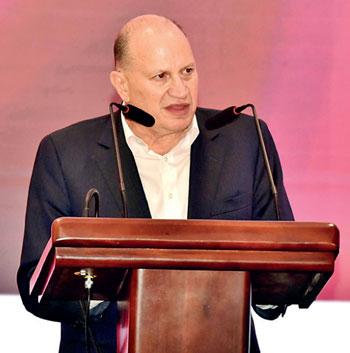 |
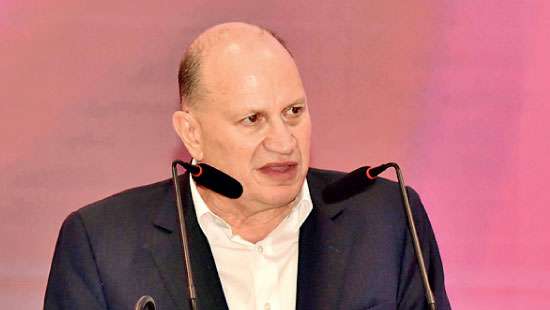
| Sir Mark Tucker PIC BY WARUNA WANNIARACHCHI |
By Nishel Fernando
Deeper regional and global integration will ultimately determine how Sri Lanka emerges as a regional hub in the reconfigured global economy, according to AIA Group Independent Non-Executive Chairman Sir Mark Tucker.
Delivering the keynote address at the Sri Lanka Institute of Directors Chairman’s and CEO’s Forum held in Colombo this week, Tucker emphasised that while the nation has achieved commendable economic stabilisation, transitioning to sustained expansion will require a sharp focus on good governance, long-term capital mobilisation and strategic integration into the shifting global supply chains.
Setting the stage by analysing the evolving geopolitical landscape, Tucker noted that the established ways of working across trade and economics are being challenged, creating a less predictable environment, where national security increasingly shapes economic decisions.
However, he firmly dismissed the notion of a retreat in globalisation, pointing out that world trade grew by 7 percent in 2025, to surpass US $ 35 trillion, with intra-Asia trade reaching record levels.
“My strong belief is that globalisation continues to undergo a significant reconfiguration, not a retreat,” he stated.
He added that “future growth may be concentrated in new trade corridors, more service-driven and increasingly shaped by digital capabilities and AI”.
In this reconfigured landscape, Sri Lanka’s promising growth trajectory stands out.
“These achievements are highly encouraging and I believe that they represent the beginning of the next critical phase of Sri Lanka’s growth journey,” Tucker observed.
He noted that the country is moving from crisis-era stabilisation toward a more predictable policy environment.
To truly capitalise on this momentum, Tucker stressed that long-term sustainable growth would require capital at a scale far exceeding what the public sector can provide.
Reconnecting to long-term private capital will depend heavily on establishing credible, investable and bankable pipelines, particularly through robust public-private partnership frameworks in sectors like infrastructure, energy and logistics.
Crucially, Tucker warned that capital only flows where there is trust, making strong corporate governance standards an absolute imperative. “Even the strongest investment case can fail if good governance is lacking, creating uncertainty, inconsistency or unmanaged risks,” he cautioned. Commending the Sri Lanka Institute of Directors for its role in advancing corporate governance, he added that the boards must lift standards in risk management and financial controls to ensure institutions remain resilient.
Beyond institutional governance, Sri Lanka must leverage its strategic competitive advantages, including its location on the main East-West Indian Ocean trade route, its highly proficient professional workforce and its vast blue economy potential.
Tucker highlighted that as the centre of gravity in global growth shifts towards the Indian basin, South Asia and the Middle East, Sri Lanka has a unique opportunity.
“As global trade patterns reconfigure and services grow in importance, Sri Lanka’s geography, immense talent and sector strengths can position it as a regional centre as the country moves decisively to integrate with the surrounding economic architecture,” he explained. Achieving this will require the nation to act thoughtfully and move quickly to accelerate the existing trade agreements and develop new ones to anchor market access.