 Nishel Fernando
 Reply To:
Name - Reply Comment
By Nishel Fernando
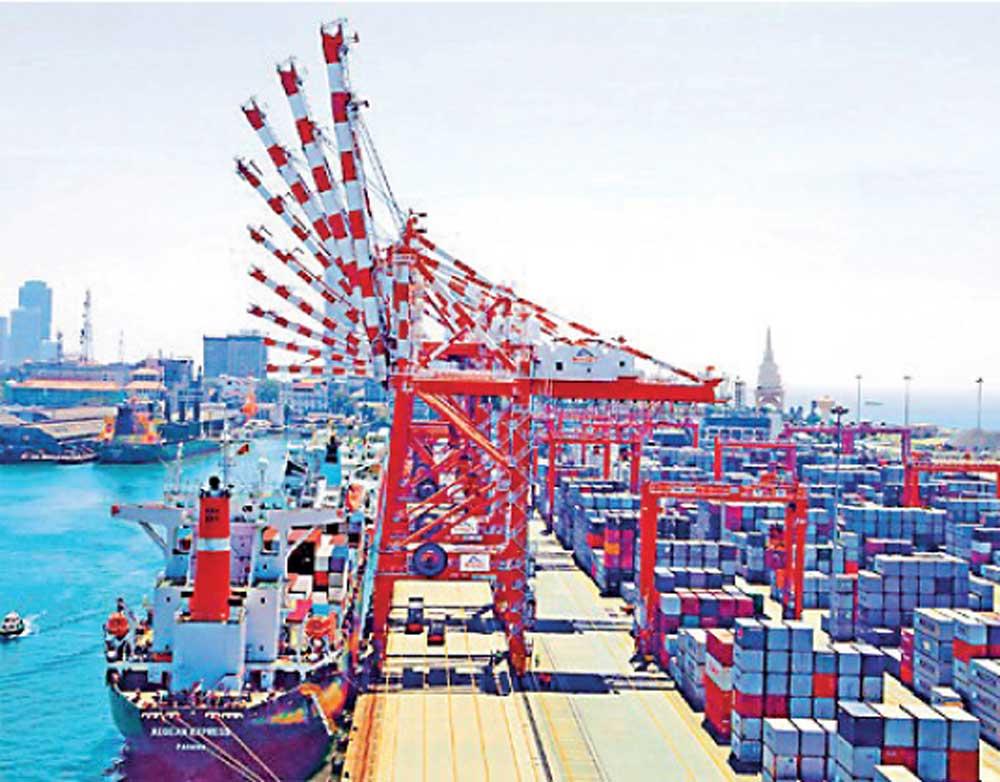
The Port of Colombo kicked off 2026 with robust performance metrics, driven by a significant expansion in its core transshipment business and the successful scaling of new deep-water terminal capacity.
According to the latest performance review, the transshipment volumes at the port grew by a commanding 14.9 percent in January 2026, reaching 604,173 twenty-foot equivalent units (TEUs), compared to the 525,768 TEUs recorded in the same month last year. This segment continues to be the lifeblood of the port’s operations, consistently accounting for 80 percent of Colombo’s total container throughput.
This transshipment boom catalysed a broader operational uplift, with the port’s overall container throughput swelling by 14.7 percent year-on-year to hit 754,730 TEUs in January 2026.
A closer look at the local trade dynamics reveals a shifting economic landscape, as the export volumes registered a strong 17.2 percent growth to 61,358 TEUs, signalling a recovery in domestic manufacturing and outbound trade. In contrast, the import volumes contracted by 8.1 percent to 52,774 TEUs during the same period. Further contributing to the operational intensity, the restowing activities experienced a massive 64.3 percent jump, reaching 36,425 TEUs.
Interestingly, this double-digit volume growth was achieved alongside a slight reduction in vessel traffic. Total ship arrivals at the port dipped by 2.8 percent to 342 vessels in January 2026, with container ship arrivals specifically falling to 308, from 317 in the previous year. This divergence between the surging volumes and declining ship calls underscores a broader industry trend, where the global shipping lines are increasingly deploying ultra-large container vessels to maximise economies of scale, a strategy made possible in Sri Lanka by the port’s enhanced deep-water infrastructure.
The terminal-by-terminal breakdown highlights a significant recalibration of market share within the port, heavily influenced by the introduction of Colombo West International Terminal (CWIT). CWIT proved its strategic value by handling 130,482 TEUs in January 2026, up from zero in the corresponding month last year.
This new capacity appears to have absorbed the volume from the older facilities. The state-run Jaya Container Terminal, together with UCT and ECT, saw container handling decline by 7.2 percent to 189,391 TEUs. Similarly, South Asia Gateway Terminals (SAGT) experienced a 12.2 percent drop, processing 159,325 TEUs. Meanwhile, Colombo International Container Terminals (CICT) remained the highest-volume operator, posting a marginal 1.2 percent growth to handle 275,532 TEUs.
In terms of overall cargo weight, the total tonnage handled by the port increased by 3.0 percent to reach 9,856,059 tonnes in January 2026. This growth was primarily anchored by containerised cargo, which rose 3.7 percent to 9,222,724 tonnes, a figure that includes the estimated tonnage for both SAGT and CICT. The non-containerised segments presented a mixed picture, with dry bulk growing 2.2 percent to 81,750 tonnes, while liquid bulk and break bulk handled dropped by 7.1 percent and 13.4 percent, respectively.
The Colombo Port’s impressive January performance is the result of converging geopolitical and infrastructural factors. While the ongoing maritime disruptions in the Red Sea have structurally altered the global shipping routes and solidified Colombo’s position as a relay hub, the port is also navigating intensifying regional competition, most notably from India’s maritime infrastructure push. The recent operationalisation of the Vizhinjam International Seaport in Kerala, India’s first deep-water transshipment terminal, represents a direct challenge to Colombo’s historical dominance.
Positioned just 10 nautical miles from the busy Suez-Far East shipping route and equipped with a natural depth of up to 24 meters, Vizhinjam has already begun attracting ultra-large container ships and mainline services that traditionally relayed through Sri Lanka.
With Adani Ports steering the facility, Vizhinjam had already been handling in excess of 100,000 TEUs a month by late 2025, capturing a slice of the lucrative Indian cargo that typically accounts for over 70 percent of Colombo’s transshipment business. Furthermore, the Indian government’s recent manoeuvres regarding the cabotage regulations have incentivised coastal relay traffic within the Indian ports, amplifying the competitive pressure on the transshipment volumes.
However, Colombo’s strong January performance indicates a deep resilience against this emerging threat. The strategic activation of CWIT—itself uniquely developed in partnership with the Adani group and its local partner JKH—has provided the critical capacity and highly automated efficiency needed to retain the major shipping lines and absorb the unexpected volume surges.
While Vizhinjam is slated to expand its capacity to 6.2 million TEUs in its future phases, Colombo’s entrenched scale, operational maturity and swift turnaround times have allowed it to maintain its formidable market share and commercial credibility in the Indian Ocean.