Reply To:
Name - Reply Comment
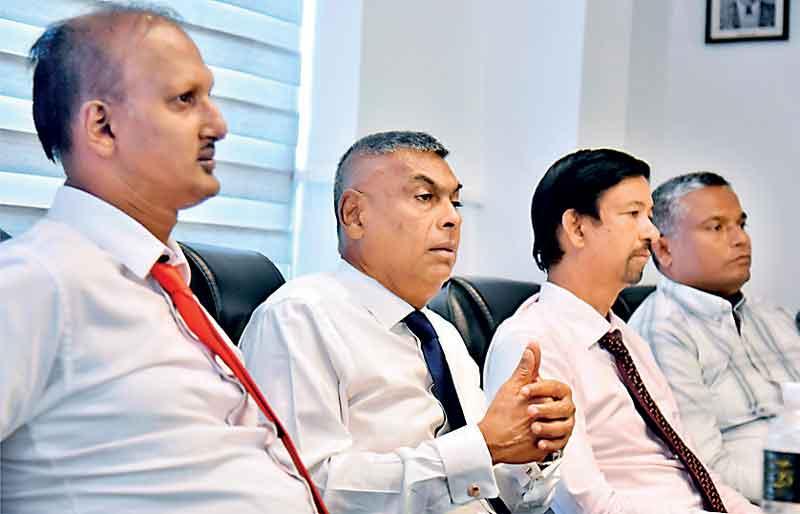
CFMASL President Shiran Fernando speaking to journalists, while other members of the association look on
Pic by Kithsiri de Mel
Sri Lanka’s canned fish manufacturers are seeking the removal of the 18 percent VAT imposed on locally produced canned fish to ensure accessibility for low-income families to the cheapest source of protein in order to tackle malnutrition among lower-income households.
Local consumption of canned fish has dropped from around 300,000 tins per day two to three years ago to approximately 200,000 tins as of now.
“Canned fish is actually meant for the poorer people of Sri Lanka. It is one of the cheapest forms of protein available in this country. So, we are requesting the government to take off the VAT on canned fish since it’s an essential item,” said Canned Fish Manufacturing Association of Sri Lanka (CFMASL) President Shiran Fernando, addressing a press conference in Colombo last Friday.
If the VAT is removed, the price of a canned fish tin could decrease by around Rs. 50-80 per can, making it more affordable and accessible, particularly for low-income families.
Fernando shared that the WHO has already warned about the far-below protein intake levels among Sri Lankans.
“This is critical in a country where malnutrition remains a serious issue. By making canned fish more accessible, the government can improve food security and nutrition among lower-income communities, ensuring that millions of Sri Lankans have access to an affordable and nutritious protein source.
Canned fish is 100 percent natural with no preservatives. There is absolutely no reason why the consumption can’t increase,” he added.
Sri Lanka’s canned fish industry has the capacity to produce 500,000 cans daily, which is double the current consumption.
Meanwhile, Fernando also called on the government to take measures to develop infrastructure in the East Coast fisheries sector, including making the Oluvil Fisheries Harbour operational to realise the untapped potential in the East Coast.
“The government has promised that they will open the Oluvil harbour, and more than 400 to 500 fishing boats can be parked there. Then again, you will see more fish coming from the East Coast.
At the moment, we are fishing on the West Coast, but in the East Coast, fish are getting old and dying. Nobody is catching them,” he stressed.
This move is expected to ensure a steady supply of fish year-round, strengthening production capabilities and securing long-term industry growth.
If the right kind of support is given, CFMASL members are also keen to move into the production of Maldivian fish, which can bring further forex savings to the country.
Prior to the establishment of the domestic canned fish industry, the country used to spend US$ 79 million per year on canned fish imports.
The government, nearly one year ago, banned canned fish imports into the country. However, Fernando pointed out that imported canned fish products still remain on the shelves of groceries and supermarkets, indicating a large-scale entry of imported canned fish into the country prior to the ban.
The local canned fish industry also plays a key role in sustaining local fishermen.
“Prior to the canned fish industry starting in Sri Lanka, apart from the fact that we used to utilise a lot of foreign exchange to import, the fishermen in this country could not get good prices for their fish. Now, my association and I buy most of the fish from Sri Lanka at very lucrative prices for the fishermen,” he added.
Fernando urged the government to continue supporting the industry, as it is eyeing exports, particularly targeting markets such as South Korea.
“We are requesting them to help us more in the future, where we will actually go into exports of cans. That is our final goal. My association and I want to actually export canned fish in the future,” he said. (NF)