Reply To:
Name - Reply Comment

 By Nuzla Rizkiya
Sri Lanka’s apparel industry is upbeat about future growth and expansion with industry leaders emphasising the need for greater collaboration and policy consistency to sustain the sector’s current growth momentum.
Stakeholders opined that the current period is an opportune time to engage in industry-wide collaboration and explore new partnerships to leverage Sri Lanka’s strengths to drive growth and attract new buyers.
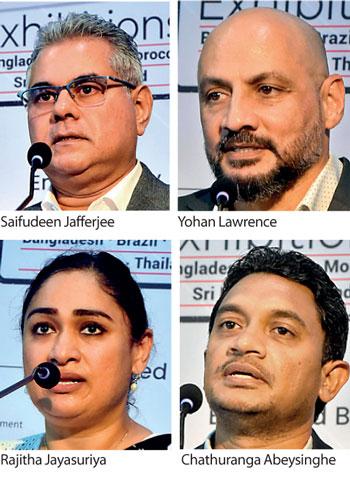
Commenting on the industry’s current trajectory, Joint Apparel Association Forum (JAAF) Chairman Saifudeen Jafferjee opined that the sector must strengthen its backward linkages to counter challenges in the geo-political landscape.
“Current tariff wars and the trade agreements being discussed are challenges, but they also present opportunities. We need to form strategies to establish Sri Lanka as a true apparel hub,” Jafferjee said addressing the 14th Sri Lankan edition of CEMS-Global USA’s Textile Series of Exhibitions currently taking place in Colombo.
He urged that the country’s reputation as an ethical manufacturer should be promoted to improve design development and brand creation.
Additionally, he emphasised the importance of strengthening backward integration in supplying capacities, which would further enhance the industry’s competitiveness and sustainability.
As of 2024, the fashion and apparel sector has grown to become a pivotal contributor to the Sri Lankan economy, providing employment to over 350,000 individuals directly and up to one million indirectly.
Export earnings from the sector last year surpassed US$ 4.7 billion, with apparel and manufacturing production accounting for approximately 7 percent of the country’s GDP.
Building on this momentum, the industry has set itself a target of achieving US$ 8 billion in apparel exports for 2025.
However, industry leaders caution that achieving this ambitious target requires policy consistency and improved collaborations to improve Sri Lanka’s competitiveness in the global market.
JAAF Secretary General Yohan Lawrence highlighted the importance of forming global partnerships to connect local manufacturers with international suppliers as a vital tool to expand market reach.
“Every year, Sri Lanka is seeing slightly bigger exhibitions, more exhibitors and more throughput. It’s not just about large factories—small and medium enterprises (SMEs) also benefit significantly from these events by gaining access to new suppliers of raw materials, chemicals, and machinery,” Lawrence stated.
Reiterating his sentiments, Sri Lanka Apparel Exporters Association (SLAEA) Chairperson Rajitha Jayasuriya highlighted the apparel sector’s pioneering role in placing Sri Lanka on the global map by facilitating employment and trade opportunities.
“Innovation, machinery, technology, and other opportunities for the apparel industry continue to expand and we must make use of them,” Jayasuriya said.
Meanwhile, Deputy Minister of Industries Chathuranga Abeysinghe commended the apparel sector’s resilience in navigating challenging periods, especially during the postwar era, the COVID-19 pandemic and the economic crisis that followed.
He acknowledged how the apparel industry has set an example for all other sectors in navigating turbulent and challenging times.
“The government and the apparel industry must share a unified vision to achieve the US$ 8 billion export target. We must ensure that we retain our reputation as an ethical and high-quality manufacturer,” Abeysinghe said.
Pix by Kithsiri de Mel