Reply To:
Name - Reply Comment
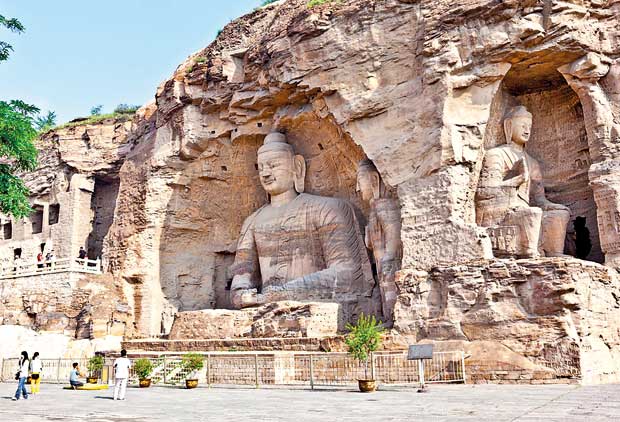
It is believed that Buddhism reached China through the Silk Route around first century A D, and subsequently all forms of art and craft arrived there from countries like India, Nepal and Sri Lanka. A tacit example for this would be the paintings found in grottoes built along the Silk Route in China. Mogao, Longmen and Yungang are the three most important places in China where Buddhist grottoes are found. The most famous and beautiful among them are the grottoes found in Yungang, built in fifth century AD. I had the privilege of witnessing these historical masterpieces last August.
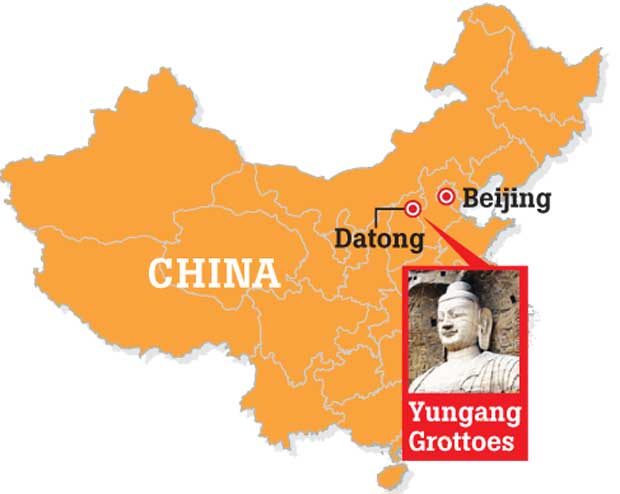
Yungang is situated in the old Kingdom of Datong. In the slopes of Yungang mountains is a beehive of grottoes, about 1km long. There are 45 main grottoes and more than 100 Buddha Statues.
Buddhist prelate Tan Yao who lived here was instrumental in the construction of grottoes. He had received the patronage of 54 merchants who engaged in trade along the Silk Route -- this was confirmed by an inscription found at the location (it was the oldest and most elaborated record about the building of Yungang grottoes). Moreover, the characters are top rated calligraphic works.
According to history, monk Tan Yao was in-charge of cutting five caves in the Western suburbs of State Wu. While they are referred to as the five caves of Tan Yao, they were built during the Northern Wei dynasty (460-471 AD). As a mark of respect to the prelate, a statue was erected at the entrance of the historical site. Other major caves had been mostly completed in the 18th year of the Northern Wei dynasty (494 AD). Kings like Emperor Xianowen who then ruled the dynasty had greatly supported this cause.
It is believed that more than a staggering 40,000 craftsmen toiled to put up the grottoes and statues -- most of the statues were built according to the Gandarwa tradition of India. I was indeed surprised when my coordinator Chen Luying of Foreign and Overseas Affairs in the Shanxi Province told me some of these statues were from Sri Lanka. In the history books of China, Sri Lanka is referred to as the Kingdom of Lions. The arts and crafts that flowed to China through the Silk Route mixed with the natives that existed in China and obtained its present form. That could be found in Yungang grottoes today.
The terrain divides the grottoes on the hill into three natural but neat clusters; the East, Central and West. Caves in the East are mostly house pagodas called Papoda caves, while the caves in the central area have front and rear chambers with main Buddha figures sitting in the middle and relives carved on the ceiling and walls. Whereas the caves in the West are smaller.
This place is in fact a treasure house of Buddhist artwork, sculptures, statues and murals of Gods and Goddesses, birds and animals, beautiful flowers and exotic plants as well as images of those who sponsored the building of grottoes.
Extremely beautiful Buddha statues could be found in some of these grottoes, and the tallest of them is about 16 metres. They express love and compassion.
The Buddha Statue found in cave number 12 is Thirteen metres in height and is valued for being a true representative of Yungang grotto arts. It reminds me of the Samadhi statue at Mahamevuna Uyana in Anuradhapura.
It is however recorded that in the 5th century, the then emperors and their immediate families have had private temples. Some of the statues in these temples portrayed different stages of Buddha’s life -- some portrayed the Buddha preaching and ladies spraying flowers from heaven.
In cave number 20, dancers and musicians portray Buddha’s ascendance to Buddhahood. These statues are beautifully sculptured and the dresses in them resemble what the people wore during that time.
Further, Yungang grottoes become a turning point of the development of Buddhist art in China. The statues of Dunhuang Mogao and Longmen were both influenced by Yungang grottoes that have the largest collection of grotto artworks in China. The site was inscribed on the UNESCO list of world natural heritage in 2001.