07 Mar 2025 - {{hitsCtrl.values.hits}}
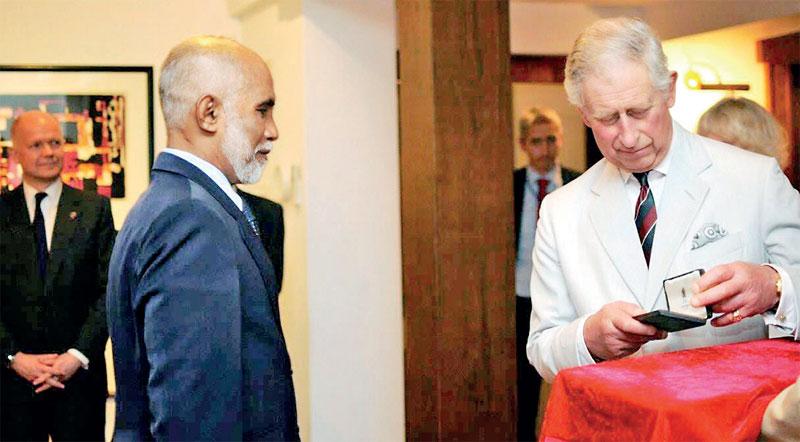
T.J.I. Ismail receiving the honorary MBE medal from Prince Charles in 2013
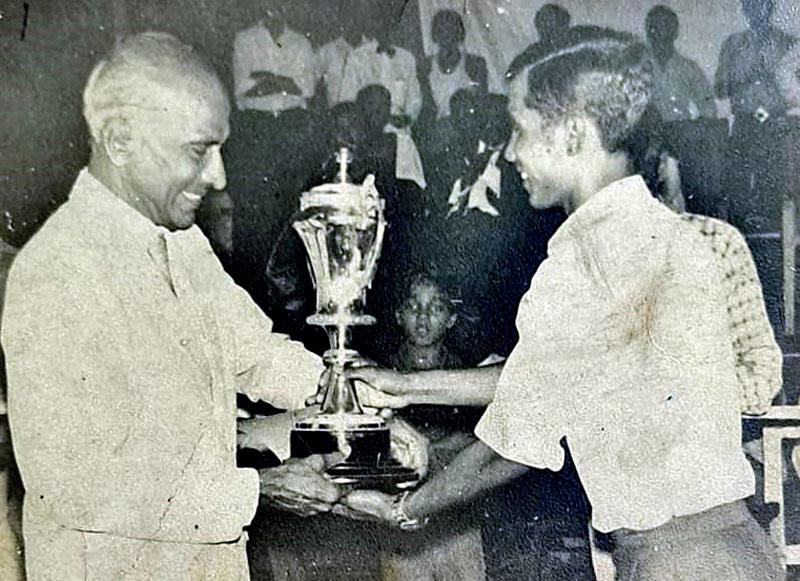
T.J.I. Ismail receiving the trophy from Danton Obeysekera after being adjudged Best Boxer at the Albert Perera Memorial tournament
By ALLAAM OUSMAN
|
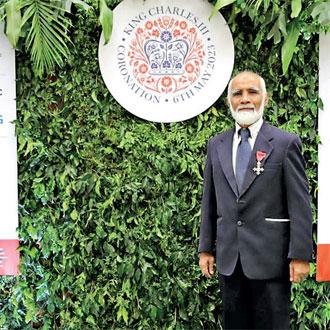
T.J.I. Ismail was a guest at Westminster House in Colombo during the Coronation of King Charles |
|
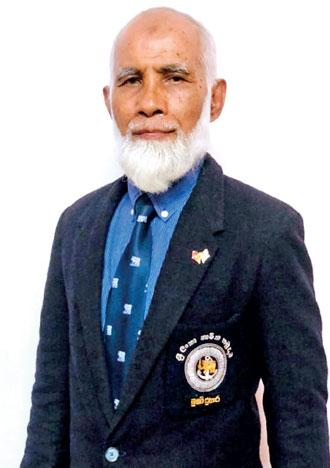
Tuan Jainudeen Ishaq Ismail
|
Tuan Jainudeen Ishaq Ismail’s journey into boxing began at a young age, inspired by his elder brother, Zarook Ismail. Growing up in Slave Island and studying at St. Michael’s College, he would walk to school with his brother, who was already involved in boxing. Encouraged by his parents, Ismail joined training sessions, marking the beginning of an extraordinary boxing career.
“I never planned to be a champion. I just loved boxing. My brother was already in the sport, and I followed him. My parents didn’t stop me, so I trained hard and kept winning,” he relates.
His initial training was under Anton John, followed by H.M. Marzook, an Asian Championship medallist, who focussed on fundamentals – teaching him only straight punches. His competitive debut came in 1966 at the Junior Championship held at the Ceylon Recreation Club. Nervous in his first bout, he fought wildly and lost on points. However, just three months later, he entered the Stubbs Shield in the 75-pound category, securing a surprising victory. The final saw him defeat Azwar from St. Sylvester’s, a seasoned boxer, thanks to his speed and agility. “Even when I fought my first Stubbs Shield meet, I was nervous. But once I stepped into the ring, all I could think about was moving fast and landing my punches. That speed became my greatest weapon,” he shares.
Ismail quickly established himself as a dominant force in school boxing. In 1969, he was named Best Boxer at the Stubbs Shield. The pinnacle of his amateur career came in 1971 when he achieved a remarkable feat – winning the Best Boxer title in five major tournaments: Intermediates, Stubbs Shield, Clifford Cup, Layton Cup, and the Nationals in the Flyweight (112.5 lbs) category. This rare accomplishment may have set a world record at the time. “Winning five Best Boxer titles in one year? At the time, I didn’t think much about it. I just kept boxing and winning. But later, I realised it was something special,” he says humbly. Upon finishing school in 1971, Ismail was sought after by all three Armed Forces. He chose the Navy, where he joined friends and fellow boxers Wijetunga and Somapala Perera.
During his time in the Navy, he continued to excel in the ring, winning the Best Boxer title twice in 1973 and 1974 at the Inter-Command Championships. He also claimed the Best Boxer award at the Albert Perera memorial tournament. His fiercest rival was V.R. Amarasinghe from St. Matthews, whom he defeated 14 times. However, after joining the Navy, Amarasinghe managed to beat him once, though Ismail avenged the loss later that year in the Nationals. “Every time I fought, I went in with the mindset that I had to win. I never took it easy, even if I had already won before. That’s why I beat Amarasinghe 14 times before he finally got one back on me!” he reflects.
“The Navy was a great experience. It kept me disciplined. I fought some of the best boxers in the country while I was there,” he relates.
“Some fights I will never forget. Like when I fought Wije Nimal (R.D.W.N. Perera). He charged in like (Mike) Tyson. I got caught once, and my tongue had a big hole in it. But I didn’t back down. Third round, I finished it with a TKO,” he says. “One of my toughest fights was against De Kauwe in the Asian Trials. The fight got so heated that there was commotion outside the ring. That was boxing back then – intense, passionate,” he shares of his controversial loss.
In 1978, after five successful years of service, Ismail decided to leave the Navy to focus on his family life and also hanging up his gloves in 1979.
Married in 1975, Ismail welcomed his first daughter in 1979 and a son in 1982. To provide for his family, he joined Jafferjee Brothers as a security officer, later being transferred to their factory in the Katunayake Free Trade Zone. A brief stint working in Oman and Saudi Arabia followed, but he ultimately returned home, struggling with homesickness.
A chance meeting with a former boxing friend Chandradasa led to his employment at the British High Commission in 1983. His commitment and dedication saw him rise to the position of Head of the Guard Force at the British High Commission in Colombo in 1993, a role he held for two decades until his retirement in 2013. For his exceptional service, he was honoured with the honorary Member of the Order of the British Empire (MBE) by the Queen of England. “Thirty years of service – it was a different kind of fight, but I gave it my all. Security work was serious because of threats from Middle East. I remember finding anthrax in letters. We had to be sharp, check everything. That’s why I was honoured with the MBE. It wasn’t just a job. It was about protecting people,” he shares.
Handling security threats was just one aspect of his duties. “Whenever there were demonstrators, when they came, I would go to the gate and control them. My attendance – everything was good.” During the 2013 CHOGM summit, he had the privilege of receiving his MBE medal from Prince Charles before the royal’s official meeting with the Sri Lankan President. “Prince Charles came first to where I was with my family, gave me the medal, and then went to see the President,” he recalls with pride.
Looking back, Ismail attributes his boxing success to disciplined training and natural ability. He never entered a ring expecting accolades but focussed on giving his best in every fight. His unique boxing style, inspired by footwork similar to Muhammad Ali, combined speed with strategy, allowing him to outmanoeuvre opponents. “I used to step on toes. Just toes only, I would punch and lift. Marzook used to say, ‘Use only the left hand.’ If I got a chance in the corner, I would combine speed, shuffle and all,” he said.
However, he believes that the modern boxing landscape has changed drastically. “The standard has dropped,” he observes. “In our time, we trained with discipline. We skipped, jogged, and listened to our coaches closely. The discipline is not the same. We used to train standing, watching, learning. Now, I see boys sitting, chatting. They don’t study the sport,” he points out. He also notes a shift in fighting mentality. “The knockout mentality is not good. In our time, we boxed for three rounds, controlled the fight, used skill. Today, they just swing wildly for knockouts. Boxing isn’t just about power; it’s about skill. You don’t always have to go for a knockout – you can outbox your opponent,” he explained. Another major concern is the lack of technical discipline. “We were taught to keep our hands up, use footwork, and be patient. Now, I see boxers dropping their hands too early, mimicking professionals without understanding the fundamentals. Style is missing now. For three rounds why do that? Professionals, yes, but in amateur boxing, you must stay sharp from the first second,” he points out.
Despite turning 72 in December, Ismail remains active and fit. “I still practice. Skipping, shadowboxing – just enough to keep myself sharp. Boxing is in my blood,” says Ismail who used to walk every day from home to the British High Commission in Colpetty from Maradana.
For boxing in Sri Lanka to thrive, Ismail stresses the need for proper coaching, discipline, and respect for the sport. “Young boxers must observe and learn. We used to stand and watch sparring sessions, learning from every fight. Now, many lack that focus.”
He also stressed on sportsmanship. “Before fights, we shook hands properly. After the fight, same. Today, it’s just a quick touch of gloves. Even after a fight, we had respect. Now, I see boxers jumping around after winning. That’s not discipline,” he observed.
From a legendary schoolboy boxer to a respected professional and security expert, Tuan Jainudeen Ishaq Ismail’s legacy is one of dedication, resilience, and excellence. “I have no regrets. From school to the Navy, to my career after boxing – I gave everything 100%. That’s the key to success in anything: discipline and dedication,” he summed up his life
06 Jun 2026 5 hours ago
06 Jun 2026 5 hours ago
06 Jun 2026 6 hours ago
06 Jun 2026 8 hours ago
06 Jun 2026 8 hours ago