18 Feb 2025 - {{hitsCtrl.values.hits}}
|
|
 |
 D. P. “Budge” Rogers, the flank forward, came here as the Skipper of the England Team; Flying wing three-quarters Mike Bulpitt and Andy Hurst were here with the Bosuns; Aussie international Charles Peter Crittle came with the Australian Emus Team; When the Blackheath Team visited Sri Lanka (then Ceylon) they had England and Barbarians Skipper Peter Bell; Similarly, we saw internationals Jean Le Droff and Michel Pebeyre playing for the Paris Universite Club.
The long list of those distinguished players, along with the galaxy of other names who thrilled the local crowds years back, goes further down, even passing the in-goal area.
Apart from organising the local tournaments and arranging participation in the All-
India Tourney and later, the Rugby Asiad, our rugby administrators of yesteryear provided us with a rare opportunity to watch some of the high-class teams and top-class players in action on our home soil.
It was the time when our rugby calendar was moving fast and full of activities. This is something in contrast to the present-day scenario, wherein it is a rare sight to see aforeign team visiting our country, except for a sanctioned match or a tournament once in a way.
Most of our visitors in recent times for fifteens rugby were from lowly-placed Asian countries! This piece is to re-capture one of the most colourful phases of our rugby history when Ceylon RFU welcomed team after team to grace our rugby fields.
Imagine, from August 1969 to November 1972, say within a period of 40 months, the Ceylon RFU hosted not less than a dozen
of teams from all parts of the world, who have collectively played a total number of 40 matches against various local teams, including the All Ceylon XV.
40 matches in 40 months! Unbelievable. Here is the countdown.
The Bosuns from England, with nine rugby internationals in the tour party, arrived inColombo on a two-week tour in 1969. Led by Andy Hurst, one of the strongest running wings in British rugby, they had famous players such as six-footer Mike Bulpitt and England wing forward Peter Bell, among others.
The importance of the tour was highlighted even before the arrival of the visitors. “The Bosuns visit here is important since rugby fans and players, for the first time, will have a glimpse on the meaning and effects of the new rugby rule which forbids a team from kicking to touch outside its own ‘25’.”
The opening match of the tour was played on 1st August 1969 at Havelock Park againstthe Colombo Clubs, led by Noel Brohier. The visitors’ 56 points to 3 victory was hailed by the press, stating “It was rugby magic all the way – straight from the rugby bible.
The long list of those distinguished players, along with the galaxy of other names who thrilled the local crowds years back, goes further down, even passing the
in-goal area
The Bosuns XV out-ran, overpowered and out-played the Colombo Club XV. They are teaching us plenty on how the game should really be played.” Then the visitors travelled to Nittawela to defeat the President’s XV by 48-5, and then to Radella to defeat Up-Country XV by 56-3 before confronting the All-Ceylon Team at Longden Place.
The All-Ceylon Team read: John Burrows, M. A. Majeed, Selva Canagasabai, Chang Fa,Jeff Ratnam, Omar Sheriff, Denzil Kobbekaduwa, Hadji Omar (Captain), Mike de Alwis, Y. C. Chang, S. U. Mendis, K. Ratnapala, Indrajit Coomarasamy, Maurice Merrinon and Keith Paul.
Result: Bosuns 34 – All Ceylon 08. It is said that the Bosuns have always allied themselves with charity. In keeping with this long-standing practice, Bosuns players were involved in hat collection on the grounds for charity purpose and later donated the collection to a few charity homes such as Preethipua Home, Hendala.
On 12th August, there was a “Sevens” competition at Havelock Park involving the visitors and a few selected local teams. Play began at 3.30 p.m. with the tickets being priced at One Rupee (unreserved seats) and 50 cents (standing).
The following comment appeared in a match report: “It was a superb exhibition by the visiting Bosuns who showed us that there is more to it than running with the ball in 7-a-side rugger.”
Before defeating the All-Ceylon Team in the 2nd “Test” by 22 points to nil, the Bosuns outplayed the Combined Services Team, which had nine soldiers, four airmen and two sailors, by 17 points to 8 at the Galle Face.
The Bosuns hadn’t things their way in the 2nd rugby ‘Test”. A rugby scribe wrote: “A crowd of nearly 10,000 rugby fans chanted ‘You have done it Ceylon, well done’ as Skipper Hadji Omar led his plucky team out of the ground after a lion-hearted performance against the Bosuns.
The scoreboard, which showed 22 points, did not mean anything at all – for it was Ceylon’s day, and was one of the greatest performances by a local side.”
With the departure of the Bosuns, came the Joint Services Team from Singapore in October 1969 to play a match against the Defence Services XV. Singapore 17 - Defence Services 8.
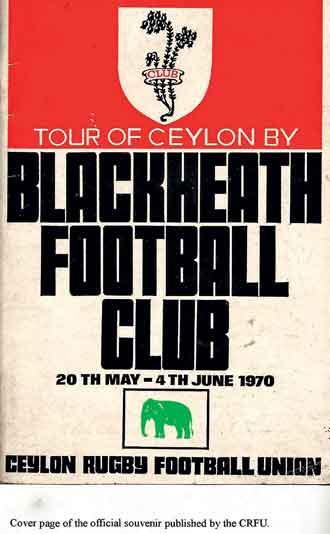
Then came the Blackheath Football Club from England, known as the oldest open rugger club in the world. During their stay from 20th May to 4th June 1970, they played five matches and won all.
It is a matter of interest that Blackheath’s match against the Up-Country was played at the Dickoya and Maskeliya CC (DMCC) Grounds at Darrawella, as part of the Centenary celebrations of the home club.
Interestingly, in the formative years, Dickoya’s rugby jersey was of Blackheath colours. The newly formed All-India Rugby Football Union Team Captained by Stephen Ryder Smith arrived here in October 1970 on a three-match tour.
It is said that the IRFU team selection was made on a ‘fifty-fifty ratio’ among the Europeans and Indians. Skipper Smith was no stranger to the island, having arrived with the Combined Oxford-Cambridge team and the Calcutta RFC previously. He was so popular with the local crowds, and as one of our rugby correspondents noted: “If one player took my eyes and mind from the play itself, that was Stephen Ryder Smith.
Smith had a magnetic appeal. Whether he tied his boot laces, tucked up his socks or signalled positions to his players, it was so hard to drag one’s eyes away from the player.”
The Indians beat Up-Country 9-8 at Radella but lost to the Ceylon Team (Capt. Abdul Majeed) 5-16 and the Defence Services XV 13-14.
In October 1970, the Singapore Rugby Union Team too came here to play a couple of matches against the Ceylon Team. Visitors won both the matches, 11-6 and 16-9.
Paris Universite Club was the next rugby visitors to the island.
Then came the Blackheath Football Club from England, known as the oldest open rugger club in the world. During their stay from 20th May to 4th June 1970, they played five matches and won all
They emerged victorious in the first two matches in a three-match tour. Then came the final match of the tour. On 26th August 1971 at Longden Place, the Ceylon Rugby Football Union XV created history as the first rugby team composed entirely of Ceylonese players to defeat a team from Europe! Final Tally: CRFU XV 13 (Omar Sheriff and Reggie Bartholomeusz a try each, Glen Vanlangenberg 2 conversions and a penalty): Paris Universite Club 8.
Incidentally, Sri Lanka’s first and only victory up to then against a foreign team (other than in the All-India Tourney) was against the visiting Western Australia Team in 1938. The 1938 All-Ceylon team led by Jack Seaton was wholly comprised of Europeans except for three Ceylonese players Percy de Silva, Percy de Zilva and Clair Roeloffesz.
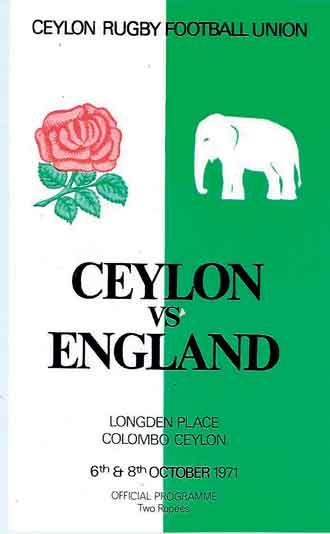
“Here we come, Ceylon!” shouted the Englishmen from Singapore after touring Japan, Hong Kong and Singapore under the captaincy of ‘Budge’ Rogers. They were here in October 1971 to play two rugby “Tests”.
To quote a press comment: “Not since the British Lions played a game in Colombo in 1951 on their return home from New Zealand have Ceylon had the opportunity of witnessing such skilled exponents of the game.
The Englishmen are bound to provide attractive attacking rugby on the last lap of the first ever tour of the Far East.” At a press conference, the manager of the tour party, Bob Weighill declared “that the main idea of this Far East tour was to spread the gospel of rugby amongst rugby playing countries.”
The Ceylon team for this historic match against England as announced, read: N.H. Omar, B. C. W. Jayasekera, T. Holdenbottle, K. Ratnapala, A. V. Benedict, Tony de Sylva, E. Gunaratne, G. Udugama, R.Pietersz, G. Vanlangenberg, R. Bartholomeusz, Jeff Ratnam (Captain), Omar Sheriff, M.A. Majeed and R. Schokman.
The men who introduced the game to the world won convincingly, 40 points to 11. Then for the second rugby “Test”, four changes were made in the host team, with the inclusion of D. M. Balasuriya, D. Jayasundera, Bandula Wijesinghe and Darrel Wimalaratne. Scores: England 34 – Ceylon 6.
The Ceylon RFU Rugby Team was involved in the third confrontation against an overseas team under the captaincy of Jeff Ratnam within a space of 10 days in 1971, when they clashed with the Nchanga Rugby Club from Zambia to record a glorious victory by 18 points to 11.
Paris Universite Club Team toured again in August 1972. They were victorious in all three
matches they played, scoring over fifty-plus points on each occasion.
Immediately after the departure of the team from France came the famous London Welsh RFC to play six matches within a period of two weeks. They gave a torrid time not only to the opponents, but also to the scoreboard operators placing some basketball scores on the board. The results of the London Welsh matches: London Welsh 70 – CRFU XV 3, London Welsh 104 – Defence Services 3, London Welsh 96 - Colombo Clubs 3, London Welsh 108 – Up-Country 4, London Welsh 106- President’s XV 4 and London Welsh RFC 66 – CRFU XV 3.
Then, the Australian Emus Team landed in Colombo on 25th September 1972. The tour party, which included famous players such as John Dempsey Joy and Terence Paul Davoren, was managed by Norman W. Tasker, a leading sports journalist in Sydney.
Their tour record was action packed yet one-sided affair, as they ran over Colombo Clubs by 34 points to 15, Defence Services 36-9 at Badulla, President’s XV 43-4 at Nittawela, CR and FC 46-0 and CRFU XV 52-9.
In November 1972, the touring RAF GAN Island team played a couple of matches at the Galle Face and lost to Sri Lanka Air Force 6-7 and to Sri Lanka Army 6-12.
Commenting on the English tour in 1971, well-known rugby correspondent of the “Times of Ceylon” M. B. Marjan remarked: “Sri Lanka, ranked third in Asia, behind Japan and Thailand, with limited opportunities of playing abroad, couldn’t have done better.
Comparatively speaking, the local side put a commendable performance. Tactically, the visits of Bosuns, Blackheath and the England RFU Team have again taught us the virtues of ‘tight’ rugby.”
06 Jun 2026 7 hours ago
06 Jun 2026 7 hours ago
06 Jun 2026 8 hours ago
06 Jun 2026 06 Jun 2026
06 Jun 2026 06 Jun 2026