05 Feb 2016 - {{hitsCtrl.values.hits}}
By Sarah Muiz
At the recent launch of the Global Human Development Report (HDR) 2015 titled “Work for Development”, it was revealed that there were 168 million child labourers worldwide and this situation limits and shrinks the capabilities of children to become worthy citizens of tomorrow. HDR 2015’s lead author Dr. Selim Jahan says that there are more than twenty billion people in forced labour with their rights violated and their human dignity shattered. “Everyday thirty million people go to work in mines and that kind of work puts them at risk,” he said at the launch organized by the UNDP.
President Maithripala Sirisena contributed a special feature to the Report titled, Community participation for improving rural livelihoods – lessons from the past. This feature article was recorded as the first time that an article contributed by a Sri Lankan President has been featured in the UNDP’s HDR. The event -- attended by a gathering of distinguished personalities including Special Assignments Minister Sarath Amunugama as the Chief Guest -- was insightful on how work can contribute to the enrichment of human development.
The HDR 2015 defines ‘Work’ as a concept that is broader than jobs or employment. It interprets ‘Work’ as “a means of contributing to the public good, reducing inequality, securing livelihoods and empowering individuals. Work allows people to participate in society and provides them a sense of dignity and worth. In addition, work that involves caring for others or voluntarism builds social cohesion and strengthens bonds within families and communities.” It also defines Human Development as “expanding the richness of human life, rather than simply the richness of the economy in which human beings live. It is an approach that is focused on people and their opportunities and choices.”
“This new world of work presents great opportunities for some, but also profound challenges for others” - UNDP Resident Representative and the Country Director Joern Soerensen
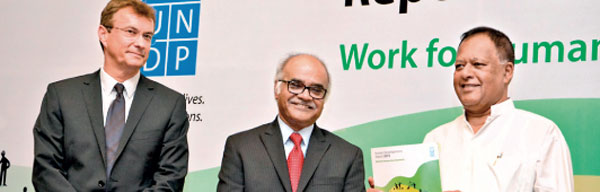
Pic by Samantha Perera
Mr. Soerensen said the HDR 2015 was the latest in a series of global human development reports published by the UNDP since 1990. He said the Report called for equity and easy work for all and views work in its various dimensions and dynamics through a human development lens.
“The HDR encourages the Government to look beyond jobs and consider the many types of other work available. Only by taking such a broad view can the benefits of work be truly harnessed for sustainable development. HDR 2015 urges us to look at work as a means of unleashing human potential, creativity, innovation and experience. It recognizes work as an essential to make human life productive, worthwhile and meaningful. Work enables people to earn a living, give some means for an individual to participate in society; it provides them with security and gives people a sense of dignity. When we look at the world of paid work, it is evident that women are engaged less in the work force when compared to men, they earn less, their work tends to be more vulnerable and they are under-represented in senior management and in the decision making process. In the overall, the HDR looks at this new world of work which presents great opportunities for some and also profound challenges for others. The report we are launching today in Sri Lanka urges the Government to act now to ensure that no one is left behind,” Mr. Soerensen said.
Policies related to human development should be introduced to facilitate women better
Independent Consultant and Director for the Centre of Poverty Analysis, Dr. Ramani Gunatilaka said women exposed to discrimination and sexual harassment would not help contribute to the positive progress of human development and noted that it was time for policy makers to focus on polices that contribute to the healthy progress and development of women as much as men. She said it was work that contributed towards human development and not necessarily jobs and noted that the labour force participation of women in comparison to men was relatively low in Sri Lanka.
“The UNDP’s approach to development aims at human development. One important point the report makes is about women’s market participation while making note of the barriers women face with regard to this. Doing paid work enables women to earn a good income, expand their savings, fulfill their capabilities and realize their true potential. As the labor market in Sri Lanka becomes tight and men’s participation reaches the maximum, economies need to bring in more women into the paid workforce if economy is to grow and poverty to reduce,” Dr. Gunatilaka said. She said women were stressed due to the excessive work load and burden they shouldered as caretakers of family members and friends, work pressure, harassment, violence and attacks they had to undergo in society. Dr. Gunatilaka said men were often better paid and women were assigned mundane and routine work that did not promise them promotions or salary increments.
“We are told that sexual harassment is rife even within Parliament. Women are not given a chance to speak in Parliament and if they do, they are often ridiculed by the media. Women cannot be guarded like the environment and treated as an unlimited resource that can be extracted and exploited forever. It is an issue of providing basic services and focusing on policies to make life easier for women, reduce the stress they face and make them more productive citizens,” she said.
Minister Sarath Amunugama said the largest segment of those employed in the Middle East are women and today they are remitting nearly four to five billion US dollars.
“Today the main stay of our foreign income is the remittances. These remittances are going into the most deprived sectors of our economy. Women must be respected a lot in society because the courage they show is immense to go abroad and earn a living for their family. However with declining oil prices there will be shrinkage of activities in the Middle East. Already we can witness a plateauing of the remittances to Sri Lanka this year. For ten years it has been continuously increasing at a fast phase. This year, for the first time we witness a plateuing of the remittances and I hope this will not decline further in the future,” he said.
“It is imperative that the links between human development and work are strengthened,” Dr. Selim Jahan
Dr. Selim Jahan said the world of work is changing very fast with huge implications on human development. She said people were moving towards a heavily polarized world of work. As such, enhancing human development through work will require holistic policy interventions to ensure that every individual who desires to work will be enabled with equal opportunities.
“Work is not only about jobs, employment or paid work; the notion of work takes a much broader perspective. Work also includes unpaid care work, voluntary work and creative expressions like writing a book or playing music. The broader definition of work is fundamental and crucial to human development and for enhancing human capabilities and creating opportunities for human beings.
Today, a significant gender imbalance in paid and unpaid work is witnessed in society. Women are disadvantaged both in the world of paid and unpaid work. One cannot enhance human development unless those imbalances are redressed. Sustainable work is crucial for sustainable development goals. In order to enhance human development through work, it is essential to identify some pragmatic, strategic policy options as well as an action agenda” he said.
Dr. Jahan said impressive progress has been made in various areas of human development with work contributing to such progress. According to him, more than two billion people have been lifted out of low human development and more than one billion people have escaped extreme poverty over the last quarter of a century.
“The work of a billion people engaged in agriculture, the creativity of 450 million entrepreneurs around the world, the helping hands of 930 million volunteers have contributed to such progress. Meanwhile, it is important to recognize that there is a significant human deprivation and a huge human potential remains unused. Today, more than 790 million people suffer from hunger and 800 million adults are illiterate. Every minute 11 children under five are dying and every hour we are losing 23 mothers while giving birth to a child. There are more than 200 million people who are out of work of which 74 million are younger people. 800 million people have been termed as working poor. In order to accelerate the human progress we have achieved so far and to address the deficits we have, it is imperative that the links between work and human development are strengthened,” he said.
01 Jul 2026 59 minute ago
01 Jul 2026 2 hours ago
01 Jul 2026 2 hours ago
01 Jul 2026 3 hours ago
01 Jul 2026 3 hours ago