12 Mar 2025 - {{hitsCtrl.values.hits}}
 Donald Trump last week issued an executive order making English the official language of the United States of America. The order rescinded a previous presidential decree issued by former President Bill Clinton requiring federal government agencies to provide assistance programmes for people with limited English proficiency. Instead, it now allows the agencies to decide whether they want to offer documents and other services in languages other than English.
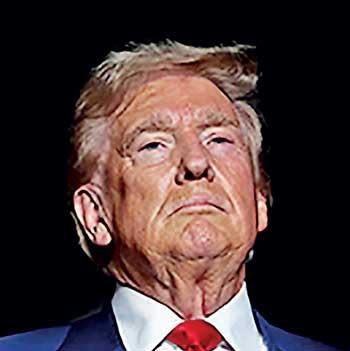 The executive decree, one in many dozens Trump has issued since assuming office, hardly made headlines. It was drowned out in a labyrinth of news the 47th president of the USA keeps churning out daily, ranging from the global reverberations of public goading of the Ukrainian President Volodymyr Zelenskyy in the Oval House to the 25 per cent trade tariff just came to effect on imports from America’s two main economic partners, Canada and Mexico.
Going by the Sri Lankan experience, one would have expected the Hispanic American leaders to protest loudly, hold a hartal, blackout the vehicles with English numberplates and, over time, make it the singular gripe fuelling their political existence. Worse still, as it happened in this country, this self-reinforcing grievance would then morph into suicidal terrorism -- and the so-called moderate minority leaders become apologists of a nihilistic terrorist group.
That is what happened in Sri Lanka, where many pundits habitually describe the root cause of terrorism as S.W.R.D Bandaranaike’s decision - after a similar landslide election victory - to make Sinhala, the mother tongue of an overwhelming 75 per cent of the population, the official language of then Ceylon.
Demography cannot be any different: nearly 68 million of America’s 340 million residents speak a language other than English, according to the US Census Bureau.
By our thesis, many millions of ethnic minorities should now feel that making English, which is the common denominator of the pre-dominant Anglo-Saxon culture of the USA- a grievous snub at their cultural pride. At least their political leaders would keep telling them so until they internalize it.
None of that seems to be happening. But why? Experts may cite many explanations. But there is one stubborn reality that any member of these societies has internalized: There exists an unassailable racial and cultural hierarchy. Just when you think it is no longer there, the periphery strikes back, restoring the status quo, just like Donald Trump’s MAGA crowds have illustrated most poignantly.
Ethnic minorities and immigrants put up with it. And the most aspiring of their members strive to be part of it and go the extra mile. At times, they are reminded of what they are not, such as in the fabled exchange between the Indian American Republican presidential candidate Vivek Ramaswamy and conservative talk show host Ann Coulter.
Some of the most ambitious become the most outrageous dog-whistlers in order to get accepted, like the Nigerian-British Tory leader Kemi Badenoch, who herself a product of birth tourism, now wants the legal migrants to wait 15 years to become British citizens.
And most livid opponents of their country of birth, like the Indian-born Sikh separatists in Canada who celebrate the Air India bombing, are also taking immense pride in their allegiance to their adopted country. But, as the growing tide against migration and Justin Trudeau’s political demise suggest, a good part of the White working class is not buying it.
This racial and cultural dynamic is present almost everywhere in Europe and North America. Ethnic minorities and migrants play along, and many make a genuine effort to get absorbed into the dominant cultural narrative. The only exception to the norm, probably, is the induction of a large cohort of Muslims from North Africa and the Middle East, with Islam essentially producing a competing social-cultural milieu. Europeans now ponder over looming cultural and social dislocation in those societies, and the pushback from the native community is equally becoming perversive. However, more than not, this essential racial and cultural hierarchy, or its preponderance over the rest, has historically proved to be a bulwark of stability in those societies.
What happened in Sri Lanka or then Ceylon was the exact opposite. When the country gained independence, that racial and cultural hierarchy had been flipped upside down. There was a major disjuncture between the political clout of the newly empowered rural Sinhalese majority and their prestige and economic status. Similarly, as for the minority elites, there existed a disjuncture between their exalted social and economic positions and their relative political power in a country which is predominantly Sinhalese Buddhist. This gave into two competing dynamics: The ethnic majority to claim their rightful place in their country commensurate to their numerical strength and the minority political elites to scramble to gain political clout matching their social and economic positions. G.G. Ponnambalam’s 50: 50 demand, i.e., 50 per cent seats in the state assembly for ethnic minorities, was an earliest of such machinations.
S.W.R.D Bandaranaike’s decision to make Sinhalese the official language was meant to grant the demographic majority their rightful place. Yet, it was flawed in its implementation by dethroning English altogether, effectively robbing the local children of opportunities in a world dominated by English, and by not providing commensurate language rights for Tamils.
Yet, it was not making Sinhalese the national language that propelled the ethnic war; it was the disjuncture between the political clout and the social and cultural positions in the wider society. The conflict worsened over time exactly because the disjuncture that fuelled the conflict persisted.
That disjuncture was finally addressed most brutally with the complete annihilation of the LTTE.
Some local pundits consider Singapore, where Lee Kuan Yew opted for English as the official language in a majority ethnic Chinese country, as a different yet more successful nation-building model. It is successful indeed. But, making English the national language was not meant to foster national cohesion; it was meant to foster elitist cohesion. Considering ethnic nationalism in its most fervent form is an elitist construct that was a forward-looking decision. However, its implementational success was founded on the unique governing model of the People’s Action Party (PAP), which ruled the city-state since its independence party. The PAP sheltered all amenable members of ethnic minorities, at the same time, steadfastly excluding and litigating into bankruptcy anyone who opposed it. Even now, there is a clear racial hierarchy in politics in Singapore: PAP itself claims that the country is not yet ready for a non-Chinese as its prime minister. Hence, the decision to offer Tharman Shanmugaratnam, who many considered good enough to be the next prime minister, the consolation prize of a ceremonial presidency.
I do not want to sound like a party pooper. These are good times in Sri Lanka as far as ethnic relations are concerned. Divisive ethnic nationalism has been defeated, and the NPP, which ran on a post-race agenda, has won.
Why highlight the unsavoury past? The problem, however, is that essential demographic reality and competing aspirations are still at work. History has shown that any ambitious and divisive political figure could easily poison the Sri Lankan demography. (NPP’s public security minister now says Islamist fundamentalism is raising its head in the East.) If Sri Lanka is to maintain its hard-won ethnic peace, it should take lessons not from the sentimental bleeding heart analysis but from hard-nosed realist assessments of its past. They may not be pretty, but they would save the country from another conflict.
Follow RangaJayasuriya on X
20 Jun 2026 2 hours ago
20 Jun 2026 3 hours ago
20 Jun 2026 4 hours ago
20 Jun 2026 4 hours ago
20 Jun 2026 5 hours ago